


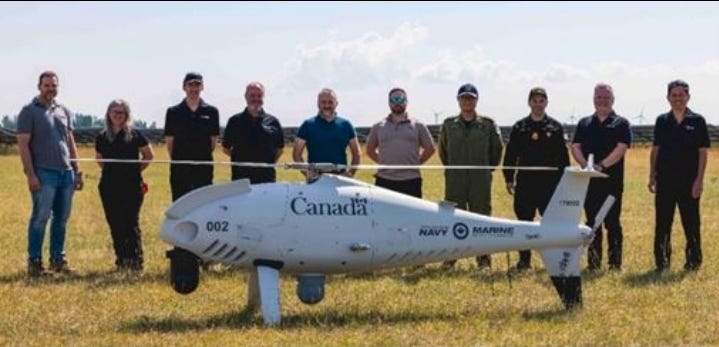
ADM(Mat) provided the following update on the status of the CU179 Peregrine fleet being procured through the RCN ISTAR project. ADM(Mat) provided the following image and statement:
“The Royal Canadian Navy (RCN) has reached an important milestone in modernizing its maritime capabilities.
The successful Factory Acceptance Test of the first CU179 Peregrine uncrewed aircraft system marks a significant step toward introducing a proven uncrewed aviation capability aboard Halifax-class frigates.
Led by the Director of Joint Robotics and Autonomous Systems (DJRAS) within ADM(Mat), this achievement reflects the strong collaboration between the Defence Team and industry, as well as the dedication of the teams who supported testing, engineering and airworthiness validation.
Equipped with advanced surveillance sensors, the CU179 Peregrine will enhance situational awareness and help the Royal Canadian Navy operate effectively in increasingly complex maritime environments.
As the Advanced Naval Capability Unit prepares to receive its first system, this milestone represents another step forward in delivering innovative capabilities that will support current and future naval operations.”
Noah Note: For those that don't remember, the CU179 is a Schiebel S100 UAS currently contracted under the Royal Canadian Navy ISTAR project to acquire a long-range Intelligence and Surveillance platform for the Halifax-class Frigates.
MDA was contracted last year to deliver an initial two S-100 systems at a value of approximately $39 million, along with an additional in-service support contract has an estimated value of $27 million for a period of five years that could be extended up to 20 years. The contract has options for up to four additional systems to be procured, I expect that in the current enviornment, with UAS a renewed navy focus that they will.
Weighing in at a max 200 kg, the S-100 has a 50 kg standard payload capacity, accompanied by a 10kg payload capacity in the nose and sides. It has an endurance of ~6 hours and a data link range of up to 200km. The endurance can be extended to 10+ hours with external fuel tanks.
Its all-weather, day-or-night capable tested at temperatures ranging from -40°C to +55°C. The S-100 is capable of autonomous take-off & landing thanks to its Deckfinder precision landing system and NATO-compliant Harpoon Grid Capture System. It is STANAG 4586 compliant with full MUM-T (Level 5) capability.
The MDA-Schiebel relationship stretches back well over a decade. The team previously competed on the last navy ISTAR attempt that went to Qinetiq and the Skeldar V-200. That attempted to produce the CU176 Gargoyle before crashing and burning almost immediately with nothing to show for it.
Since then MDA has provided the S-100 to at least one other customer amd have been working with Transport Canada and Whale Seeker to use the S-100 in the tracking of Marine life. MDA brought together a top-notch team for this one, including Arcfield, UVAD, IMSAR and Wescam.
Its a proven platform with more than a decade of service and in service with over a dozen countries including allies such as the United Kingdom, France, Norway, Germany, Italy, etc. It is also a foundational platform in several EU UAS Initiatives along with her big sister the S-300.
Overall, it is a fantastic platform that provides the navy, and the Halifax with a detached Long-Range ISTAR capability it hasn't had before. IOC is for next year, though I wouldn't be shocked to see them go through the AOPV first as a trial before hitting the Halifax, still dome work to be done getting them set. One of the great thing about the AOPV, great for trialing and experimenting with stuff like this.
AOPS should each have one sitting in the back of the hangar. Not like we have helicopters to put in there.
Would this be used just for onboard sensors, or would they be deploying sonobouys with it as well? Im assuming this would provide some much needed air support on the Halifaxes while their cyclones languish in their hangers...