


MDA will deliver an initial two S-100 at a value of approximately $39 million. They have also been awarded an additional in-service support contract has an estimated value of $27 million (including taxes) for a period of five years and could be extended up to 20 years. The contravt has options for up to four additional systems to be procured (they likely will)
The two new contracts have the potential to contribute $18 million annually to Canada’s gross domestic product and create or maintain 145 jobs annually to the Canadian economy over a 20-year period. Initial operational capability is anticipated in 2027, with full operational capability expected in 2032.
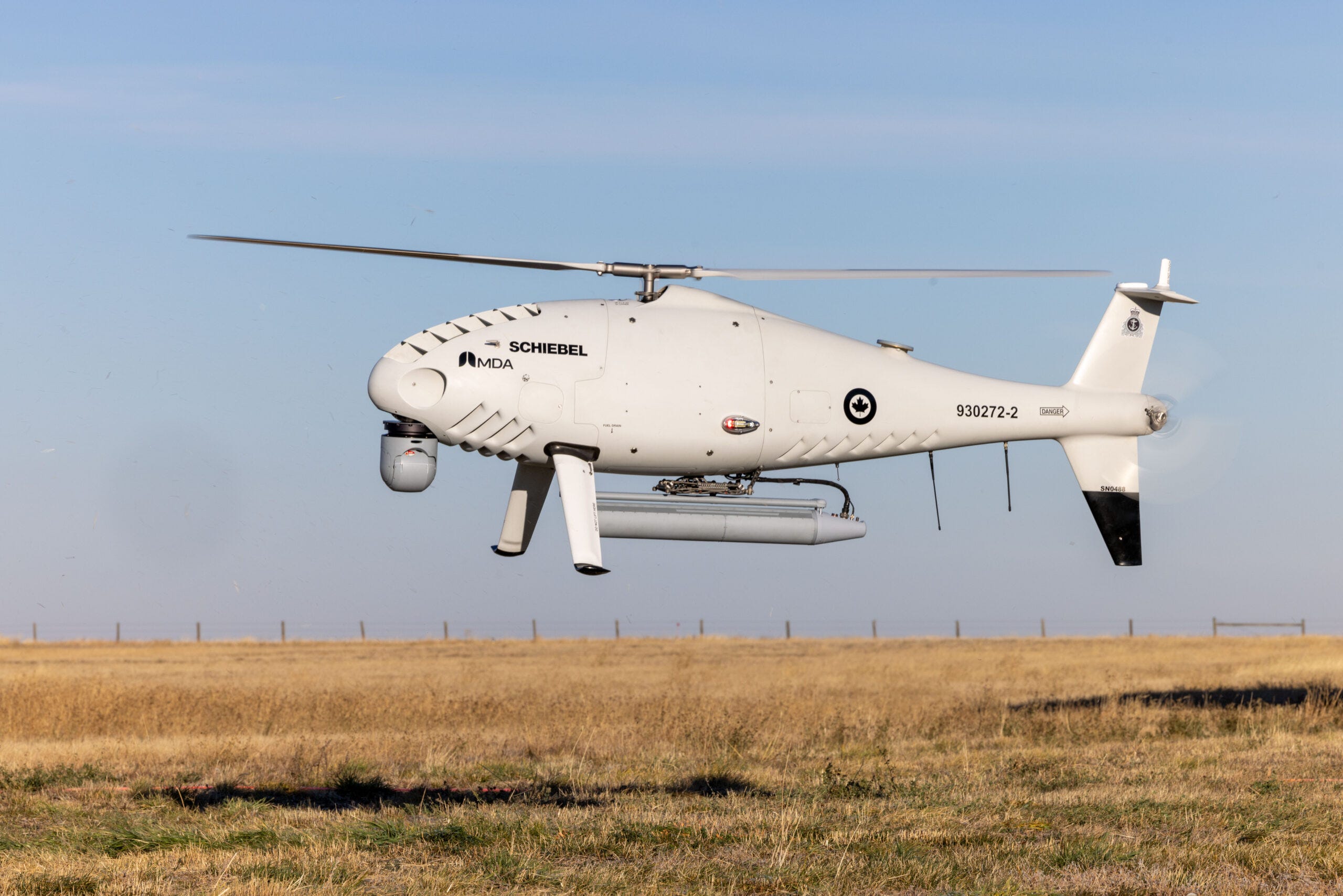
Weighing in at a max 200 kg, the S-100 has a 50 kg standard payload capacity, accompanied by a 10kg payload capacity in the nose and sides. It has an endurance of ~6 hours and a data link range of up to 200km. The endurance can be extended to 10+ hours with external fuel tanks. Its engine is capable of using either aviation gasoline (AVGas) or kerosene-based heavy fuels including F-44 (JP-5), F-34 (JP-8), and F-35 (Jet A-1)
Its all-weather, day-or-night capable tested at temperatures ranging from -40°C to +55°C. The S-100 is capable of autonomous take-off & landing thanks to its Deckfinder precision landing system and NATO-compliant Harpoon Grid Capture System. It is STANAG 4586 compliant with full MUM-T (Level 5) capability.
The MDA-Schiebel relationship stretches back well over a decade. The team previously competed on the last navy ISTAR attempt that went to Qinetiq and the Skeldar V-200. That attempted to produce the CU-176 Gargoyle before crashing and burning almost immediately with nothing to show for it.
Since then MDA has provided the S-100 to at least one other customer amd have been working with Transport Canada and Whale Seeker to use the S-100 in the tracking of Marine life. You can see it below.
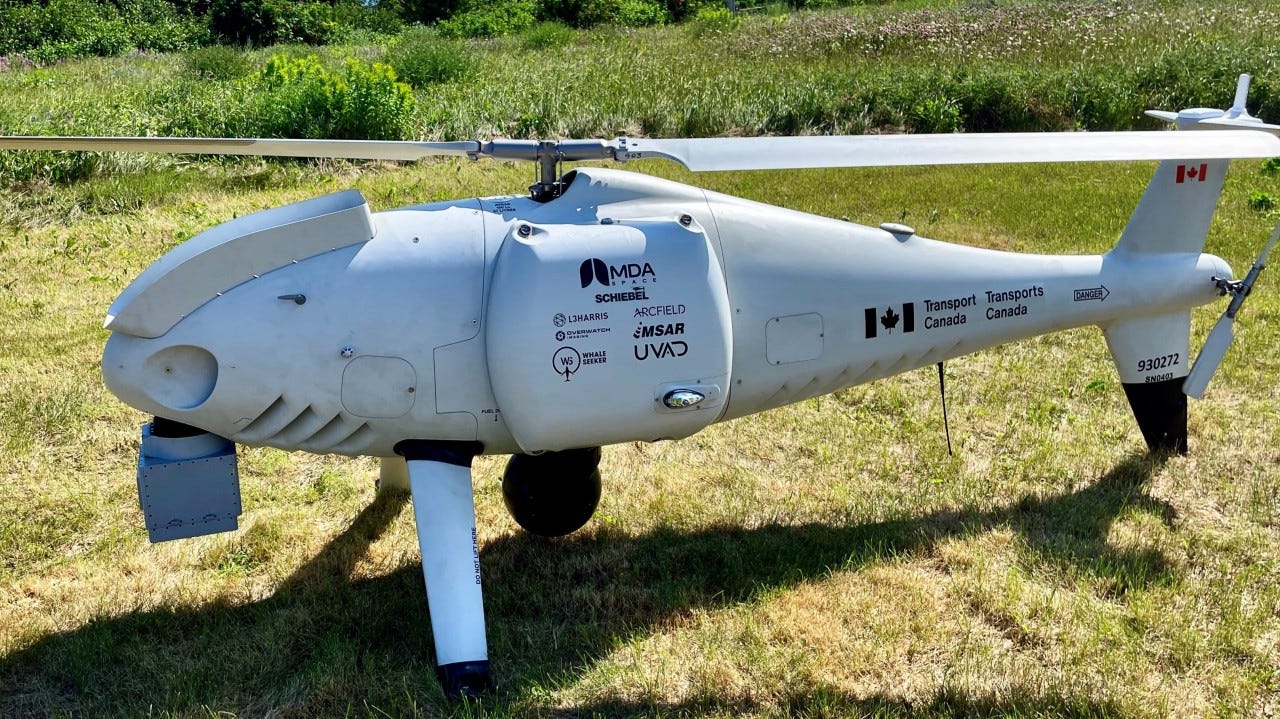
As we've seen the S-100 in Canadian service will likely feature the Wescam MX-8 EO/IR system as well as one of IMSAR’s NSP Synthetic Aperture Radars.
The NSP is interesting because theyre tested both the smaller NSP-3 and the larger NSP-5 radars. No idea which one will be leaned upon. If I has to guess the lighter NSP-3 might be more likely, as it doesnt require sacrificing space to include it. The NSP-3 features a Max Imaging range of up to 16km and a Maritime Detection and Tracking range out to 41nm. The NSP-5 can get out to 34km and 71nm respectively.
Anyways the partnership has been around for a long-while. Its well-established with Canadian partners and will be fitted with Canadian sensors. I will say on a personal note that I am pleasantly surprised.
This whole last year all I've heard about was V-Bat, sometimes the LX-300. I had honestly got caught in it so much that I thought it was gonna take it. Then a few weeks ago I was told V-Bat wasnt making it and I arrogantly believed that had to be false.
Well colour Noah wrong. Let it be known that sometimes hype is just hype. I aint complaining though. I love competitions where multiple options have a chance! Much more fun than the usual obvious winner or two options. ISTAR had several fairly decent competitors involved, all of which had their own claims.
In this case the S-100 provides higher payload capacity than V-Bat, is more customizable and had a fairly stacked Canadian team here. Its also a proven platform with more than a decade of service and in service with over a dozen countries including allies such as the United Kingdom (as of last year), France, Norway, Germany, Italy, etc.
It was also recently selected by the European Defence Agency under the Autonomous Systems for Cross-Domain Logistics (Air and Land) programme, which will see it paired with several smaller UAS and UGV as part of autonomous logistic trials.
Its proven and widely-used. It will feature predominantly Canadian sensors and technology. It had a lot of big names like MDA and Arcfield attached. I should also note it isnt MDAs first contract for Unmanned Aerial Systems.
They were the Prime Contractor with AeroVironment on the Maritime Miniature Unmanned Aircraft System (MMUAS) that gave the RCN the Puma as well as with the Raven back in 2013. So yeah, I should have given it more love. I am sorry S-100. I didnt know your game.
Now that ISTAR is out of the way we can now move on to the other RCN UAS projects. The AOPS currently has an RFI out for unmanned aerial systems that just got an update the other day (you know that though because you read the newsletter) and the JSS will also be getting its own dedicated UAS.
Plans are also in the works to eventually do a followup to RCN ISTAR for the River-class. No idea if the navy will add a.dedicayed system for the Continental Defence Corvette when that comes around. The plan is certainly to outfit them eith a number of unmanned systems, however it's also likely it and the Rivers will share a class.
By that point the RCN will have a fairly healthy roster of UAS tailored to specific roles and tasks, ranging from small quadcopters to larger Logistical UAS that we will see on the JSS. We still don't know what that will look like, but it'll be interesting to see where those requirements fall.
Between Hammerhead testing, the various UAS projects, and the Underwater Enviornmental Assessment project the Navy is taking a very forward looking approach to unmanned systems. Its a wonderful thing to see the service really take a leap on this early, as opposed to our traditional model of waiting until others have well moved on.
So my commandment to those in charge. Youre doing great, and I can't wait to see whats next!