


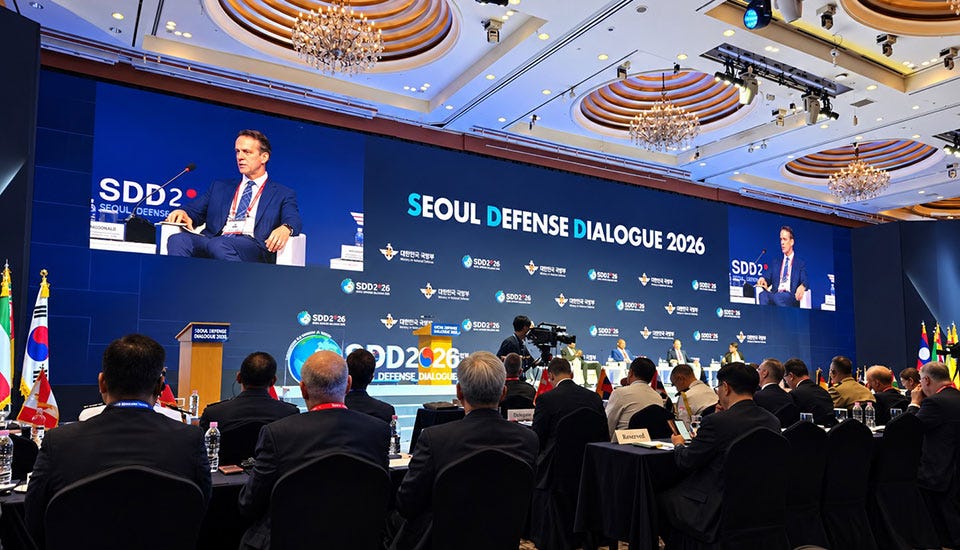
Defence Team representatives strengthened relationships with Indo-Pacific partners during the 15th Seoul Defense Dialogue (SDD), held September 7 to 9, in Seoul, Republic of Korea (ROK).
Senior Associate Deputy Minister of National Defence, Kevin Brosseau, led the Defence Team’s delegation, with support from Canada’s Senior Military Representative to the Indo-Pacific, Lieutenant-General (LGen) Derek Macaulay, Canada’s Ambassador to the ROK, Philippe Lafortune, and additional Defence Team representatives.
Hosted by the ROK Ministry of National Defense, the SDD brought together approximately 1,000 participants from 67 countries and international organizations. Senior defence officials and military leaders discussed international security, evolving alliances and partnerships, defence-industrial resilience, security on the Korean Peninsula, the global maritime order, and emerging challenges in cyber and space.
For Canada, the SDD provided an opportunity to engage directly with partners on shared security priorities and advance defence relationships in a region that is important to Canada’s security and prosperity.
“Canada’s participation in the Seoul Defense Dialogue underscores our commitment to strengthening a secure and resilient Indo Pacific,” said Mr. Brosseau. “Through direct engagement with regional partners, we advance shared priorities and reinforce Canada’s role as a dependable contributor to regional stability. These engagements deepen the foundation for continued cooperation as partners navigate an increasingly complex security environment.”
During the SDD, Mr. Brosseau participated in a plenary session focused on the evolution of alliances and partnerships, emphasizing middle powers’ agency in today’s security environment and Canada’s role as a reliable and constant partner in the Indo-Pacific region. Mr. Brosseau and LGen Macaulay held bilateral meetings with representatives from the ROK, the Philippines, Japan, and Thailand. The meetings focused on shared security priorities and opportunities to strengthen defence cooperation.
The engagement took place as Canada and the ROK continue to deepen their defence relationship. Under the Canada–ROK Security and Defence Cooperation Partnership announced in October 2025, the two countries identified the SDD as one of the high-level forums supporting continued defence and security dialogue.
During the Canada-ROK Foreign and Defence Ministerial meeting in February 2026, Defence Ministers from both countries agreed to initiate measures to start negotiations on a Defence Cooperation Agreement, and in June 2026, Prime Minister Carney and South Korean President Lee announced formal commencement of those negotiations. This agreement will strengthen cooperation in research and development, defence industry, logistics, and materiel, and reinforce the Agreement on the Protection of Military and Defence Classified Information (commonly referred to as a GSOIA) which entered into force in June 2026.
Defence Team engagement with the ROK extends beyond senior-level dialogue. Canadian Armed Forces members regularly engage with regional partners through deployments, exercises and other military activities.
“Canada’s security and prosperity are closely connected to the Indo-Pacific region. Engagements like the Seoul Defense Dialogue allow us to strengthen relationships with our partners, deepen our understanding of the regional security environment and identify practical opportunities for cooperation. Maintaining a consistent presence and building trusted relationships are essential to Canada’s contribution to security and stability in the region,” said LGen Macaulay.
For Canadians, sustained engagement in the Indo-Pacific helps Canada understand developments in a region that is central to global trade and security, while strengthening the relationships needed to address shared challenges.
Participation in the SDD reinforced Canada’s commitment to working with partners in support of a secure, stable and resilient Indo-Pacific region.
Noah Note: Compared to the last two years, this years SSD went by very much quietly. No ministers. No big fanfare on our side compared to other years. Obviously post-CPSP the priorities have shifted in terms of what gets settled and who goes where. There is also the fact that Canada and Korea have already established an extensive binational system of shows, minister-level meetings, and regular collaborative dialogues to coordinate with each other.
We still have a deeper Defence Cooperation Agreement in the works. While there is no doubt some things have shifted, the Korean side of things is still very much engaged on Canada amd deeper collaboration.
There is no lack of opportunities there, but I do make note of how quiet it feels. It's a bit strange after the last two years, though I understand the why…. Still feels weird.