


Canadian-built engine places domestic aerospace expertise at the core of a new autonomous aircraft for Arctic defence and allied markets
OTTAWA, ON, Nov. 17, 2026 /CNW/ -- Dominion Dynamics today announced a collaboration with Pratt & Whitney Canada to advance Dominion Scout, an Autonomous Collaborative Platform (ACP) being developed for Canada’s defence needs and allied markets. Dominion is leading development of Scout, which will be powered by a Canadian-built PW300-series engine.
The collaboration aligns Dominion’s aircraft development and mission autonomy using Pratt & Whitney propulsion expertise. Scout’s airframe is being designed around the engine, placing Canadian technology at the centre of the aircraft’s development.
“Collaborating with Pratt & Whitney Canada places proven Canadian aerospace expertise and reliability at the heart of Scout,” said Eliot Pence, founder and CEO of Dominion Dynamics. “We are building an aircraft designed to meet the unique demands of the Canadian Arctic, with aspirations to serve allies facing similar challenges. Keeping this work in Canada will not only strengthen our defence capability but also create and sustain skilled jobs through a new generation of aircraft.”
The collaboration brings together Dominion’s rapidly expanding engineering teams in Ontario, Quebec and Nova Scotia with Pratt & Whitney’s established manufacturing base. Pratt & Whitney Canada is headquartered in Longueuil, Quebec, and maintains operations in Ontario, Nova Scotia and Alberta.
This strengthens the domestic supply chain behind Scout and positions domestic aerospace suppliers to serve new lines of work in the defence market. Building for Canadian and allied customers diversifies demand for their expertise, creating resiliency in the Canadian economy and giving skilled workers a stake in an emerging global industry.
“Canada’s economic sovereignty and security depend on our ability to build the technologies and capabilities we need here at home. This collaboration demonstrates the strength of Canada’s aerospace sector and the extraordinary expertise we have in Quebec and across the country,” said Industry Minister Mélanie Joly. “By strengthening domestic supply chains, creating good, skilled jobs, and building Canadian-made solutions for Canada and our allies, we are making our economy more resilient while positioning Canada to lead in the next generation of aerospace manufacturing.”
Dominion is designing Scout around long distances, extreme cold and limited infrastructure of the Arctic. The aircraft is intended to operate alongside crewed fighters and receive tasking from airborne or ground-based command systems. Its airframe is optimized for the PW300 engine family, which has a proven track record of over 6,000 engines produced and 33 million flight hours.
“Propulsion is fundamental to an aircraft’s range, endurance and reliability,” said Scott McElvaine, Vice President of Business Development and Marketing at Pratt & Whitney Canada. “Working with Dominion early in Scout’s development allows us to integrate our engine expertise into the aircraft’s design. By leveraging a commercial off-the-shelf solution, we can deliver an innovative product more efficiently. With proven engines for all ACP thrust classes, we’re proud to bring local engineering and manufacturing capabilities to support the growing global market for autonomous military aircraft.”
Building the aircraft around a proven PW300 engine series creates an opportunity to retain engineering, manufacturing and future support work in Canada. As Scout progresses toward production, Canadian and allied demand could broaden the customer base for domestic suppliers and help make the jobs they support more resilient.
The global autonomous aircraft market size is valued at $16.4 billion in 2026 and is expected to grow to $61 billion by 2034. Air forces around the world are moving quickly to field autonomous combat aircraft. The United States, Australia, the United Kingdom, Germany and Japan each have funded programs of their own. Dominion is positioning Canadian industry to compete as this new class of military capability develops.
About Dominion Dynamics
Dominion Dynamics is an Ottawa-based defence technology company developing autonomy, sensing, communications and command and control systems for Canada and its allies. Founded in 2025, Dominion is building Scout, Canada’s first Autonomous Collaborative Platform, and has deployed its AuraNet platform with the Canadian Armed Forces in the High Arctic. Learn more at defendthedominion.com.
Noah Note: A natural, but still interesting partnership here. This is the second Canadian jet drone to have some engine discussion the last few weeks, with UVAD Falcon getting confirmed Safran engines the other week.
Of course from an Industrial standpoint aligning to P&WC is your only option. There isn't another option domestically. You don't get a choice, unless you can pull some next level moves. There was rumors of another comoany looking at engines, but my understanding is it was for smaller drones and CCA.
Getting a quote from Madame Joly on a release like this is also a fairly notable endorsement for a relatively new and in-development product. Of course, P&WC is again a golden child. They are a strategic assset and one of our aerospace anchors. Anytime they're involved, wsepcially growing their defence market is notable.
The PW300 is also notable. It isn't the most common engine to see utilized in CCA, but has an ective campaign and I know there has been loads of interest. It's selection here gives us a bit of an interesting look at Scout, which is still a relatively unknown aircraft (not shocking at it's stage of development)
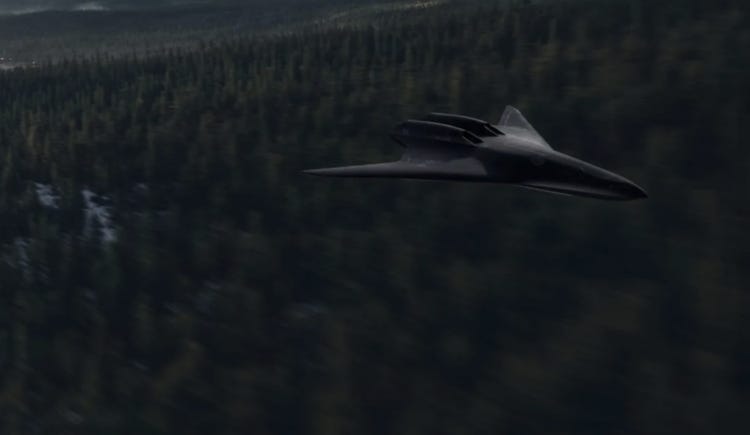
For those that dont know, the PW300 is a business jet engine in the 4,700 to 8,000lb thrust class. We don't know what version of the 300 is being looked at yet. That alone puts Scout in a category above most other CCA that we commonly see like Valkyrie and Fury, and pushed it likely towards Ghost Bat size or slightly bigger. Keep in mind, those are on single engines in the 2,000 to 3,700lb range while Scout will seemingly be running dual-engine.
So this isn't a small platform. It's a bigger, heavier CCA, below the fighter-sized platforms that we see someone like Saab building, but firmly in the heavier medium-class CCA. Scout is seemingly built for range, payload and potentially large power margins for sensors. I wouldn'tcall it an attritable platform.
The engines themsleves seem to not be fully buried, a tradeoff likely to still keep Scout cheaper and easier to maintain. Putting the intakes and exhaust up top also hides them from radar and IR below, and keeps them from sucking up gravel, snow and ice when operating from potential northern strips. Two engines also give you some extra redundancy when operating in the Arctic, though whether that is a concern here is yet to be seen.
Of course, Scout is still in-development. I don't expect to see the design stay the same throughout the whole process, bur the early designs point to a fairly comfortable middle-class platform with notable stealth features, higher power margins, and the rsnge needed for extended operations in Canadas Arctic.
It isnt the largest or highest-end platform but also is a step beyond cheap, easily attritable systems, backed by a Canadian-engine and built with a native Canadian Autonomy stack. Not bad for the countries first attempt at a class of CCA like this.
For any experts out there; is the P&WC 300 a fully Canadian designed engine and are all critical parts fabricated in Canada?
And a similar question for the ever eternal PT6 series engines?