


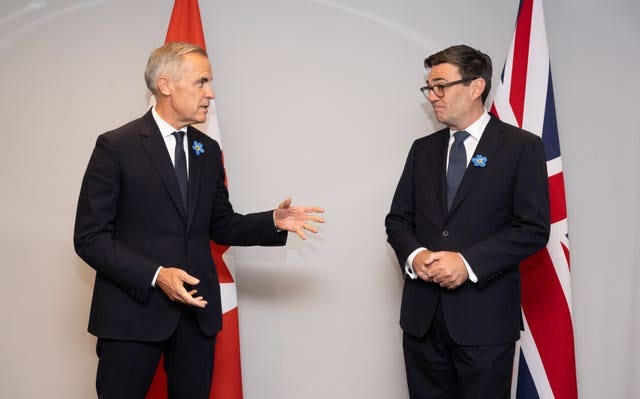
A small one today, and one I was waiting a bit to see before speaking. My boy Kyle, who has remained on top of this file, was the first one to report today that Canada and the United Kingdom were in discussions on merging or creating some sort of joint model between the Defence, Security and Resilience Bank and the UK-led Multilateral Defence Mechanism.
To quote Kyle, whom you should go support at his original reporting:
“The United Kingdom and Canada are talking about merging their proposed defence financing initiatives to amplify their effects, a senior Canadian government official said Wednesday.
The official, who was briefing reporters on background, said Ottawa is very confident they'll reach an agreement on bringing the two proposals together to form a joint institution, though that decision might not emerge from meetings this week.
Prime Minister Mark Carney has championed the creation of a global Defence, Security and Resilience Bank to supply allies with low-cost borrowing for defence. He's enlisted support for that venture from eight countries, including Latvia, Luxembourg, Greece, Belgium and Ukraine. But no G7 country other than Canada has signed on.
The United Kingdom's separate effort, called the Multilateral Defence Mechanism, is designed as a financing vehicle for joint purchases of military equipment and has won support from the Netherlands, Finland and Poland….
…. British media first reported this week that Burnham's finance minister, John Healey, is considering joining the Defence, Security and Resilience Bank.”
This isnt a new discussion mind you. Prime Minister Carney had previously met with former Prime Minister Starmer on the sidelines of the July NATO Summit in Ankara to discuss defence financing. It also comes the same day that Canada announces our formal application to join the UK-led Joint Expeditionary Force.
I do want to counter some things though on this. The DSRB is a bank, a financial instrument to utilize.
By comparison, the MDM is a procurement vehicle. It is there to facilitate the rapid and joint procurement of common equipment. This includes through direct grant funding and pooled buying, but explicitly removes itself from long-term financing as the DSRB would, similar to supporting industry.
Despite those differences, though, the two are competitors. Capital is always going to be a limiting factor, and the DSRB asks for a fairly hefty commitment out of the gate. There is also a bit of an open debate to be had on either side about the value of the other. Certainly, certain UK officials have used MDM as an idealized model that they believe fits better than DSRB.
That is changing here, though. The interest from the UK is there, and these talks are serious, a far cry from a few months ago when officials were very much set in the competitors’ mindset. I have previously said I didn’t see a merger coming, and I am still hesitant to say a merger is appropriate. I don’t think this is looking at that.
These are two separate, distinct things. They have different frameworks, goals, and setups. Perhaps there could be some sort of reciprocal membership down the line? Where members have an option to easily participate in both? That would be far more reasonable and realistic. It could also be that we see more joint initiatives financed through both instruments, or a portal through which joint procurements through MDM can be supported by the DSRB.
The key thing will, of course, be financial. Do we expect the MDM participants to participate financially in the DSRB on top of the MDM? Is it an opt-in program where certain people might be part of both and some not? In that case, how do we interact in a system for Joint Procurement where one partner might be locked out of one of the major financial instruments?
How this is executed upon will be key. This is not a merger of two similar programs, but arguably two complementary instruments both having to be balanced in terms of participation, financial commitment, and how their mechanisms interact with each other. Insinuating that these are similar programs is misleading to the struggles that integrating both under one framework might present.
It won’t be as simple as it is being made out, especially as both instruments are still in the process of organizing and establishing themselves. Some might argue it is better to do this sort of thing at inception, as it provides the opportunity to shift direction and plans while an organization is fluid, but in the current setting, where both instruments are fairly different from each other, and given the obvious need for both to start moving, trying to integrate both into each other can present challenges and delays to both starting to provide to their members.
Something to think about, at least. There is a path forward, but it isn’t so simple, I feel, as many think, and I still am yet to be convinced of a merger like some. It doesn’t feel like the path for something like that is there yet.