


I have been a part of this community for around three years now. For many, that is a blip on the radar. One thing I was always told was how quickly the community would latch onto things they liked and how quickly things spread.
I certainly have been credited in many respects with creating trends and interest in certain things or companies. I know many have told me that a lot of what they know about Roshel and how they discovered them was through me and my work covering them in my early days.
But for the last year and a half, one company has managed to dominate my headlines. One company has crept from a relative unknown here into a common topic of discussion.
I was always destined to talk about Hanwha, and naturally I feel it was destined for them to become such a hot figure in the Canadian defence community. Truthfully, the company's ability to lie low for so long is a testament to their quick ascension to the global stage.
A decade ago, Korean defence exports accounted for a small percentage of the overall market. The industry exported a respectable but meagre $2–3 billion annually until around 2020. In the last five years, though, the value of Korean arms exports has exploded, backed by quick turnaround, a precedent for supporting local industry, and a willingness to transfer technology—usually at a cheaper cost than most other Western alternatives.
In 2021, the value of Korean arms exports jumped nearly 145% to \$7.25 billion. This number peaked in 2022 at a massive \$17.3 billion, backed by large contracts from the likes of Poland on the onset of the war in Ukraine. While this figure has dipped from that peak, the estimate is that the industry will see nearly \$23 billion in sales this year.
The Stockholm International Peace Research Institute, which published its "Trends in International Arms Transfers, 2024" report just the other week, now ranks South Korea as NATO's second-largest arms exporter, tied with France.
Hanwha, while not the only company involved, is by far the one reaping the most benefit from this explosion, with Hanwha Aerospace seeing a 79.9 percent rise in second-quarter net profit to $207.1 million, up from $115 million a year earlier.
Hanwha itself is a Fortune 500 conglomerate with its hands in just about everything from finance to energy, and even hotels and department stores. When we speak of Hanwha from a defence perspective, we tend to focus on Hanwha Aerospace and Ocean, where the vast majority of their defence portfolio resides.
However, the company also has stakes in a number of other industries, including energy, plastics, finance and insurance, retail, and leisure. These will be important later.
This also includes a baseball team, for some reason. I don't know why Hanwha has a baseball team, but I learned that last week and wanted to bring it up.
In the last two years, Hanwha has also expanded into shipbuilding with the acquisition of Daewoo Shipbuilding & Marine Engineering (now Hanwha Ocean) in 2023, and more recently the acquisition of Philly Shipyard from Aker last year.
The company has also increased its stake in Australian shipbuilder Austal to 20% from the previous 9%. This came after an attempt to acquire the company last year was rejected due to concerns that the transaction would not receive the necessary regulatory approvals from Australian and U.S. authorities.
Defence has always been a part of Hanwha’s core identity, having started life as the Korea Explosives Company in 1952. While the company quickly expanded during the '60s and '70s into a number of other industries, especially energy and chemicals, it has always maintained a presence in the Korean defence industry, with the company returning fully to it during the mid-1990s with the likes of the K200A1, KAAV, and K9.
So, not a new company, but certainly new to the global stage for many of us. You need to know a bit of the company's history and where exactly their interests lie if you want to truly understand what exactly Hanwha’s plans here are.
Naturally, once Hanwha had determined that Canada was a target of priority, it was only a matter of time before they became a major topic of conversation. While not intentional, it would be reasonable to say that Hanwha’s strengths align well with the demands of many people here and with those in government.
The company has been scoping out Canada for nearly five years now. They did not suddenly appear. Canada has seemingly always been a long-term goal for Hanwha to break into. It is only now that we are seeing the culmination of that work.
Back in March, Hanwha presented their offer to the Canadian government, an unsolicited proposal that promised to be the cornerstone for rebuilding the CAF into a military prepared for the modern battlespace.
That proposal, its contents, and what exactly was promised have been unknown to the general public since then. It was years of work put into a singular package, proposing to support both the Royal Canadian Navy and the Army in their modernization efforts.
It has probably been one of the hottest topics I've seen debated over the last few months, and I tried hard, very hard, to get as much info on it as possible. Months of questions, investigating, and digging for numbers. Now, finally, I can say that I know what that package included and how Hanwha plans to build a new defence ecosystem in Canada.

Hanwha for Canada
The package presented to the government in March was actually three separate proposals brought together by Hanwha. The package itself is built around four main concepts:
Delivering Next-Generation Capabilities today
Delivering capabilities cheaper and faster than competitors
Building Canada’s Defence Industrial Base
Helping fulfill the goals set out in Canada’s Indo-Pacific Strategy.
To deliver on these concepts, Hanwha developed three separate proposals, two for the Canadian Army and one for the Royal Canadian Navy:
KSS-III for Canada
Expedited Land Fires
Onshoring Defence Capabilities
This package has a total value of approximately $25–30 billion and covers multiple ongoing projects including CPSP, LRPS, IFM, and even MEDCAV, a project still very early in development that I was surprised to hear was included.
It also fulfills the demands of the now-dead Self-Propelled Howitzer UOR, which itself never made it to funding thanks to IFM taking priority and moving up the timeline.
This package also represents the minimum demand for Hanwha to deliver on their promise of creating a defence ecosystem in Canada, including local manufacturing. Before we get too far into all that, though, let's break down the proposals and what they include.
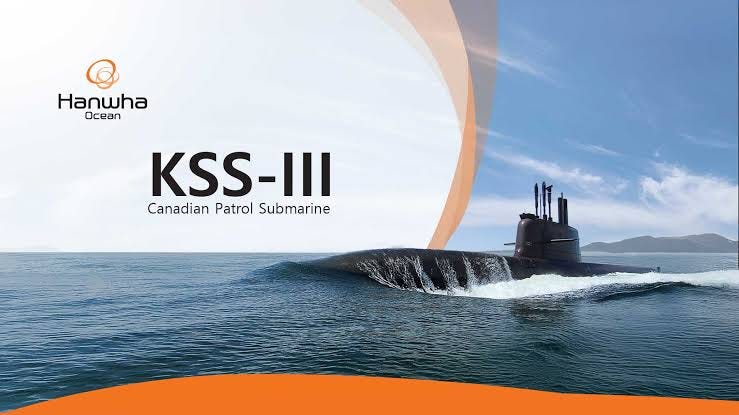
KSS-III for Canada
By this point, I believe we've all heard the KSS-III proposal. Certainly, if you follow me regularly, you hear it about once per week on average. However, for those new here, let's give you the rundown.
As part of Canada’s efforts to modernize its navy fleet, the federal government has launched the Canadian Patrol Submarine Project (CPSP), aimed at acquiring between 8 and 12 diesel-electric submarines to replace the current Victoria-class.
Hanwha, as one of the two companies downselected for the program, is offering its KSS-III Batch II submarine to fulfill these requirements. The KSS-III is the Republic of Korea’s first indigenously designed and constructed submarine, with the ROK Navy operating license-built German designs in the Type 209 and Type 214 under the Jang Bogo-class and Sohn Wonyil-class, respectively.
The Batch II is another beast entirely, slightly larger than her Batch I sisters currently in service, measuring 89.4m in length with a displacement of 4,000 tons submerged. It is one of the largest diesel-electric submarines available on the market—a staggering 24m longer and over twice the displacement of the Sohn Wonyil-class.
Several improvements have been made in the Batch II submarines compared to the Batch I. For the first time ever, a Korean submarine will be equipped with lithium-ion batteries as compared to the traditional lead-acid batteries commonly found in most diesel-electric submarines.
Compared to traditional lead-acid batteries, lithium-ion batteries provide significantly higher energy density, allowing longer submerged endurance and faster speeds without increasing the vessel’s weight. They recharge more quickly, enabling shorter snorkel or surface times that reduce detection risk. They require less maintenance, have a longer operational lifespan, and are safer with modern thermal management systems.
The Batch II will use commercial NCM cells from Samsung SDI, although Hanwha plans for new options to be available by the time we see the first of ours delivered. This will allow the Batch II to stay submerged for several weeks longer than her Batch I sisters, reportedly up to 6–8 weeks.
They will also feature an improved air-independent propulsion (AIP) system, a new retractable bow thruster, an upgraded sonar suite developed by LIG Nex1, new MTU 4000 U83 engines built under license by STX, and an upgraded combat management system.
Their combat systems have also received an upgrade, with the Batch II increasing its VLS count from the Batch I's six cells to ten. The KSS-III is one of the only conventional submarines equipped with a vertical launch system, capable of firing the Hyunmoo IV-IV submarine-launched ballistic missile (SLBM).
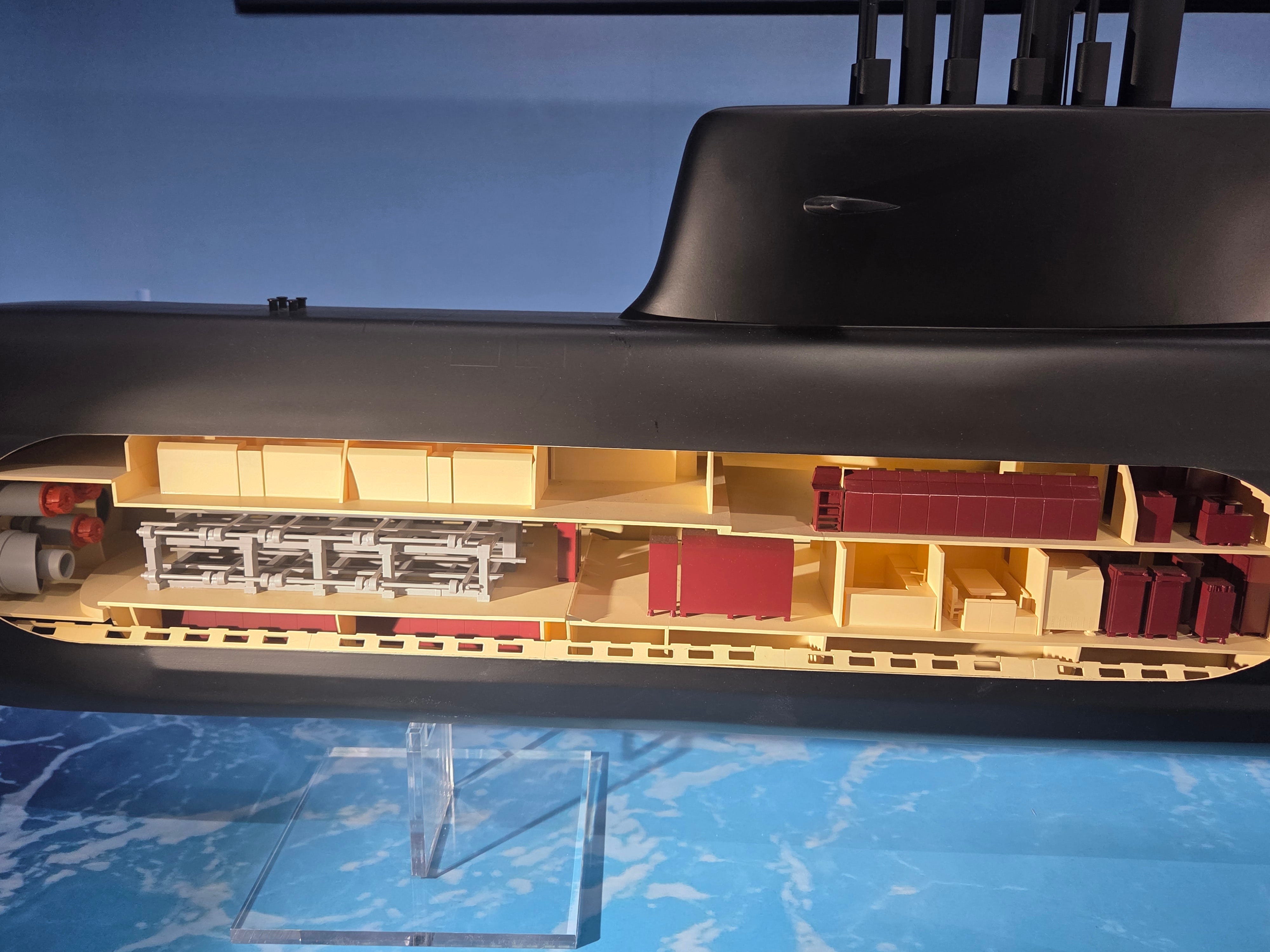
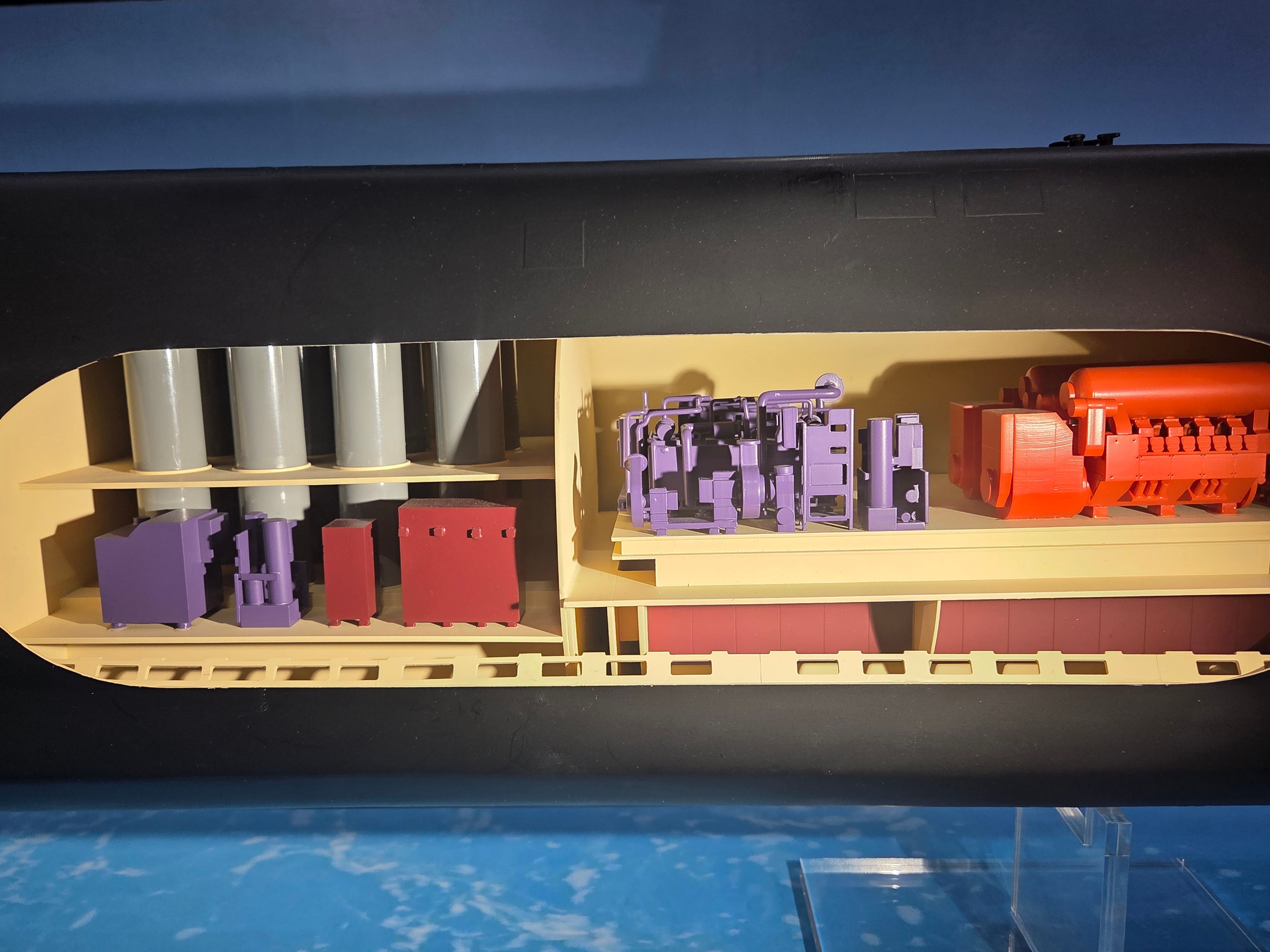
As part of their offering to CPSP, Hanwha is proposing the same model of the Batch II that the ROK Navy is receiving. This allows Canada to fulfill its desire for a military-off-the-shelf platform that is proven, in service, and available now.
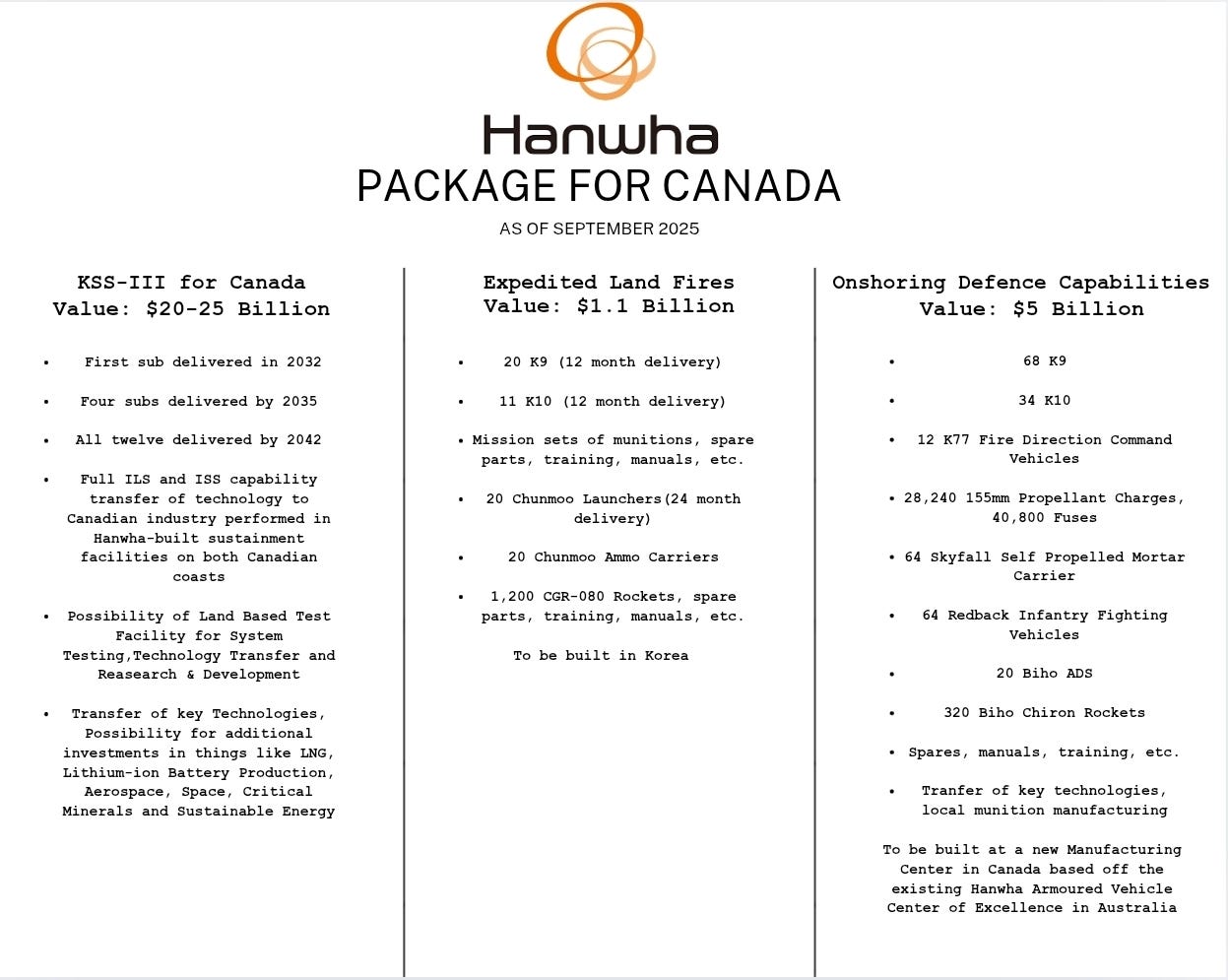
Hanwha is offering to deliver four KSS-III submarines to fully replace the Victoria-class before 2035, with the first in 2032, assuming a contract is awarded in 2026. Hanwha estimates that earlier retirement of the Victoria-class fleet will result in estimated savings of approximately \$1 billion on maintenance and support costs.
So, now we have recapped the offering itself. It's the offering that we have been presented with over the last year. That hasn't really changed much. What we do know now, though, is exactly what is being offered alongside it.
Any project in Canada, as many of you know, is not solely decided on the platform itself. Other factors, including the economic benefit to Canada, are also major considerations in the decision-making process.
Hanwha, above all, places a heavy focus on building local industry and delivering economic incentives in their deals. It has always been a major part of their playbook, pushed by a government that encourages expansion globally and sees the political potential that these sorts of defence deals provide.
We will talk more about this in a while. For now, you just need to understand that Hanwha's strategy for helping secure contracts includes a heavy focus on domestic involvement and economic incentives.
That's no different here. From what I know, some companies have been engaging with Hanwha on new submarines since 2020. Hanwha announced their first MOUs two years before the project's official launch last year.
Hanwha's aggressive strategy of relationship-building has always been a strong point for them, and one that they have shown off over the course of CPSP as they have slowly built their Canadian roster.
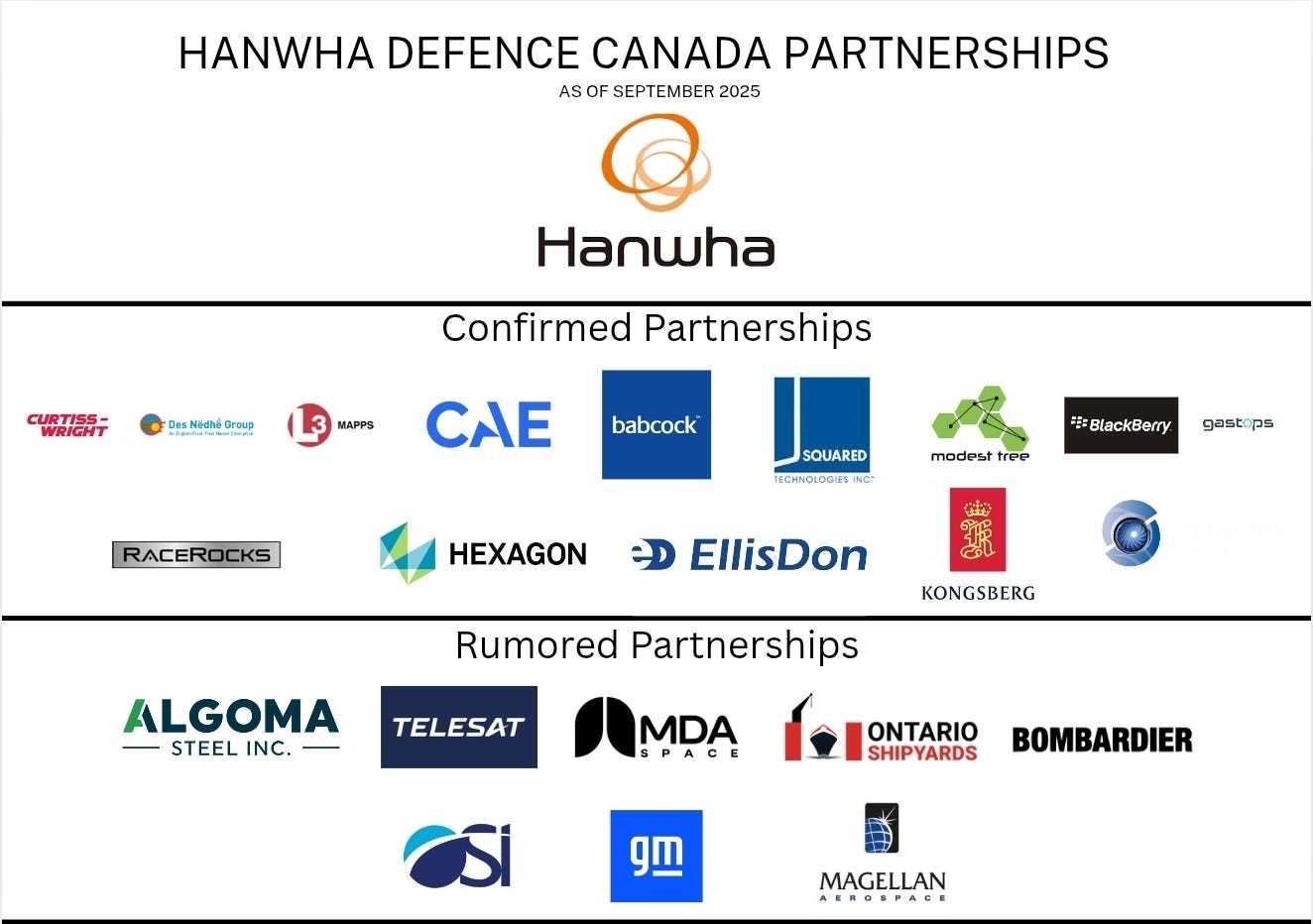
As of right now, Hanwha has signed MOUs or agreements with over a dozen Canadian companies, including Babcock, CAE, Modest Tree, Des Nedhe Group, J Squared, Gastops, Curtiss-Wright Indal, Kongsberg, Paradigm Shift, Hexagon, BlackBerry, L3Harris, RaceRocks, and Ellis Don regarding both CPSP and land projects.
I have also heard that they are in further negotiations with several other major companies, including MDA, Telesat, Bombardier, Algoma Steel, Ontario Shipyards, GM Canada, OSI, and Magellan Aerospace. There are likely a lot more put there, but you get the idea.
Hanwha has a strategy of reaching out to everyone and trying to bring on as many partners as possible. Some of these might not even be tied to any projects themselves, given that current ITB policy does not dictate that economic benefit needs to come from individual projects.
Given both their active involvement globally and their many other businesses, Hanwha maintains a very open pool of partners to work with, and indeed this is something they have highlighted to decision-makers.
A CPSP selection might not just mean economic investment in the defence sector. Hanwha has also proposed further investments in LNG, lithium-ion battery production, aerospace, critical minerals, and sustainable energy.
They are also offering full ILS and ISS capability and transfer of technology to Canadian industry, performed in Hanwha-built (using Canadian construction companies and workers) sustainment facilities on both Canadian coasts.
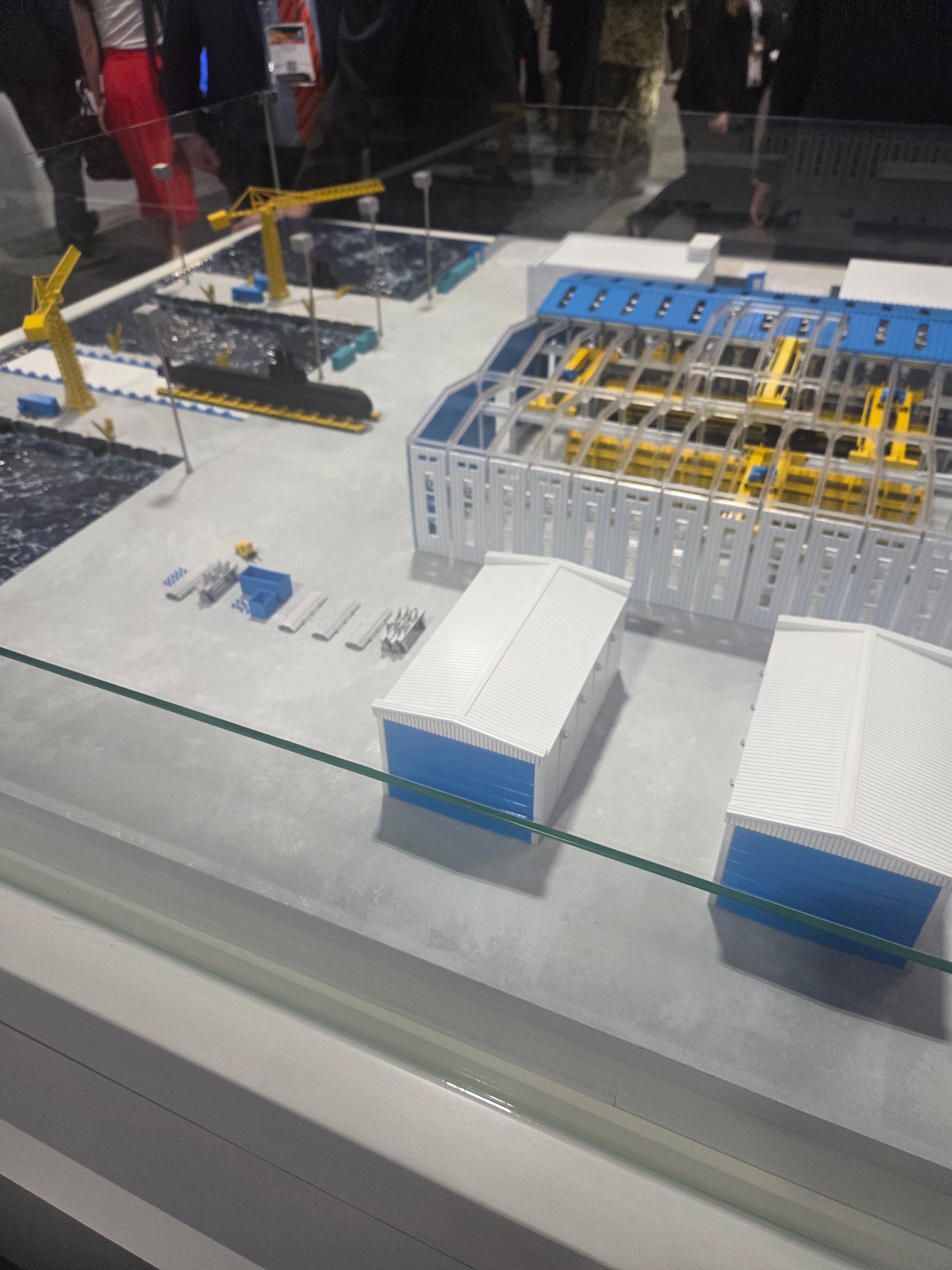
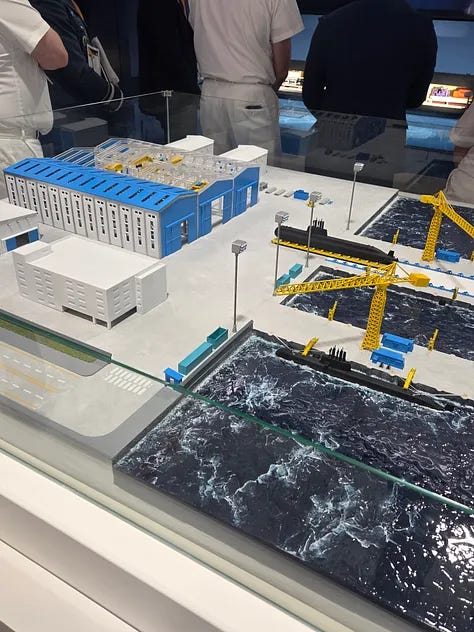
Hanwha has also expressed interest in establishing a new land-based testing facility in Canada modeled after their LBTS in Siheung, South Korea. This facility would help facilitate the transfer of key technologies, act as a testing ground for key systems, and help support research and development locally.
That would be extra to the package, but I'm told the offer is there. The total value of this offering is pegged at between \$20–25 billion. It is by far the most comprehensive package I have ever seen given for a project, and goes to show the extent to which Hanwha is willing to offer to secure a major deal like this.
It is only one part of the package, though. There are still two other major proposals that have been thrown into this package, and they are by far the ones that people were most interested in. Now, for the first time, we can take a look at them.
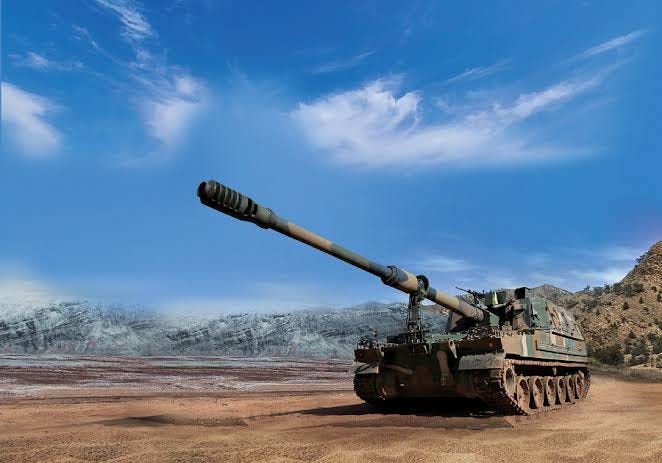
Expedited Land Fires (ELF) & Onshoring Defence Capabilities (ODC)
I am doing both of these together because, in essence, they are two phases of one larger proposal. ODC is meant to build off the work that ELF does, while ELF attempts to fill a critical gap previously identified by the Self-Propelled Howitzer UOR, while also likely showing off Hanwha’s ability to deliver new capabilities quickly. You can't discount showing off!
To start, let's discuss ELF first. This package is specifically designed to fulfill both the SPH UOR as well as Canada’s Long-Range Precision Strike project in one go. Hanwha puts its value at $1.1 billion and it includes:
20 K9
11 K10
Mission sets of munitions, spare parts, training, manuals, etc.
20 Chunmoo launchers
20 Chunmoo ammo carriers
1,200 CGR-080 rockets, spare parts, training, manuals, etc.
The K9/K10 would all be delivered within twelve months, while the Chunmoo would be delivered in twenty-four months. The twenty Chunmoo does not fully fulfill the estimated twenty-six systems desired by LRPS, but it comes fairly close. The twenty K9s, however, fulfill the original goal of the SPH UOR, delivering Canada a battalion of modern howitzers within one calendar year.
From this point, ELF moves into ODC, which takes a far more comprehensive look at the Canadian Army and its requirements. It not only includes a top-up of K9s, as well as the addition of 120 mm Skyfall mortars to fulfill the requirements of IFM, but also aims to fulfill Canada's requirement for a new medium cavalry vehicle and VSHORAD GBAD system as set out in Enduring Phase II.
In total this package has a value of $5 billion and includes:
68 K9s
34 K10s
12 K77 fire-direction command vehicles
28,240 155 mm propellant charges and 40,800 fuses
64 Skyfall self-propelled mortar carriers
64 Redback infantry fighting vehicles
20 Biho ADS
320 Biho Chiron rockets
Spares, manuals, training, etc.
All of which are to be produced at a new facility in Canada. This deal also includes full technology transfer and munitions production as outlined in IFM. Hanwha uses the term 'friend-shoring' a lot here to emphasize how this facility could be used not just for Canadian needs, but also globally.
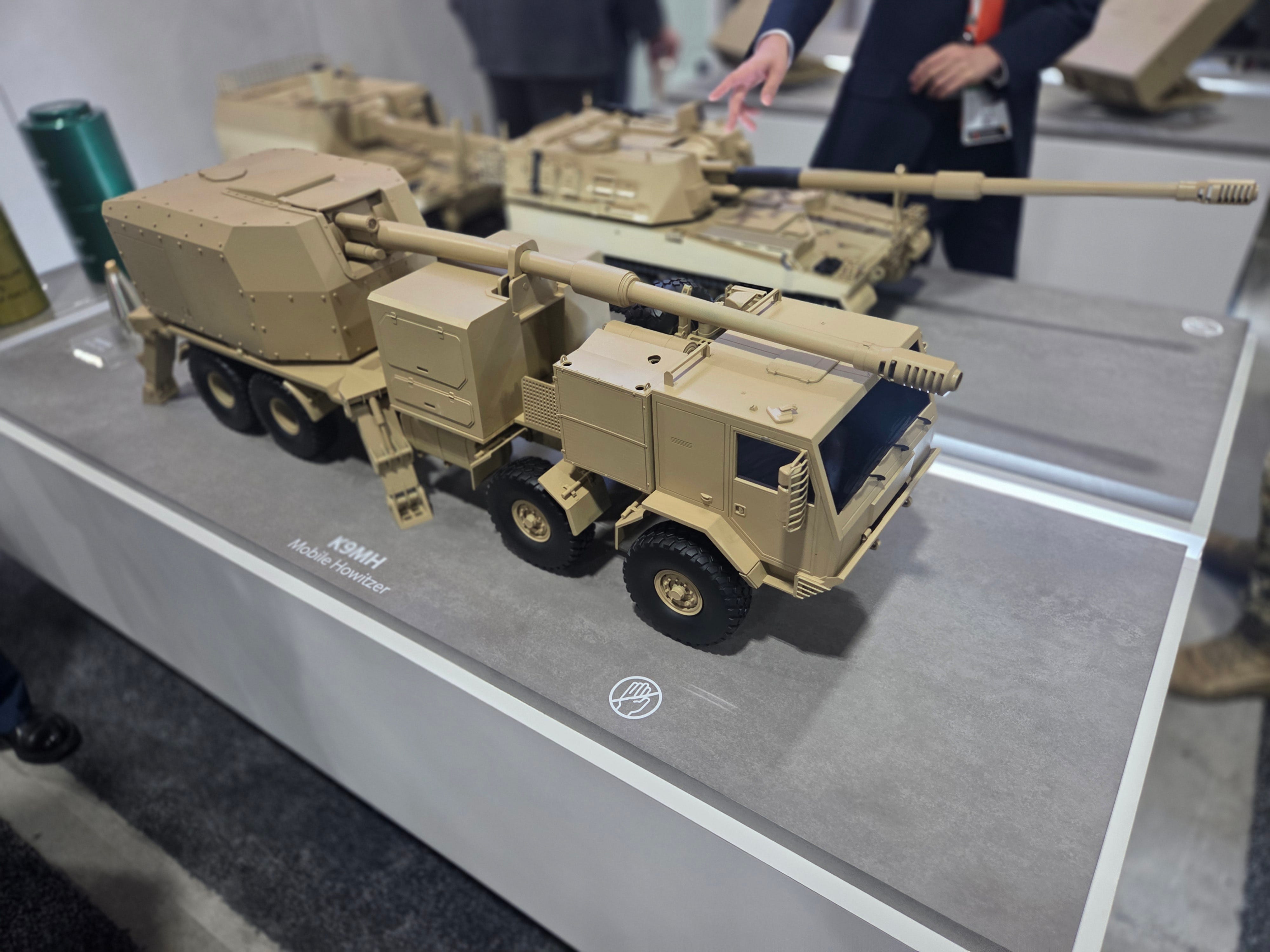
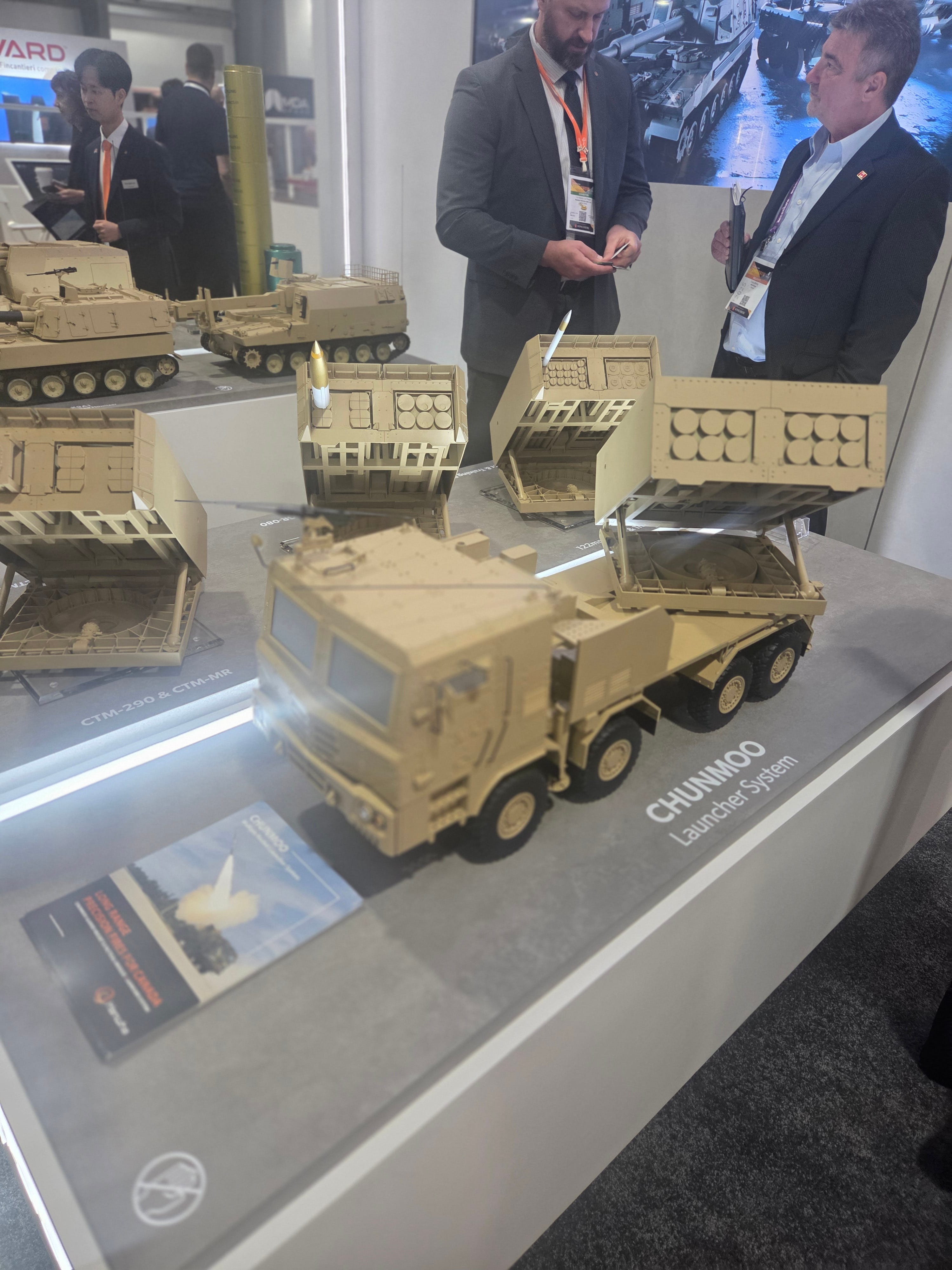
The model here is almost identical to what Hanwha did with Australia. For those who don't know, in 2021 Hanwha was contracted to supply the K9 (locally known as the AS9 Huntsman) and AS10 Armored Ammunition Resupply Vehicle as Batch One of the L8116 Protected Mobile Fire Program. They were also awarded a contract in 2023 to provide the K21 (AS21 Redback) as part of the Land 400 Phase 3 (tracked IFV) program.
As part of this contract, Hanwha offered to manufacture these vehicles domestically at a new Hanwha Armoured Vehicle Center of Excellence (H-ACE), a 32,000 square metre, state-of-the-art facility that features a 1,200-metre test track, deep-water test facility, incline test, production halls, workshops, and space for up to 400 workers on site.
This facility started construction in the spring of 2022 and was completed in a staggeringly quick 21 months, officially opening in August of last year. The proposal here is to essentially take what had been done in Australia and do it here. As of now, Hanwha Defence Australia includes over seventy domestic suppliers.
The packages laid out here are the minimum required for Hanwha to establish this facility. Although obviously some varying combinations are certainly out there, this is what was proposed.
The inclusion of MCAV here is surprising, as is GBAD. Both MCAV and Enduring Phase II are very early in development, to the point we're still in the identification phase for both as far as I'm aware. It seems strange to include them here, even with Hanwha being known for jumping on things extremely early and starting work when projects are still on the drawing board. They do it constantly, as we've established, and that isn't honestly a bad thing. That aggression and early control of the narrative has been a major benefit to them time and time again.
Certainly they are doing something right there, considering the massive success of the last five years. So who am I to question what they throw in?
Putting it together
What Hanwha is offering here is substantial; there is no doubt about that. In a single package, Canada could complete several major projects, including CPSP, IFM, LRPS, and acquire a new tracked IFV. This is on top of a new land-vehicle manufacturing facility, dedicated maintenance hubs on both coasts, and the potential for a new land-based testing facility.
All this, promised investments, full technology transfer... It is quite easy to say that Hanwha, above all, has thrown everything they could reasonably throw onto the table. I don't think there is much else they could throw at this point that would change the outcomes, save for more partnerships. However, they're already excelling at that in CPSP.
The total value of this package, again, is likely to be approximately \$30 billion. That is a significant cost, but it gives us an idea of what the trade-off is for this. The vast majority is tied into CPSP, to which Hanwha is offering a substantial package, backed by a very strong domestic team that is likely to continue growing in players.
It is overwhelming, but not surprising. This is what Hanwha does. This is their bread and butter: offer large packages, offer tech transfer and domestic production, and bring local companies into the wider Hanwha supply chain.
Hanwha is aggressive. People always look at me weird when I say that, but it's true. They are aggressive marketers. They aggressively pursue projects the moment they learn of their existence. Hanwha, time and time again, finds a way to control the narrative, and in turn the messaging, simply by being the only person talking about things.
And again, it works. It's worked for them over and over again. It's something that many other companies have yet to figure out and properly adapt to. What Hanwha does well is getting itself out there and getting established locally.
Part of that is culture, yes; another is, of course, the Korean government's direct role in supporting arms exports, something in which they take a proactive role and encourage. It's a whole-of-government approach, where the government makes itself an active player in securing contracts, which in turn opens these doors to the possibilities of things like tech transfer and domestic production.
When the government is an active player in the process, a lot of these more complex issues become far less of a concern. It's a benefit that Korean companies have that many others in the Americas and the EU lack at this scale. It's an organized, well-oiled process that has now become an established, working system.
Sometimes it fails—see the Australian frigate project. The issues there are what helped lead to Team One Korea in CPSP, with the Korean government getting directly involved in the process.
And to Hanwha themselves, you might remember me bringing up earlier their other businesses and their importance. It's something I haven't seen discussed much yet in terms of CPSP; however, it is an important factor.
Hanwha’s bid, as you see, goes beyond defence. It takes a whole-of-company approach that turns CPSP into a key to unlocking further investment into Canada. It's a dangling ring hanging above our heads, promising to see new investments in battery production, LNG, and critical minerals if only we give them this opening.
It's something that other defence companies do, sure, but something Hanwha can do at a far greater scale than most, especially given their massive presence in the energy sector.
Canada has recently started LNG export off the west coast with the opening of LNG Canada Phase I, and Phase II has just been designated a project of national interest. Other projects like Woodfibre, Ksi Lisims, Cedar, and Tilbury are also in the works. In total, we are talking about upwards of 50 MTPA of export capacity if all these go through.
LNG development has been seen as a top priority by the Carney government, and indeed there is Korean demand for it. Energy, more specifically Alaska LNG, was a big part of the US–Korea trade deal signed a few weeks ago.
So, where am I going with this?
I want to highlight a lot of these topics because I don't think you can really talk about this bid without talking about the advantages that other people see in doing business with us.
There is a good reason why we are seeing things like friend-shoring and why we're seeing Hanwha talk about other investments beyond the defence sector. There is a reason why Hanwha is so intently focused on us.
And that isn't to downplay the significance of a contract like CPSP. It's still a contract worth tens of billions, one of the largest singular sub-orders in decades in terms of numbers. Of course anyone would want to win that.
However, to put it into a category on its own without looking at the wider picture dismisses a lot of what is being done here. Canada is a resource-rich, highly educated country that is in a position now where it is searching to diversify its trade from the United States and attract mass foreign investment.
There is a lot of opportunity for a company like Hanwha, already a major player in the energy sector, to come in here and take a piece of what is still a highly undeveloped and still young sector like energy, or an established but struggling sector like aerospace.
There is value in a country like Korea wanting to promote these relations in order to secure a supply of critical minerals, something they lack, and diversify away from the Chinese mineral supply chain.
There is huge value in having another G7 country investing in one of your strategic assets like the KSS-III or securing your defence supply chain by investing in a country away from conflict, especially when your country's industry is highly vulnerable in the event of conflict—the struggle of living on a tiny peninsula.
I think that oftentimes, when we have these discussions, we don't look at what the other side believes they can benefit from us, especially when we look past the financial aspect of winning the contract.
There is very clearly a lot that Hanwha sees in us beyond contracts, or selling a vessel to a NATO country and proving they can make it work (although that is important as well).
And I believe that's why we see them be so aggressive. It's not just about the submarines or the K9. It's about opening the door to the Canadian economy and getting inside.
Something like CPSP is a great way to start that, especially when talking about things like battery manufacturing or the manufacturing of key parts—both of which give Hanwha an opening to jump into other sectors like critical minerals.
And to that, I think it actually makes this proposal more beneficial to us. It's not just about selling us equipment. It's clear that Hanwha sees us as a partner. They want to do a lot more here, and I do think that's important to know and an important thing to be acknowledged.
Does that make them more trustworthy than others? No. Does it give us more room for leverage? Does it give more reason for Hanwha to stick to their commitments? Does it present a lot more opportunities than other companies could typically offer themselves? Yes, it does.
And I'm not specifically calling any option the best when we're looking at the equipment itself. That comparison will be in another post in a few weeks.
However, you can now see what I see. You can see the offer on the table, and for those of you who have heard me talk about this kind of stuff for the last few months, who have questioned where I'm coming from, I hope it gives you a better idea of what I mean when I speak about how our value—the potential we have—is recognized and seen by others.
It's also why I've spoken about how you can't judge CPSP based solely on the defence aspect. The fact was CPSP was always going to be a lot more than that, and I am sure that TKMS and Germany have very similar ideas, and very similar discussions as Hanwha in this regard—to look beyond defence and to what other benefits there are.
This package is substantial. It is probably the largest singular package we will ever see in terms of defence, at least for a long while. I always love to believe in the potential of these things. Everyone knows I'm hopeful and everyone knows that I am an industry-first person.
This fits everything I would love to see. It is the kind of package that I would dream of, and I believe many of you would as well. I certainly know that there are going to be a lot of you who are captivated by this, and for good reason.
Youthful ignorance, I know. My heart and soul have not yet been crushed enough by the defence industry in the Canadian procurement system. I like to believe that there are better pathways than what we have now, and I like to believe that we can do a lot more than we're currently doing.
I love to believe in our potential, and I look at this, and I want to truly believe that we could pull something like this off, that we can make this work. There are smaller, poorer countries who can make these things work.
And part of me does tell my heart that it is wishful fantasy, that I'm being blinded by my own desire to see the inevitable. A part of me knows the attitude on defence spending will dry up, and that given percent is unlikely to ever come. That all presents major risk.
However, it's a risk I am willing to take myself. It is a risk I hope many of you at ISED—hello to all of you who follow me—are also thinking of at a time like this. I am not endorsing this specific package and saying take it now. However, I am saying it deserves a proper look and a proper debate before being dismissed.
I believe this is the kind of mentality we need to have, the kinds of deals we need to be discussing and negotiating. We live in trying times, where we don't have the same mandate to be slow and cautious. We need risk. We need bold choices. We need to make the hard decisions.
That starts with the conversation.
Wow, that is indeed some package…but I suspect it will give Public Works a caniption fit pointing to the nescessity of having to break this up into those individual projects. But yes maybe not specifically what some of those writing the RFI’s want but it has to be close. The only thing not covered that was suggested by others was the FA 50 fighter. (Which admittedly we don’t need but I suspect is a bridge to the KF21 which maybe we do, depending on if you believe in a aplit fighter fleet). Great piece of work Noah. (Now how well will the KS III work in the arctic….)
Well written, Noah.
The Korean team will be beaming with glee, knowing they have a Canadian rooting for this massive modernization package to go through and revamp the ailing Canadian Defence Complex.
Frankly could've been a Hanwha for North America if they didn't sleep on their behind back in the 70s, and would've been exporting, ships, drones, subs worldwide by now, but time to learn from the Koreans and rebuild that indigenous capacity and know-how fast.
Think they should explore similar with Sweden's 🇸🇪 Gripen-Es, too