


In its latest competition, IDEaS is calling upon prospective competitors to present their solutions for an innovative, low-cost, attritable UAS to address critical gaps in military readiness and industrial capacity. The aim is to accelerate the development of scalable, cost-effective UAS solutions that:
Enhance operational effectiveness;
Improve interoperability; and,
Strengthen Canada’s domestic industrial base.
The development of cost-effective, attritable UAS represents a transformative opportunity for Canada’s defence and security industry. By fostering innovation and enhancing domestic capabilities, this challenge will position Canada at the forefront of UAS technology while ensuring the protection of national sovereignty. DND/CAF are hosting this challenge to:
Observe advancements in Canadian low-cost UAS capabilities relative to the current state of the art;
Stimulate the growth of Canada’s domestic UAS industry and workforce;
Identify supply chain patterns and vulnerabilities;
Enhance Canadian capabilities for rapid UAS deployment and iteration; and,
Increase DND/CAF familiarity of the design principles and features that drive UAS innovation at scale.
To break this down further, the Challenge is looking for First-Person Unmanned Systems with a unit cost of $800 or less. The contest will consider only proposed solutions currently within Technology Readiness Levels (TRLs) 1 to 6 inclusively.
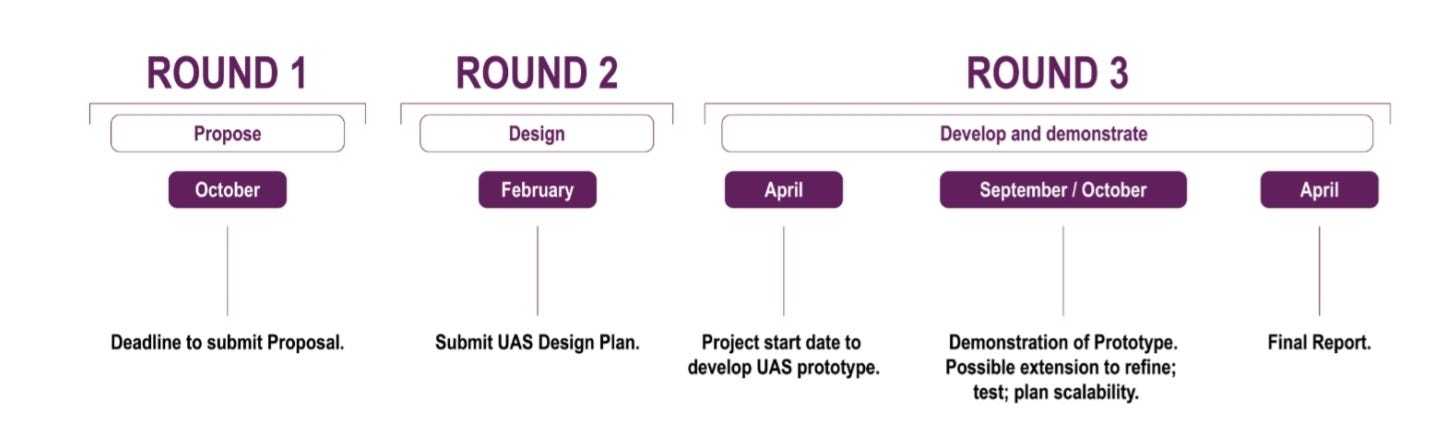
Submissions to the project are due Wednesday, October 8, 2025, at 2:00 PM Eastern Time. This contest is open to:
Canadian universities and educational institutions chartered in Canada;
Canadian incorporated for-profit organizations;
Canadian incorporated not-for-profit organizations;
Canadian provincial, territorial, and municipal government organizations;
And for those curious about the prize money fir this challenge:
Round One: Submit a proposal – a chance to be awarded a $35,000 cash prize.
Round Two: Provide detailed plans for a scalable, low-cost UAS systems – a potential to receive funding up to $350,000.
Round Three: Demonstrate UAS prototype – eligible for additional funding up to $650,000.
Design considerations
Applicants are encouraged to include the following design considerations in the proposed solution:
Interoperability and Modularity
Design interchangeable components for rapid adaptation to different roles, from ISR (intelligence, surveillance, and reconnaissance) to logistics and basic combat.
Use open architecture that allows future upgrades or modification by the military or contractors.
Lower production costs and increased speed and flexibility of manufacturing.
Components should be designed to allow rapid repair and replacement using basic tools and minimal technical expertise, such as components that can be easily printed locally, reducing reliance on complex or foreign supply chains. This is especially important in remote and austere environments like the Arctic.
Environmental and Technical Constraints
The UAS must function reliably in cold, arctic, harsh operational environments, requiring special consideration for battery life, temperature resilience, and weatherproofing. The system must be energy-efficient to maximize flight time and reduce dependency on frequent recharging. The system must be easy to operate with minimal training, particularly in harsh environments where specialized support may be unavailable.
Scalability and production feasibility
The design should allow scaling from 1 unit to 100+ units within weeks to months. This ensures that production can meet growing demand and respond to emerging operational needs quickly. The solution should utilize efficient production methods (such as modular design and 3D printing) to support scalable manufacturing that can meet military needs in a time of conflict or crisis.
Proven utility in core military functions
Demonstrate effectiveness in basic military roles (e.g., light surveillance, or reconnaissance);
Include payload capacity for basic sensors (e.g., cameras, environmental sensors);
Ensure range, with suitable endurance, for short to medium-distance operations.
Security and Cybersecurity
Given the rising concern over cybersecurity, especially with foreign-made systems, the UAS should be designed with basic cybersecurity measures to prevent hacking, jamming, or other forms of disruption. The design must rely as much as possible on domestic supply chains to reduce dependence on foreign countries for critical components, enhancing national security and reducing vulnerabilities.
The primary focus of this challenge is less on the UAS itself and more on the scalability and manufacturing. There is a lot of effort here to explore new, innovative ways (like 3D printing) for scaling up drone product. I do recommend you check out yourself. The whole PDF is available without restriction and contains a lot of these tidbits beyind the consideration.
There is also a heavy focus on the Arctic, but that shouldn't shock anyone by this point. Almost every challenge has some Arctic considerations involved, if not the majority these days have an Arctic focus.
For Canada the adoption of UAS has been slow and troubled. It was only a few months ths ago that we had articles about the lack of a dedicated project for FPV, something that riled a lot of feathers. I for one see their value, but they're far from high on my own priority list. Thats just me.
The UK has launched a wide range of UAS projects including StormShroud, Project Asgard, and Stalker among others. They're also testing with FPV drones. The Armée De Terre (I love saying that) has been testing containerized 3D printing facilities for creating Micro and Mini UAS. Those facilities can produce dozens of these drones a day.
Across NATO there has been major efforts on multiple fronts to rapidly expand and diversify UAS fleets. Canada has been a laggard there, something I have heavily criticized given Canada’s decently-sized and developed UAS industry. There is far from a lack of players in this field, especially at the Micro and Mini level.
Volatus, Avidrone, ARA Robotics, Aeromao, North Vector, ZenaTech, Draganfly…. There are many potential vendors, all without a variety of solutions ranging from Micro to Class II/III UAS. These are just the ones I can think of off the top of my head. There are quite literally dozens around.
We have tried. The Teal 2 is now in regular service among all the branches. There have been small acquisitions around. The RCN just announced the ISTAR contract and is pushing forward on new UAS for the AOPS and Protecteur-class.
We tried to create a system for quick acquisition by adopting the U.S. Blue List and launching the GPUAS initiative, which would allow units to purchase their own systems through the approved list. Sadly that didn't work for a number of reasons, overly-complex, restrictive and costly when considering many of those approved UAS were ranged in the $25,000+ catagory. It was never gonna work out sadly.
You can't do this with $20,000 UAS. There is room for these higher-end systems. However it can't be relied upon to be the bulk of your unmanned fleet. While others might be able to afford that, it isnt something we can nor should attempt to replicate.
When it comes to Unmanned Systems we tend to create a viscous loop. We start with wanting cheap, disposable systems and then w start adding new requirements, new security features, STANAG requirements, minimum capabilities that are asking either to much or for contradictory capabilities.
Its a common theme you get if you spend a bit of time talking to those who design UAS. By the time you're finished your disposable system is now $35,000 and your budget is blown on a small amount of very boutique little drones that you can no longer call disposable because you only procured a very small number of systems thanks to overblowing your estimates.
And we talk about this mainly in the context of Micro/Mini UAS but we rarely talk about the gaps in our Class II and III systems. While the Blackjack is great, and I've only heard positives about those who've used them, they are a limited fleet.
There has been talks about getting more. Thats great, however they're also multi-million dollar drones. They're expansive, high-end systems that have no lower-end complement. I am much more concerned about this gap that the Micro/Mini deficit because at least there is disvussion there, and efforts like these.
For the catagory between them and something like Guardian there is almost little discussion, and no big concern that we lack these cheaper, long-range ISR and Strike platforms that the Wars in Ukraine, Nagorno-Karabakh, and even the Twelve-Day war to an extent show are a vital part of the modern battlespace.
The best news we have is that a few Ukrainian UAS companies are looking to set up production here. At least one who produces in this catagory is reportedly very close to striking a deal on. Thats great, theres a lot there to be learned from the Ukrainians, however we shouldn't be hopeful that we can just take Ukrainian designs and build a mythical fleet.
It not only ignored the differences in demands we might have, but also ignores a healthy, thriving industry trying to find ways to expand but not being given the chances to prove themselves more.
There might be room there. I love the Shark and PD2, and maybe theres room for those designs in our fleet. However it ignores that we already have people here and the industry prepped. Is the supply chain fully there? Not yet. There is work to be done. Challenges like this are great because they attempt not just to bring them together but also provide a chance to find and cataloge those gaps in the UAS Supply Chain.
We’re collectively talking about Unmanned fleets in the hundreds of thousands. That is a massive potential for industry to capitalize on, especially with a country that has the raw materials, established industry, and healthy education system to bolster the student-to-talent pipeline to really capitalize as an end-to-end provider where others can't.
We oftentime ignore a lot of these strengths in favour of focusing on the difficulty of creating the supply chains, or the cost of upstarting this industry. Our VC and financial ecosystem is risk-adverse, especially to defence. That means that sadly, a lot of these companies either fail fighting or waiting on the scraps of funds theyre handed out by things like IDEaS programs or they merely move abroad where easier financial vehicles are available.
This also goes deeper into DRDC and IDEaS lack of a proper pipeline for concepts to go from design to the field. Even a small order for trial can go a long way for a company to raise funds and secure orders elsewhere.
Companies, especially upstart SME can't afford to wait a yeat or two to hear back from competitions, or survive off scraps until the next contest arrives, if it does. If there are no garuntees, no pipelines to contracts than you essentially have a life support system just trying to keep some sort of startup industry afloat. You don't have a development pipeline.
I digress though. Those are seperate issues. I love this concept. I think this is a great, albeit late challenge. I am excited to see what is produced from it and what concepts come out of the woodworks to show off. I am expecting big things here people!