


Its been a few months since we last really talked about SAFE here. It isnt that things necessarily have not been happening, but moreso that they haven't really involved us directly until now.
Prime Minister Carney made reference last week to SAFE during his announcement on the new Major Projects Office, specifically that negotiations were supposed to begin this month on hammering out a proper agreement.
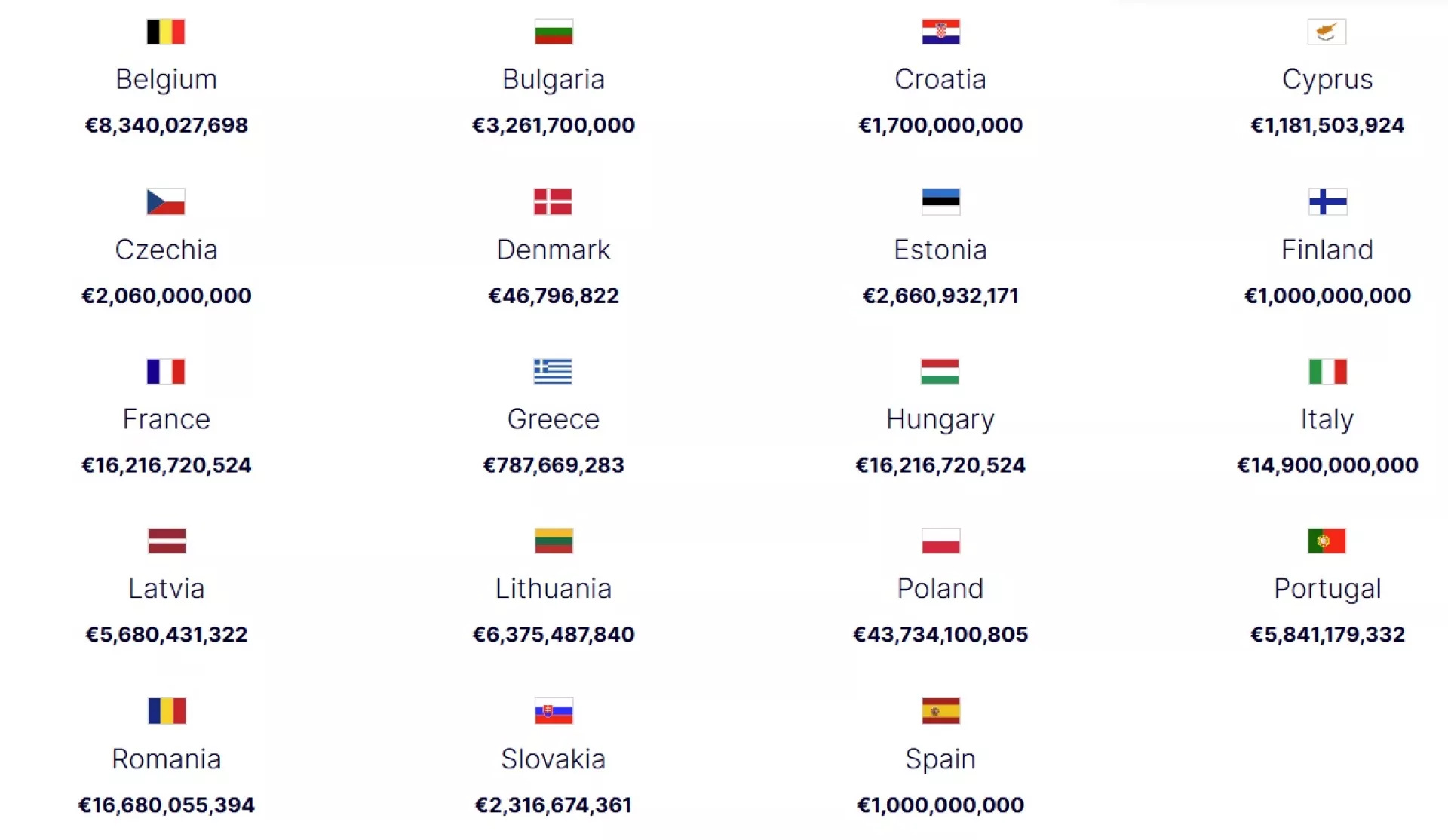
On the EU side of things, discussions about SAFE reached a heated point this week. On Tuesday, EU officials announced the tentative allocation of funds between the 19 EU states expected to receive funding.
Poland will receive the largest amount out of the 19, with the Eastern European country set to receive €43.7 billion out of the fund. Almost as much as the next three largest (France, Italy, Romania) combined. These four represent more than two-thirds of the total amount of the €150 billion fund.
On Friday, EU officials were set to confirm the start of negotiations between the EU and Canada (as well as the UK) however discussions quickly turned towards the current exemptions in place for foreign components.
As of right now projects pursued under SAFE are allowed to contain foreign components up to 35% the estimated cost of the components of the end-product, as set by thr European Commission. This is designed to ensure that the funds are primarily directed at EU companies.
As part of our agreement with the EU, Canada is looking to either receive a much higher exemption or remove this restriction entirely, allowing Canadian companies the same standing as EU companies in joint-procurements.
France though raised the topic to the European Council over the week, aiming to put a 50% cap on foreign components. This would be in place despite any agreement, and set an official ceiling for Canadian involvement in joint procurements.
This issue temporarily delayed the green light for negotiations to begin, however the Council is in favour of starting negotiations, and are looking to push ahead tomorrow and set the stage for the Commission to launch negotiations. The Commission, in turn will provide its staretgy for negotiations on Wednesday and raise the topic of Canadian and British participation in SAFE against the French argument.
Reportedly the French view on this topic is not seen favorably by other EU states. That is just rumored as of this time, however there is a consensus to get things done quickly. The EU has set a deadline of November 30th to submit proposals for funding.
Not knowing the potential exemptions in place makes it difficult for member states to submit their proposals, especially those dealing with British companies. So there is very much a sense of rushing involved here to understand where Canadian and British companies, as well as potentially others like South Korea or Turkey stand.
For Canada the proposal has always been simple. While we don't have access to SAFE funding we would be allowed to partake in Joint Procurement opportunities. Our companies would also be allowed to participate in these opportunities.
However, that also came with an expectation that we would be allowed a fairly high exemption to allow Canadian companies to fairly compete with EU counterparts. Under the 50% rule, Canadian-majority products would be almost completely restricted.
A company like Bombardier, competing for an AEW contract for example, under these rules would only be entitled to a max 50% of the value of the end product to be eligible. That itself might be limiting to what Canadian contribution could be made when you have to start arbitrarily lowering the Canadian value to meet these requirements.
Simialrly, using the recent Cellula-BAE partnership as an example means a company like Cellula, under a similar situation under SAFE, would also be limited to a max of 50% the value of the end-product despite being the primary provider.
This also means certain Canadian companies, like say Roshel, who do have EU operations eould also be far more likely to focus and invest in their European operations over their Canadian operations to ensure they can participate in SAFE procurements.
That isnt to say this is bad, the vast majority if such procurements that Canada takes part in would likely be fine with that 50% rule. Keep in mind also that this does not effect anything that does not include SAFE funding.
So the field of projects this effects are not all encompassing. For example many PESCO projects could remain open so long as they dont fall under SAFE. It does however provide a natural cap to anything Canada wants to procure under SAFE.
That means that Canada, even in Joint Procurements with another state will have to accept that 50% if it goes through, and will have to deal with the fact that it will make most Majoritvely-Canadian solutions either uncompetitive or restricted.
That might not be as serious as I am making it sound, and I want to reiterate that even 50% is probably enough for most projects, especially when we are talking projects with multiple partners, or projects where the primary supplier is not Canadian.
However if your goal is to use this to secure major investment and contracts for Canadian industry? A 50% cap will naturally restrict that effort, or put Canadian companies in a position where investment is directed away from Canadian industry and to EU states.
Again take a case like Roshel, who has already moved a significant chunk of manufacturing south thanks to ongoing Automotive Tariffs, and who now has manufacturing operations in Ukraine and soon Czechia. Without a large Canadian order, or foreign orders that can reasonably be done through their Brampton facility, the company will have little reason to focus on their Canadian operation, especially as they aggressively pursue EU contracts that might fall under SAFE.
It is a tough field to see, and a reason I am hesitant to use SAFE for an discussion. The twrms of which we are allowed to participate are still in discussion, and we have no way of knowing what that final number will be.
That makes it hard to discuss SAFEs role in procurement, or ongoing projects. It is to in the air right now, and to much of an unknown to be a set positive or major factor at this time. I do want to note that I don't expect the 50% to go through. It seems the majority of member states would like to see higher, for good reasons, and I don't see why it would go through given what seems like heavy resistance.
However it is good to acknowledge these discussions, especially as SAFE is a major topic in the Canadian defence community. Ive seen a lot of people who wave off projects because of SAFE, or say its mere existence garuntees an EU advantage.
Certainly it is a discussion point, and many in government are hopeful for it as we look to use defence spending to revitalize the economy. However we should be keen to not treat it like a done deal, nor should we assume that we will get the deal we want.
I also want to make note that I do understand the French mentality here, even if the desire is specifically to maximize French industries opportunities, given they are bound to benefit substantially.
If your goal is to build a European Defence Ecosystem than 50% might seem reasonable for a third-party country. This is an EU fund at the end of the day, meant to support EU member states.
So I get it, and I get why they are adamant here. Even if I don't agree and certainly want to see us have the same status as EU member states.
Food for thought. We will hear more on this in the next few days, and hopefully it will be positive.
Great commentary and very informative, as ever. Capping at 50 or whatever doesnt seem like a very fair game for any Canadian supplier. If the name of the game was to capitalize and generate a NATO resiliency to the NATO wide supply chain under NSPA, why not bring as many NATO suppliers into the supply chain on equal ground. The whole ITB/VP EA in Canada angle is another story... ever though about doing a full commentary on the ITB policy- with all the bruises and in the raw. Maybe a commentary on where it actually sits with all this SAFE talk. Maybe I dont really understand the sense of it all. Thanks again for the post!