


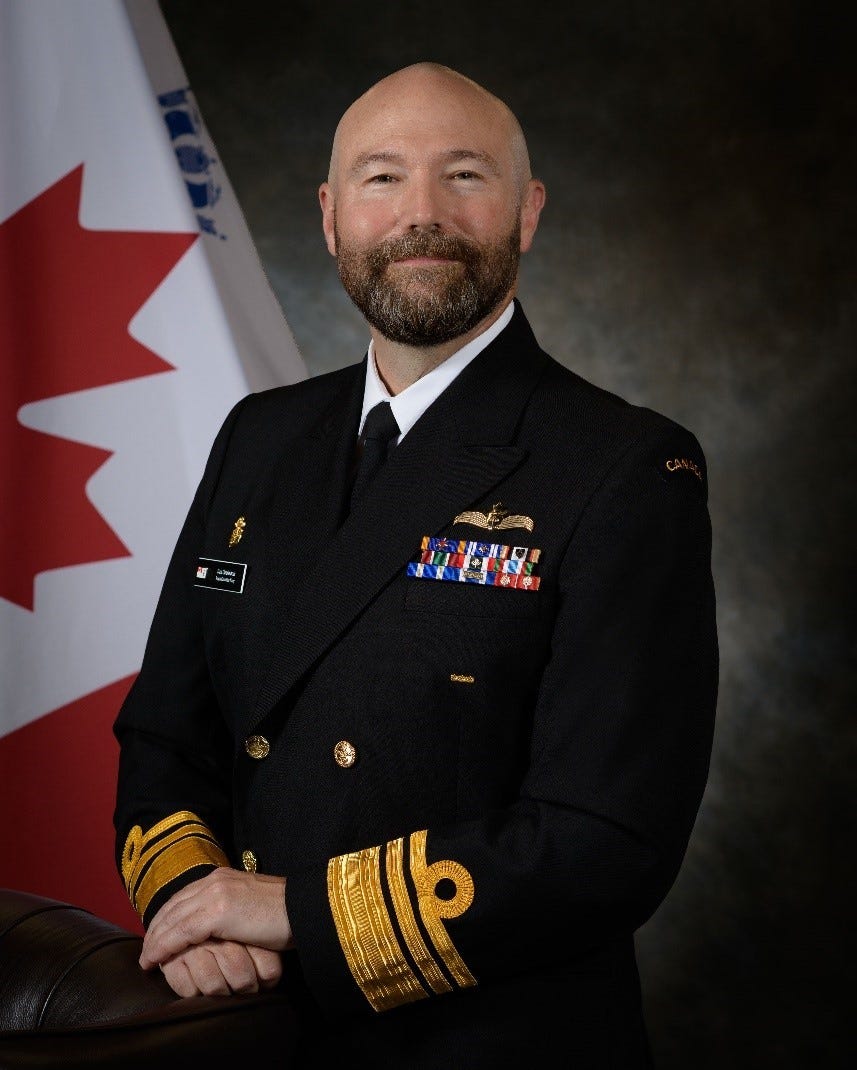
A few weeks ago, I had the opportunity to sit down with Vice-Admiral D.A. Charlebois, Commander of the Royal Canadian Navy, to discuss the future of the fleet, autonomous systems, and his goals going into the next year.
VAdm Charlebois is just over three months in the position, and is coming in at one of the most consequential moments for the Royal Canadian Navy. We are closing in on the end of the AOPVs as a project. We will soon have both of the Protecteur-class in service, and construction has started on the River-class destroyer.
On the opposite end of things, the Navy has finally seen growth for the first time in years, at the same time as the Canadian Coast Guard comes under the DND banner. It is an exciting time for the navy, but not one without challenges. Infrastructure demands, the growing needs of the fleet as we look to rapidly expand the Navy’s fleet, new threats in both the asymmetric and grey-zone domains, and a new defence policy are all looming heavy over everyone.
I am honoured to have been given a chance to sit down with CRCN, and to have these conversations with him. Originally, I planned to do this in the podcast format, I still want to, taking a note out of my senior Joetey at Go Bold and do both. Unfortunately, the audio quality of the recording requires some major work before any sort of release.
So instead I am trying something a bit new. I didn't want a standard interview cutting and working, so I have left as much of the conversation to this as possible, in as raw of a format as I can. That way you can hear everything for yourself, without my extensive editing or cutting down.
That, I feel is in our style and fair to all of you. I also want to capture the spirit of the conversation without which I feel much would be lost. I want to thank the folks at the Royal Canadian Navy, as well as to those of you who assisted on this, for making all of this come together.
I won't ramble on any further than needed. I'll let the Admiral speak for himself.
Gairn: Thank you, Admiral, for taking the time to sit down with me, and congratulations on your appointment as Commander of the Royal Canadian Navy. You’ve been in the job about three months now, coming in from Deputy Commander. What’s surprised you most about taking that leap from Deputy?
Charlebois: Yeah, I think like everything else, Noah, even though I was very close with the previous Commander in my role as Deputy — and you think that as Deputy Commander you of course do have a lot of responsibility — but ultimately, not unlike being the Captain of a ship in the Navy, the buck stops with the Commander. So all of the responsibility rests in this office. That does change my day-to-day.
But to be honest, as far as preparation for becoming the Commander goes: spending a year as Deputy Commander, being really close to Admiral Topshee as we went through some pretty difficult files, and in the midst of delivering new ships and trying to regrow the Navy, I had a front row seat, and I helped to contribute. I have a stake in it. I had a stake in this coming in.
So no excuses for me. Eyes wide open, because I’ve been back with Navy staff for over four years. Before Deputy, of course, I was Chief of Naval Capability. So I have a vested interest in all of this.
Gairn: You’re coming in at a really interesting time. This is probably the largest recapitalization of the Royal Canadian Navy since the DeWolf era, the 1950s and early 1960s. We have so much on the books, whether it’s submarines, training vessels, corvettes, whatever an Arctic Mobile Base is…
And coming from your Director General background, you were very hands-on with all of that. So to start on the general capability side: I’m not so much wondering about what’s currently going on, but what capabilities or platforms do you think are still missing from the discussion? Is there something you think is under-discussed, or that hasn’t been on the table until recently?
Charlebois: As you rightly alluded to, we are undergoing the largest recapitalization since World War II to not long after the war, into the early 50s. And we’re in the midst of delivering the future fleet now.
We’ve taken delivery of all six of our Arctic Offshore Patrol Vessels. Two Joint Support Ships are coming very quickly — later than we wanted, but they’re coming in 2027. Of course, we’ve started to build River-class Destroyers, as you well know, in Halifax with the construction of HMCS Fraser, now almost a year and a half into build.
And very quickly after assuming command of the Navy, I joined our Prime Minister in Halifax for the announcement of TKMS and Germany and Norway as the preferred bidder for the Canadian Patrol Submarine. So a lot of really important capabilities announced and in motion.
And that’s a bit of context to launch into what your real question was, which was: what else? We’ve talked a lot about corvettes. My predecessor talked a bit about Arctic Mobile Base and the ability to have a flexible capability in the North, to support existing and future infrastructure, as an idea.
Corvettes present an interesting capability that nests in between what we have in our Arctic Offshore Patrol Vessels — so an ability to operate in our North for a good portion of the year, about half the year, depending on ice conditions in the season — but in between Arctic Offshore Patrol Vessels and River-class Destroyer.
Of course, as you know, we’re retiring our Maritime Coastal Defence Vessels, so we’re losing some force generation capability there, as well as maritime domain awareness at sea, because those twelve MCDVs carried a pretty heavy burden for about thirty years when it comes to presence at sea and doing operations and training sailors.
Corvettes are interesting. And cards on the table, Noah: this is not something that we have funding for. This is not something that we have policy coverage for. But any Navy — and in my role as Commander — I challenge our team to always look at the capability that we believe we need to deliver on all the things that government asks us to do, whether that’s through government commentary or whether that’s through defence policy like Our North, Strong and Free. And of course we’re expecting a new defence policy in the coming months.
So corvettes is an interesting thing that we are definitely looking at. But if I was to give you where my focus area is and what I think is most important, it is augmenting our patrol and training vessel fleet. You’re familiar with our eight Orca-class patrol and training vessels located on the West Coast of Canada. We use those platforms heavily to train sailors: not just Naval Warfare Officers like myself, but junior operators, technicians, communicators.
These are a workhorse when it comes to training the future Navy that we’re going to need to crew our larger ships. Eight is not a very significant number; they are almost always at sea, very busy. But they don’t just provide training opportunity. That is a primary focus, to be sure, to train sailors and officers, but they also provide a significant presence at sea when it comes to building the picture, maritime domain awareness.
So if I were to give you a priority on what comes next: as you said, we’ve got River-class Destroyer, they are being built. We are in negotiations now for the Canadian Patrol Submarine; that is coming. Joint Support Ships are coming. These things are all coming. But what is not yet on the books is a replacement for our Orca-class. And I’ll fight for additional Orca-class as well, because we know the need is there, both operationally and when it comes to generating more trained sailors and officers.
Gairn: Speaking on that training and educational ecosystem, there’s been a lot of discussion in the last year about Naval Reserve expansion, bringing the Naval Reserve to new communities and broadening the scope of what Naval Reserves do. I’m curious what your picture of the Naval Reserves looks like five, maybe even ten years out, if everything worked out.
Charlebois: Yeah, another really good question, Noah. So I’m going to reach over and pull out my murky crystal ball and look ahead at the five and ten year horizon.
You mentioned our Naval Reserve Divisions. First and foremost, you’re very read in on defence and security and you are savvy on the Navy. And I think what most Canadians would understand, those maybe not as well read on defence and security: the Navy has two main bases on the East Coast and on the West Coast. That’s where all our ships are, and that is the part of our country that sees the Navy on the day-to-day.
If you live in Halifax, or let’s just say in the Maritimes in general, odds are you’ve seen a sailor in the community helping out, or you’ve seen a ship at sea. And the same can be said if you are on the West Coast: if you live in Vancouver, if you live on Vancouver Island, you’ve seen sailors and you’ve seen ships. You’d also know that represents a very small portion of the country.
So a large portion of our population doesn’t get to see a lot of the Navy on the day-to-day, and that’s where our Naval Reserve Divisions really come in. We have twenty-four NRDs that span the country. That’s the footprint today.

Over the last couple of years we have made a pivot, and this is under the leadership of Admiral Topshee. And I was a part of this: expanding, to a pretty good degree, the scope and the responsibility of what we’re asking our Naval Reserve Divisions to do in these parts of Canada that don’t see a lot of Navy. So first and foremost, we ask them to get out in the communities, because we need them to attract Canadians into the Naval Reserve Division so we can give them a career opportunity.
So we’re using our NRDs more and more now to attract and recruit sailors into our Navy. Those twenty-four NRDs are all very busy now doing that, as well as maintaining their own training and generating trained sailors to have opportunities to work within the broader Navy.
So this is a pretty significant change to the traditional mandate of our Naval Reserves. And we identified this as something that we needed to do to change the paradigm when it comes to attracting and recruiting into the Navy. Our friends at Chief of Military Personnel Command, who really own attraction and recruiting for the Canadian Armed Forces writ large, are doing a really good job for the Navy, bringing folks in.
But because the Navy was operating at such a deficit from a people perspective, we knew that the Navy needed to take control of some of it, to help and to augment how many people we’re bringing in. So our NRDs are doing that, and they’re doing very well.
Five to ten years from now, I see our NRD footprint across our country — I’m talking East, West, and even North — expanding. So we’re looking at, I think, about eight locations, starting up in Whitehorse, and then locations really across the country where there’s population centres that have the capacity to help support future growth for the Navy.
So if you look at a city like Kitchener-Waterloo, we now have a small detachment there, and I see in the future that growing, because the population and interest is there to support that. You look at some of the bigger population centres in British Columbia, you look at Moncton, you look at Sydney, Cape Breton: these are all areas that are supportive of the Navy. And we see a real opportunity to put a deeper root into those communities, to help tell the Navy’s story, and to help force generate and personnel generate more sailors for the future fleet.
Gairn: You mentioned Halifax and Esquimalt, the two main naval bases for the Royal Canadian Navy. Your predecessor discussed the potential need for future facilities, and whether those locations had enough capacity to deal with the future fleet. From your perspective, is there room for future facilities across Canada that maybe aren’t tied to the current locations we have?
Charlebois: First and foremost, I think the Navy — and pardon the really bad pun here — you’ll always see the Navy anchored out of Esquimalt in British Columbia, and of course Halifax in Nova Scotia. There’s enough room for future infrastructure growth to support the Navy that we’ll be delivering over the next twenty years.
When you talk about future infrastructure and needs, the Navy, I think like any institution, you’re always reflecting and looking inward on what might be needed in the future. And the one thing that I’ll point out, with the Canadian Coast Guard now coming into the Department of National Defence: the Navy’s always had a very good working relationship with the Coast Guard. We’re all mariners, we operate together at sea. Search and rescue, we’ve done that together for a long time. Of course, now with the Coast Guard as part of the department, they’re starting to participate more in maritime domain awareness, so we’re working together very closely there.
And the Canadian Coast Guard also has a pretty broad portfolio of infrastructure. So what we are looking to do is to expand how much we collaborate and work together, and maybe share infrastructure a little bit. So it could be that you see more Royal Canadian Navy ships using some Coast Guard infrastructure, and vice versa.
We’re going to look to expand that relationship to help support better delivery of operations at sea. As a group, we have a lot of infrastructure around our coastline between the Coast Guard and the Navy. I think we can do probably a better job on how we share and maximize the use of the infrastructure that we have.
Gairn: Speaking of the Coast Guard, Robert Hampton Gray currently has a Coast Guard helicopter embarked. Do you see room for more collaboration like that in the coming years? More day-to-day collaboration, as opposed to one-off exercises or specific operational requirements?
Charlebois: Absolutely, Noah. And you used a phenomenal example of how that collaboration has enhanced just over the last six months. A couple of years ago we would not be talking about embarking a Canadian Coast Guard helicopter in a Royal Canadian Navy vessel. It’s a great example of a relationship enhancing after the Coast Guard has joined the department. The imagery from just the few weeks that they’ve been at sea together, working as a team, has been great.
And if you look at the future, and helping to bring the Coast Guard truly into the department and helping unlock their true potential as a contributor to the defence of our country: we’re talking about secure communications, additional sensors, and training right alongside sailors and officers in the Navy. This is what we’re doing.

So we’re going to support the Coast Guard with our knowledge of defence and security, to make them a better partner in maritime domain awareness and really securing our waters and our sovereignty.
So this is a very positive step. When you talk about the broader defence and security of Canada, we’re talking 240,000 kilometres of coastline, three oceans — and I say four coastlines a lot, because we have to count the St. Lawrence Seaway and the Great Lakes. That’s an area where the Coast Guard is very present.
So we’re going to leverage the Coast Guard in the areas where they are experts in operating, and that is very much the St. Lawrence Seaway, the Great Lakes, and our Arctic. So we are learning as much from the Coast Guard as they’re learning from us. And I think in the future you’re going to see our country a much more secure place, based on that level of collaboration that I’m seeing, that you’re seeing in that imagery and the video from Robert Hampton Gray and the Coast Guard. It is a really good story.
Gairn: Over the last year or two, the Navy’s been really focusing on the experimental at the opposite end of the spectrum. We’re now seeing the AOPVs deploying with an Aerosonde UAS from Canadian UAVS. The Navy’s been undergoing a massive expansion of experimentation and capability development, and when we’re talking about capability development, there are going to be a lot of different avenues to explore.
So from your perspective, what future areas do you see as the priority for the Navy to get into and jump ahead of the curve on?
Charlebois: I mean, we’ve talked about the future fleet that we’re in the midst of delivering and will deliver over the coming decades. My perspective has always been that the defence of our country will demand a fleet mix and a balance of capabilities. And those platforms: some will be crewed and some will be uncrewed.
It’s about striking the balance between how much of each. And as we deliver River-class Destroyer, our Joint Support Ships, future submarines, additional patrol and training craft down the road, you look at capability that can fill some of those gaps.
So working with very smart Canadian industry on uncrewed underwater systems: we’ve been operating as a Navy uncrewed air systems for quite some time. I commanded HMCS Regina between 2013 and 2015, and we operated uncrewed air systems back then, and we were leading in that space.
And of course they stretch your horizon and they expand the range of your sensors, and they help provide better situational awareness. And we’re always looking for ways to enhance our ability to understand the environment in which we want to own, which is Canadian waters.

So working with industry, our defence research folks — super smart in the space of filling capability gaps and trying to do it at pace — we’re looking at larger underwater uncrewed systems, which I think we’ll see rolled out in the early 2030s. Again, building that underwater picture, filling gaps where maybe we don’t have a submarine or a surface ship.
240,000 kilometres of coastline is a lot to cover for a crewed fleet. You’re going to want to have your prime capability, like our submarines once delivered; you’re going to want to have those watching our key approaches. But we have a lot of other coastline that we need to watch. So working with industry and our very smart force development team, we’re always looking at ways to enhance our ability to understand our water space through uncrewed and, in the future, autonomous systems.
Gairn: We’re seeing that push toward autonomous systems and hybrid navies among our allies. At the extreme end, you have the Royal Navy really getting into the hybrid navy concept, looking at timelines of less than a decade to bring about a hybrid fleet. Since you brought up autonomous systems, I’m curious what your concept of an autonomous hybrid navy looks like, because of course you get a lot of different opinions depending on who you ask about what capabilities are set to mature, and what capabilities will be mature within a certain timeframe.
Charlebois: The one thing I would offer, because different navies have different needs, different requirements, different approaches: my perspective is that’s driven by a few things. That’s driven by budgets, that’s driven by available resources, that’s driven by the equipment that you’re operating today and plan to deliver tomorrow.
So if you look at the Royal Navy as an example, they’re a carrier navy. They have two large aircraft carriers. They build task groups around those aircraft carriers, one for the defence of their country, of course, but also to project power in regions of the world where their government wants to go. And they have a very small geographic area.
And I’m not saying it’s not difficult, and not a very sporty area of the world to live and defend, but a smaller piece of geography. I think their approach is great when it comes to hybrid navy. And again, it’s about delivering the right balance of capability between uncrewed, uncrewed autonomous, and crewed surface vessels.
Our situation is, I would suggest, different in Canada. Our geography alone — although a blessing, in that we are blessed with a large country, plentiful resources — also commands a lot of capability when you want to know exactly what’s going on in and around your waters. So my belief is always going to be that we’re going to need a pretty substantial crewed fleet of surface and subsurface capability, being surface ships and submarines. But we do need to lean really heavily into the uncrewed space.
So working with Canadian industry to deliver large uncrewed systems, as we’re doing on the West Coast, I think those are of critical importance, because there are going to be gaps. We do not and will not have enough surface vessels to cover off 240,000 kilometres. We have to prioritize. Ruthless prioritization, I call it. We do this in resource management, and we have to do this with resource allocation when we’re talking about ships and submarines.

So I look at key approaches, key approaches to our Arctic. If you look at right now, we have Robert Hampton Gray and an international task group, which includes a Canadian Coast Guard ship, conducting Operation Nanook, and they are very much in our eastern approaches up to the Arctic region.
We have Max Bernays on Operation Horizon right now in the western approaches to our Arctic. You have the St. Lawrence Seaway, you have the approaches into Vancouver: large approaches, large water spaces, where critical resource corridors exist when you talk about the prosperity of our country. So to me, those are always going to be focus areas for the best capability that our Navy offers.
In the future, that’s going to be River-class Destroyers and the Canadian Patrol Submarine. Today that’s Halifax-class frigates and our Arctic Offshore Patrol Vessels. And in between, in the rest of that great mass of geography, we have to be innovative and use uncrewed where we can to contribute to the defence of the country.
Gairn: Speaking on the Arctic Offshore Patrol Ships, they’ve proven to me to be wonderful modular vessels, playing a real role in building out capability development and experimentation. I’m curious what you think the future looks like for them, because you have these big modular vessels with wonderful, modern facilities on them.
Charlebois: First of all, fifteen years ago some really smart individuals in our country decided that we needed a strategy. We needed a shipbuilding strategy to build and deliver ships. We needed to rebuild our shipbuilding industry in Canada.
And the intent was: let’s build something that we need and don’t currently have, in the Arctic Offshore Patrol Vessel. As you would well know, the Navy has not had a true capability to operate in the Arctic since HMCS Labrador in the 1950s. But let’s also start with something that is not overly complex from a design perspective, because we’re going to build these ships as we build the industry around them.
Of course, they are a commercial spec, and they were designed with margins: areas in which we can grow and add capability through life, like containerized solutions. In our AOPVs which are at sea right now, we have uncrewed systems which we’re trialing, experimenting with, but also using to contribute to maritime domain awareness.
The potential for AOPVs in the future to work with autonomous and containerized solutions, to help enhance our ability to understand what’s happening in the maritime environment around our country, is extremely important.
You see how fast industry is iterating technology. We see it every day and read about it every day in Ukraine: the turnaround time as they’re evolving their autonomous and uncrewed systems that they’re using on the battlefield.
This is the space that we’re trying to get into as a Navy, and AOPVs provide a phenomenal platform to experiment and to trial, to see what works and what doesn’t work. Because, as you rightly pointed out, they’re large ships. They have a large flight deck, a large hangar, they have large cranes. We can plug and play. And we’re going to use these ships in ways that we never, fifteen years ago, thought we would use these ships for.
Initially: okay, we’re going to be able to operate in the Arctic for four or five months a year. That is great, because the Navy hasn’t been there since the 1950s. But we’re also now looking at using these ships in a mine countermeasure role, working with our partners in NATO, because we see the potential. We see that the ships have the capacity and the capability to deliver these uncrewed systems.
And we are one hundred percent going to leverage them for things that we didn’t think we were going to use them for. So you’re going to see AOPVs deploy more frequently with NATO in an MCM role. This is stuff that we’re looking at right now.
Gairn: You alluded to this a little earlier when talking about Canada as a maritime nation, because for Canada, we’re inherently a maritime nation, even though maybe that message doesn’t get out there to everybody.
Charlebois: We’re trying, Noah. We’re trying.
Gairn: Our economy and our way of living are inherently tied to the sea. Somebody once told me that Canada is a very strange place: we’re a large country, but we’re also a nation of choke points, whether it’s the Juan de Fuca, the Cabot Strait, or the St. Lawrence. And we saw that even our own geography, in places like the St. Lawrence during the Second World War, isn’t inherently safe.
So to ask you a more personal question in that regard: in the continental space, what do you think is the biggest challenge and the biggest threat to Canada’s maritime sovereignty?
Charlebois: I always go back to our geography and just our challenge there. My vision for the future Navy is to have Navy capability 24/7 in all key approaches to Canada. Full stop.
Future submarine, River-class Destroyer, and if we are successful in delivering something in between an AOPV and a River-class Destroyer: to have mass in the water. And we’ve seen it play out in real time in the Straits of Hormuz. Mass still matters. Numbers of ships at sea.
Large crewed ships provide, and will always provide, a level of flexibility, redundancy and resiliency. They provide a wide breadth of capability to pivot missions quickly, whether it’s an air defence mission, or whether it’s an anti-submarine warfare mission, or patrolling a large space to build a picture. Crewed platforms deliver that. And we need to have crewed platforms in all of our approaches.
When you look at future challenges, and where I see the areas we need to focus: we are seeing an increased interest in the waters around Canada. So if you look at the Arctic, countries are interested in resources, and we’re seeing increased activity in the North. And as climate change continues to impact the world in which we live, you’re going to see other countries interested in the Arctic, not necessarily in the Canadian Arctic, but in the vicinity of the Canadian Arctic.
And we need to know about them. We need to be able to track and monitor what they’re doing. And if needed, we need to be able to act. And to do all of those things, as I’ve said, drives a navy of a certain size and a certain balance of capabilities. And this is the Navy that we are in the midst of building for our country.
Gairn: Speaking domestically (and if I’m not mistaken, they’re coming up on their third birthday in the next couple of months), the Advanced Naval Capabilities Unit is obviously taking a very big domestic role in how Canada defends itself, and in experimentation. It’s an area of the Navy I don’t think most people know too much about, and it’s not really discussed too much.
I’m curious what you see for the future of the Advanced Naval Capabilities Unit, because they play such a big role now in our domestic defence and in the trialing of experimental platforms.
Charlebois: You kind of hit it on the head there. Again, going back to what we’ve seen real time in conflicts around the world, and the need to rapidly iterate, to test, to trial, see what works, move on quickly from something.
Part of our challenge in the past has always been that you have a big project, and they take a long time to deliver, and maybe once you get something delivered it’s actually not what you need at that moment in time.
The concept with Advanced Naval Capabilities Unit is to be agile, to respond quickly. So trialing different uncrewed systems to see what works, what doesn’t, doing that from shore initially, then going to sea in AOPVs, in Maritime Coastal Defence Vessels, of which we’re still operating some, and our frigates, to see how they work in the maritime environment.
And if it doesn’t work, we don’t need to be wed to these things anymore. In the past, we would have tried to make it work. But we have to be quicker. We have to be more agile. Again, we’re seeing it in real time: get off of what doesn’t work, and iterate what you’re seeing is actually working.

So ANCU has been a force multiplier in a lot of ways. It’s changed our approach on how we do force development and how we deliver new capability. It’s a group of generally pretty young sailors and officers. And most of our best ideas come from our people, junior folks who are very savvy with technology.
They have big ideas, and we just need to enable them as an institution. So that’s the approach we’re trying to take with ANCU: give them the resources they need, and give them the leeway they need to test, to trial, to iterate, to evolve — use what works, discard what doesn’t — so we can get better capability in the hands of our sailors at sea.
Gairn: I want to take a bit of a step back. We’ve been talking about a lot of long-term future development, but this year and next we’re seeing a lot of things happening: the commissioning of HMCS Protector coming up next year, the closing out of the AOPV, trade reforms currently ongoing. So instead of looking at the far future, what are your goals for the Navy over the next year?
Charlebois: Listen, Noah, my number one priority as Commander of the Navy is our people. Our people are one hundred percent our biggest asset. They are the foundation of our service. They provide us decisive advantage in combat because of not only the level of training they get, which is second to none comparatively to other navies, but because folks that join the Royal Canadian Navy do this as a choice.
This is not a service that you get signed up for. This is a decision that you make. And once you’ve made that decision, that shows a level of commitment and dedication. So I owe it to those folks that are signing up to join the Navy to help deliver the tools that they need to do all of the tough jobs that we ask them to do.
So people, and supporting the continued growth of the Navy, is one hundred percent my focus. I’ve said this many times to whoever will listen to me: we can deliver all of the best new capability available on the market — whether that’s Canadian conceived of and delivered autonomous capability, whether that’s submarines or destroyers — and if we don’t have the right number of talented Canadians to crew and operate those systems, it won’t matter.
So people always have to be, in my opinion, the number one priority of any commander. You just need to have good folks. What I will say is that after a concerted effort over the last few years, and you heard me talk about our Naval Reserve Divisions and their role in attracting and recruiting Canadians into the Navy, I see us turning a corner.
For the first time in my memory, and I’ve been in the Navy for thirty-four years, our Navy increased in size over the last year. And we are on a good trajectory. We cannot take our foot off the gas for a single second. We will have to continue to invest in our people, attraction, recruiting, retention, through what is a very, very nice compensation and benefit package that was announced last year. All of this is helping on our retention efforts. But we can’t take our eye off the prize, not even for a second.
We have some really, really big events coming up. Of course, we have Robert Hampton Gray conducting Operation Nanook now, and it will be up in our Arctic for the next couple of months, on its way to its new home port in Victoria, where it will join Max Bernays as our second AOPV stationed out of Esquimalt. And that’s really important, Noah, because the West Coast, they’re not seeing as much of the new ship love as the East Coast is.
So we’re building these AOPVs in Irving, and every ship is a little bit better than the last, which is exactly what you want to see in a shipbuilding program. You want to see consistent improvement, ship over ship, class over class. And we’re seeing that at ISI in Halifax, which is great.
But the West Coast has received one new ship, while we see all of the AOPVs on the East Coast. So having a second AOPV will be great for the morale of our West Coast sailors, but it’ll also give another operational platform to Commander MARPAC to do all of the important business that needs to be done on our West Coast.
And of course, as you said, 2027’s a huge year. We’re going to take delivery of HMCS Protector. We are going to launch HMCS Preserver this December. So there is a lot of goodness coming down the pipe, right towards the Navy. I can tell you that we’re ready for it. We’re excited for what’s to come.
Not to say that there’s not a body of work to go with that, but we’re ready and we’re all aligned, and I think we’re on the same page to deliver a much stronger Navy for the future.
Again, I would like to thank the Royal Canadian Navy and the many people who helped put this together. This wouldn’t have happened without your dedication. I will try to sit down with VAdm Charlebois again in the new year, where hopefully we have both a new Fleet Mix and Defence Policy to go over!
And that’s why TNSR is the best. Great interview Noah. Vice-Admiral D.A. Charlebois makes a strong first impression.
Great score. Love to see these kind of interviews - intelligent, insightful, but not too complicated for us non-military types. Gives me some hope for our navy's future.