


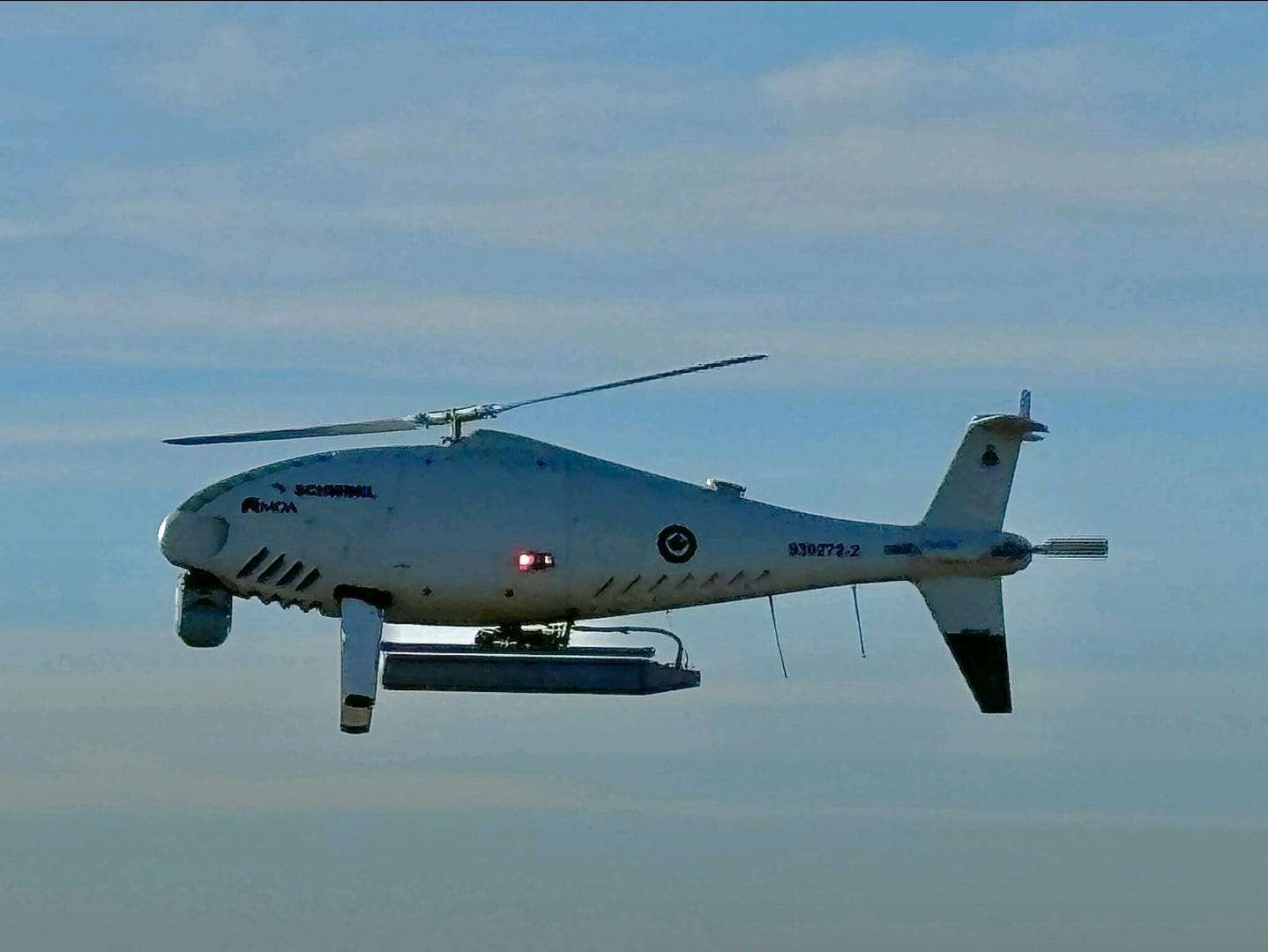
MDA decided to show off a new image of thr S-100 yesterday in its expected configuration for RCN ISTAR. While not confirmed directly, I have been told that the present version we see will be the configuration we are likely getting for the Royal Canadian Navy.
Of course the S-100 (To be known as the CU-179) could just as easily swap payloads around, one of the great things about the platform being its wide use has allowed dozens of different sensors and payloads to already be integrated. However we are likely to see them in this base configuration more than anything.
This isnt the first time we've seen this configuration, however MDA has been very frugal on releasing images of the CU-179. They are a rare treat, one that doesnt come often so when we do get them I think its worth the showing off.
Besides that I had to talk about the platform again anyways. A lot of you asked me questions about the platform and acquisition, and since almost no other media can even tell you what platform was chosen, that task falls on to me (yes im still a bit salty about how the news was handled)
Given the value of the platform, amd the capabilities it brings, I think its fair to be curious. I kinda knew I would need to do a small followup, because truthfully at the time I still didnt know some exacts I knew people would ask. So, let me answer a few of the most asked questions I got about the platform.
Q1. Is the S-100 actually what we're getting?
Yes. Despite people saying we don't know, or speculating, the platform we are getting is the S-100 from Schiebel. It will be designated the CU-179 in service. I dont know if they have a name for it yet.
Q2. Will they be manufactured here?
As far as I know? No. They will be manufactured at Schiebels plant in Wiener Neustadt. They will be fitted and maintained here though.
Q3. Why the S-100 over a Canadian solution?
That is a question for the people who made the final call. However, its best to note that the S-100 is in widespread service across NATO and among our allies. It is a proven platform that has operated everywhere from the Middle East to the High North, with hundreds in service.
It is a platform already integrated with a number of sensors, systems and capabilities, one that is continuing to expand in the roles its able to perform. Its a platform that continues to revieve new orders and experimentation, such as the recent decisions by the European Defence Agency (EDA) to use the S-100 to fulfill the heavy-lift requirements of the Cross-Domain Logistics Programme.
Basically it's interoperable, proven, and a platform already receiving a lot of support and investment. It will be equipped with Canadian sensors and systems, maintained in Canada, and serviced by Canadians.
This should also speak to the fact MDA brought together a top-notch team, including Arcfield, UVAD, IMSAR and Wescam. That is already a very impressive roster for a project like this.
Q4. When will we see the S-100 on the Halifax? Will we see it elsewhere?
IOC is for 2027. That's the plan. The funny thing here is that we're likely to see the CU-179 on the AOPS before the Halifax its destined for. The AOPS, for all its great features, is also the Navies premier test platform lol. Its likely we will see them tested out on the AOPS first before the move on to the Halifax.
One of the many great things about the AOPS. ANYWAYS the Dewolfes have their own UAS project. Thats going through the process right now. The JSS will also have their own UAS, though that one will have a logistics focus. I spoke about these projects more in the original contract award post, amd if you follow the newsletter you'll know were currently tracking the AOPS UAS.
Q5. What are the capabilities of the NSP-5?
Great question! The NSP-5 is a high-performance, multi-mode, and multi-domain airborne radar system designed for intelligence, surveillance, and reconnaissance (ISR) missions. It is primarily designed for Group 3-4 unmanned aerial platforms and various manned aircraft.
The standard configuration has a diameter of 5.4 inches (13.7 cm), a length of 44.5 inches (113 cm), and a weight of 16.5 lbs (7.5 kg). It operates on the Ku frequency band. The system is compliant with MIL-STD-810G for a range of environmental factors, including temperature, rain, humidity, vibration, and shock, ensuring reliability in harsh operational settings.
the NSP-5 delivers powerful provides high-resolution SAR imaging, with resolutions ranging from 0.3 meters to 1 meter, and boasts a substantial SAR collection rate of over 2,000 square nautical miles per hour when operating at 80 knots. Its MTI mode can detect targets with a minimum velocity of 4 knots over vast distances, with a maximum range of 140 nautical miles (259 km).
For more specific tasks, its Ground Moving Target Indicator (GMTI) mode has a detection and tracking range of 16 nautical miles (30 km), while its Inverse Synthetic Aperture Radar (ISAR) mode for maritime classification is effective up to 39 nautical miles (73 km). Available in variants like the NSP-5(S) and NSP-5(X), it offers specialized modes such as Coherent and Non-Coherent Change Detection, as well as tracking for both vehicles and ground personnel (dismounts).
Combined with the WESCAM MX-8, as MDA has done, the CU-179 becomes a very potent platform for the RCN, providing them a persistent, Over-the-Horizon ISTAR capability out past 250km. That is a capability we haven't had before, and one I know many are excited for.
That isnt to also say that new combinations and capabilities cant be attempted. The wonders of a platform like this where swapping payloads is built into the design, comparative to something like V-Bat. I expect we will see a lot of experimentation once the navy gets their hands on it. I can already feel the ideas probably running in Topshees head!
Q6. Will we see more S-100 in the future?
Maybe. I expect the options to be exercised quickly. Beyond that? I think theres a lot of potential. The RCN is slowly building up a very capable UAS fleet, combining smaller platforms like we will see on the AOPS, a potent mid-sized platform like the S-100, and a larger platform that we will likely see for the JSS UAS.
This isnt to also disregard the UAS currently in service, such as the Teal 2 or Puma, both of which are currently operating with the RCN, and will also play a future role along with these new platforms.
Its actually very impressive what the navy is doing with unmanned systems. Theyre building up a large roster of varying, complimentary UAS, we have the Underwater Enviornmental Assessment project looking as XLUUV, Hammerhead testing, and Topshee forever teasing me about larger MUSV/LUSV.
I like unmanned systems. I admit that. So these topics always make me a bit giddy, and in happy the navy seems to be taking the leap to try and be at the forefront, especislly when we have so many great, Caandian companies working to develop solutions like these.
Im curious how people feel about small Q&A like this for when these new platforms come into service. I usually get lots of questions, but never enough to do large pieces. Are people fine with these smaller, quick-fire posts? Do you guys like them? Let me know!
Efficient, 100% agreement w/DM.
Agree, like this compact format.