


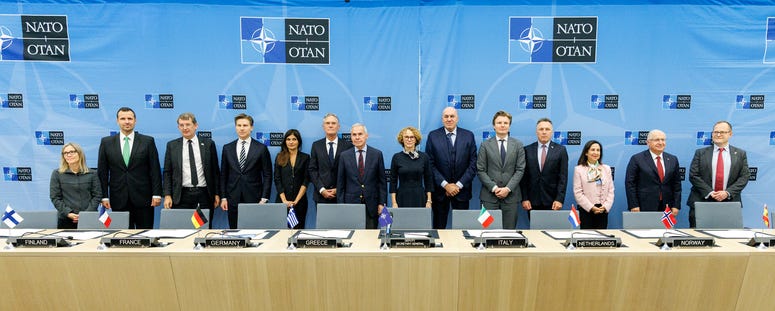
On Wednesday (15 October), 13 Allies (Canada, Czechia, Denmark, Finland, France, Germany, Greece, Italy, Netherlands, Norway, Spain, Türkiye and the United Kingdom) agreed to initiate the development of a multinational simulated training capability.
The Distributed Synthetic Training High Visibility Project (HVP) aims to respond to the ever-growing demand for multinational military training in a cost-effective way. The project will leverage existing national simulated training capabilities to create a secure network of advanced and immersive virtual training for multinational purposes.
Once available, the capability will make multinational cross-domain training more accessible and less expensive, and significantly reduce the lead time to plan and execute exercises.
At a signing ceremony held at NATO Headquarters on the margins of the NATO Defence Ministers’ meeting, Deputy Secretary General Radmila Shekerinska noted that “the project will prepare our troops for the dynamic and dangerous environment that we find ourselves in” and that “it will help ensure we have the forces and warfighting readiness needed to defend the Alliance.”
Multinational initiatives like the Distributed Synthetic Training High-Visibility Project also help maximise the use of capabilities available across the Alliance and beyond. The project is open to participation from NATO’s Indo-Pacific Partners.
Participating Allies and partner countries will work together with the NATO Support and Procurement Agency (NSPA) on the implementation of the project, including the establishment of a market place to match nations’ training needs and opportunities.
Noah Note: Leveraging each other's existing infrastructure, especially for things like training, is a very good thing to see. I find that a lot of similar NATO programs tend to go unnoticed or are quickly forgotten in the rush of things.
NATO Flying Training in Canada (NFTC) and its cousin NATO Flight Training Europe (NFTE) are both examples of similar programs designed to leverage available assets to quickly support NATO's ability to accredit and train pilots across the alliance.
Expanding this kind of cooperation to other initiatives is a good thing, and I'm happy to see us take an active role in it. We also committed, along with other NATO partners, in June to the joint acquisition, storage, transportation, and management of stockpiles of defence-critical raw materials, including through recycling existing products.
These kinds of things don't get a lot of love. They rarely get a media mention, at the very least; however, they form the backbone of a lot of our international agreements regarding defence with allies.
I hope we get to see a lot more of these with the government's focus on Strategic Partnerships and Joint Procurements.
I will be happy see other NATO forces using Suffield
“I hope we get to see a lot more of these with the government's focus on Strategic Partnerships and Joint Procurements.”
As do I, especially democratic allied coalitions of any sort, that do not include the US. This isn’t an anti-US stance. It’s become obvious that western democracies need to distance themselves from an unreliable and disruptive “ally” if they wish to flourish. History has proven over and over that a strong team is far superiour to a one-man-show.