



The room that became the home of the new Plan Qulliq (PQ) Innovation Lab holds a long history of supporting the Royal Canadian Air Force (RCAF) in various aerospace and telecommunications engineering capabilities. Over time, it evolved into a shared storage and overflow space—a quiet corner of the wing awaiting its next mission. To the RCAF Innovation Team, this room represented a rare opportunity: a blank canvas with the flexibility to be thoughtfully reimagined for a new era of innovation.
The road from idea to execution can sometimes be slow and winding, so the PQ team, led by Lieutenant-Colonel (LCol) Diane Baldasaro, decided to operate on a different timeline. They didn’t wait for a perfect grand plan to get moving. Instead, they embraced an agile mindset: start small, move fast, and deliver a Minimum Viable Product (MVP) that members could use.
It was a simple vision: to turn an available space into a modern makerspace where hidden RCAF innovators would finally have a home. The transition happened in a blur. Starting in October 2025 the dust was cleared, the walls received a fresh coat of paint, and new flooring was laid. The room was quickly filled with 3D printers, a soldering station, non-networked laptops, and even a sewing machine.
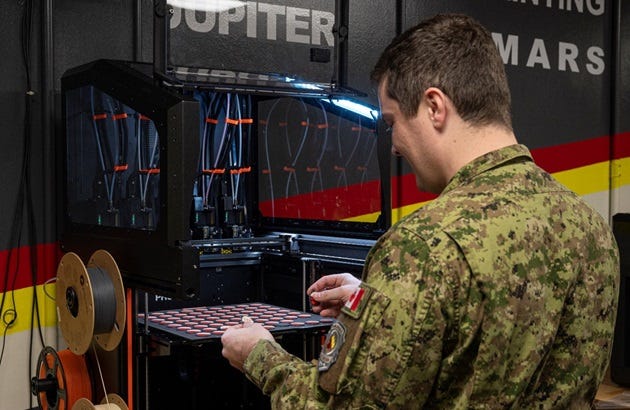
MCpl Mackenzie Birch unloads a project from the Prusa XL 3D printer in the Plan Qulliq Innovation Lab at CFB Trenton.
Photo: Aviator Julia Macleod, Imagery Technician, 8 Operations Support Squadron.
“We didn’t wait for a perfect plan; we saw an opportunity and went for it,” says Sergeant Erik Niemi, one of the lab directors. “The goal was to minimize the barriers to entry. We wanted a space where an aviator could walk in with an idea and start creating the same day.”
The lab officially opened its doors on February 25, 2026. Its rapid stand-up was made possible by the collaborative spirit at Aerospace and Telecommunications Engineering Supporting Squadron (ATESS) where the lab is co-located. ATESS Commanding Officer, LCol Barry Tang and his team shared the vision that an available room held the potential for immense good. By working together, PQ and ATESS focused on the needs of the Defence Team, proving change can happen when prioritized.
The result is a sandbox for creative solutions. It is a place where failure is embraced as a necessary step in the learning process. “We aim to demonstrate that accelerating an innovative culture is possible when we act with agility and intentionally unlock the value within our people,” says LCol Baldasaro.
While this lab, located at Canadian Forces Base Trenton, is a victory on its own, PQ isn’t stopping there. This space is more than just a room – it’s a blueprint. As an MVP, this lab allows PQ to test which equipment works best, what training is most effective, and how members interact with the space. The value realized here will be used to refine the makerspace model as PQ aims to scale this concept across all RCAF wings from coast to coast.
This is good. This is real good. This is the kind of innovative thinking that the CAF needs to thrive and find new solutions old and new problems. There is no way we can import the mentality of the Ukraine Army, but we can try to immitate the agility they have adapted to survive in our own way. Some may write this off as geeks playing with expensive toys at the government's expense, but if the CAF is serious about implementing ground up change to how things are procured, we need to allow the people in the CAF to tinker and try things, and give them an avenue to get those things in front of the people that matter. I'm a little skeptical of Aduril and they tech bro vibes, but their idea of getting prototypes in the hands of grunts, and iterating based of their feed back in real time, rather than arranging formal trials that take forever, and are really prone to being molded to the pet theories and ideas of the people in charge of the assessments... There is real value in that. It's no way to design a tank, or an airplane, but it is a much better way to design and refine items of everyday kit and equipment. And as the abilities of those who have access to these kind of maker spaces level up, either through experience or attracting more and more talent, I bet they can move on to larger systems like drones and similar game changers. This is genuinely exciting! I hope they are successful, and the template is applied elsewhere. I have a feeling that it really will depend on having leaders in place with the right aptitudes and interests... We will see!
I have no issues with innovation, and especially at the bottom of the hierarchy.
But this article, produced by the enormously expensive public affairs clag of DND, is virtually meaningless. It wasn't even evident until half way through the article where the lab was located. No examples of innovation were given. I was left with the impression that it took from October to February to clear the space and paint it. Perhaps half of the CF's PA folks should be remustered to combat arms to fill shortages there. I doubt the military would be affected negatively.