


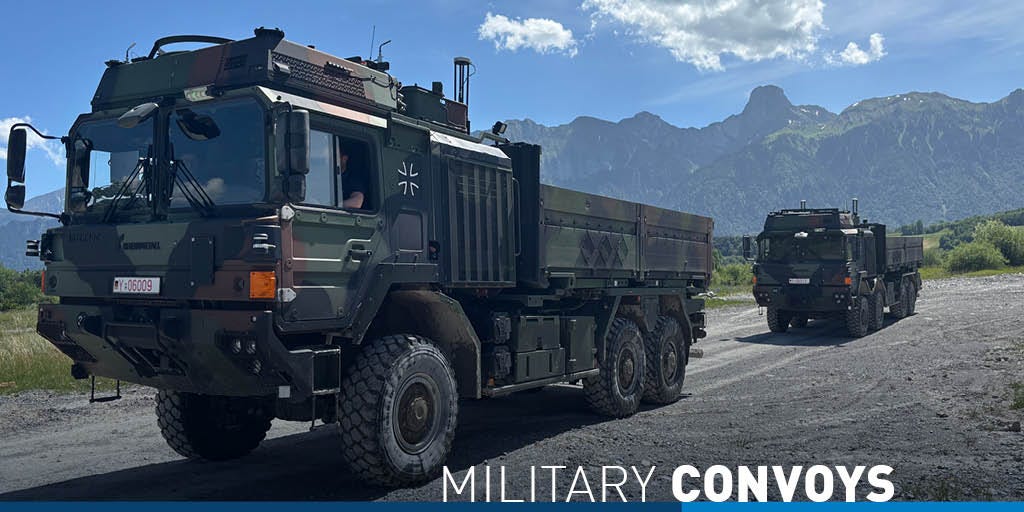
Rheinmetall has been commissioned by the BAAINBw to take full responsibility for the InterRoC VII autonomous convoy research project.
Rheinmetall was handed responsibility for the research project immediately before they won first place in the ‘Convoy Scenarios’ competition at ELROB 2026
Focus of the project: cross-manufacturing, secure and autonomous cooperation between different vehicle platforms under real military conditions
Rheinmetall MAN Military Vehicles GmbH has taken over full responsibility for the InterRoC VII (Interoperable Robotic Convoy VII) research project on behalf of the Federal Office of Bundeswehr Equipment, Information Technology and In-Service Support (BAAINBw). With this project, Rheinmetall is further expanding its leading role in the development of highly automated military logistics systems and setting another milestone on the path towards the digitalisation of military mobility.
Project responsibility was taken on shortly before Rheinmetall secured top ranking in the ‘Convoy Scenarios’ category at the 2026 European Land Robot Trial (ELROB) at the Thun military training area in Switzerland. This international testing event is regarded as Europe’s most important demonstration platform for unmanned ground systems and autonomous robotics under realistic military operational conditions. There, Rheinmetall demonstrated the capabilities of its autonomous logistics solutions in challenging convoy and transport scenarios.
Further development of interoperable convoys
InterRoC VII is the latest addition to the successful Interoperable Robotic Convoy (InterRoC) research series. The project aims to further develop highly automated convoy control and to test interoperable vehicle formations in which different vehicle platforms operate safely and autonomously together.
The focus is on efficient automation, perception and decision-making functions, as well as robust route planning for heterogeneous vehicle formations. These technologies must ensure reliable and safe convoy management even under demanding military operational conditions.
The HX vehicle family serves as the technological basis
For InterRoC VII, Rheinmetall MAN Military Vehicles is based on vehicles from the proven HX family. These military logistics vehicles are equipped with Rheinmetall’s modular PATH sensor kit and a ‘drive-by-wire kit’, which is fully integrated into the vehicle architecture.
The open system architecture enables the continuous integration of additional sensors, AI-based software functions and mission-specific algorithms. This creates a scalable autonomy platform that can be adapted flexibly to future requirements and new operational scenarios.
Autonomy even without satellite navigation
The systems developed as part of the research project build on Rheinmetall’s long-standing research and development work in the field of autonomous land vehicles. The company already possesses technologies that enable automated driving functions in real military conditions, both on the road and off-road.
A key technological focus is on the ability to operate safely even in so-called GNSS-denied environments. Even if satellite-based navigation fails or is interrupted, the vehicles can reliably map their surroundings, determine their position and conduct complex convoy operations autonomously. This capability provides decisive operational benefit, particularly in electronically contested operational environments.
Demonstration during ELROB 2026
The capabilities showcased at ELROB 2026 are being incorporated directly into the InterRoC VII research project. The Thun event provided an opportunity to demonstrate autonomous convoy management, sensor fusion, and decision-making algorithms under realistic conditions, and to further develop them in collaboration with international armed forces, research institutions and industry partners. The findings form an important basis for the next stages of development within the research project.
Contribution to the digitalisation of military logistics
With InterRoC VII, Rheinmetall is underlining its position as a leading global supplier of autonomous military logistics systems. Automating logistics transportation tasks increases the efficiency and sustainability of military supply chains, while reducing the risks to personnel in the field. The research project therefore significantly contributes to the digitalisation of the battlefield and to the development of the next generation of networked military mobility solutions for the Bundeswehr.
Future cooperation with technology specialists – AI as the key to expanding capabilities
As a specialist software and AI provider in the field of object classification and environmental awareness, Driveblocks GmbH plays a key role. The company develops modular autonomy and perception systems that combine sensor fusion of camera and LiDAR data with AI-based models. The aim is to achieve robust, real-time mapping of complex 3D environments, including object classification, open space and terrain recognition, and safety-critical decision support. This technology is specifically designed for challenging off-road conditions, such as unstructured terrain, vegetation, dust, snow, and changing visibility, and is already being used in applications across the defence, construction, and agriculture sectors.
Noah Note: Typically I wouldn't post about foreign news here, policy and whatnot, but this is a wee bit different given the context. Rheinmetall’s autonomy front is built off Canadian-developed, Canadian-supported software with the PATH kits.
The autonomy conversation is inherently Canadian, built off Canadian architecture and Canadian employees. So whenever there is a win like this, where we get to see it applied in cool ways, I always wanna make a little note to highlight it and give it some proper loving.
The Canadian Army actually has similar, albeit smaller plans to try similar, taking a Zetros or something similar and trying to see what the PATH kit can do. Isn't the first, won't be the last, but still really interesting to see that we're attempting it either way. Its important to take these incremental steps at times.
Someone once told me the greatest ideas cone from the first experiments, where you get a taste for what you can do. I hope that philosophy carries here, and in other places. There is room for innovation if you try to take it.
Any article highlighting Canadian IP, tech etcetera is a great thing to cover and gives us the knowledge that reliable trusted allies incorporate same into their programmes.
Noah, thanks for this. It's surely adding to your workload, but if it is feasible, I think there's a lot of value to noting/highlighting Canadian roles in foreign militaries' programs and this coverage would find a receptive audience.