


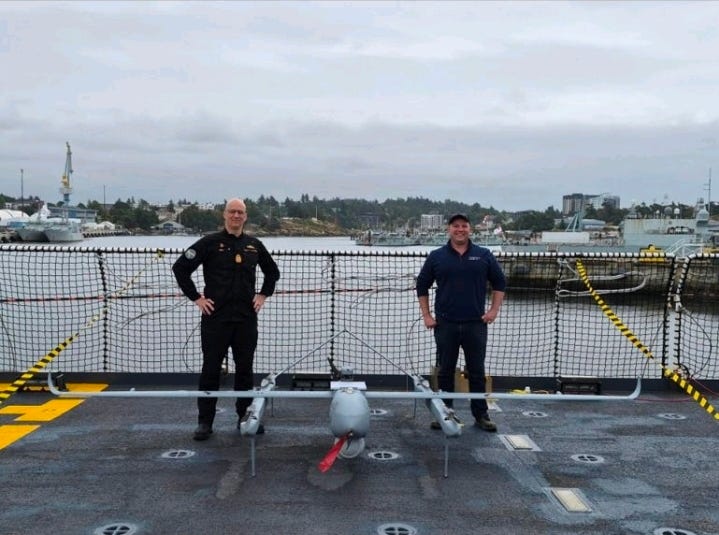
The Royal Canadian Navy today shared the first photos of their leased Textron Aerosonde UAS aboard the HMCS Max Bernays.
TNSR was the first to report of the contract with Canadian UAVS back in June when the company was awarded a $2,103,102 contract to provide, operate and sustain for the duration of operations a mature maritime uncrewed aircraft system capability in support of an RCN Arctic Offshore Patrol Ship operation.
The Royal Canadian Navy provided the Following statement and accompanying image regarding the deployment:
A major milestone for the Royal Canadian Navy 's uncrewed aviation program.
In early July, HMCS Max Bernays departed for Operation LATITUDE 2026 with a Textron Aerosonde Beyond Visual Line of Sight (BVLOS) Uncrewed Aerial System (UAS) embarked, marking the first deployment of its kind in support of the operation.
This proof-of-concept reflects the collaboration between the Royal Canadian Navy, ADM(Mat), Director Joint Robotics and Autonomous Systems, industry partners and the airworthiness community to advance shipborne uncrewed aviation capabilities.
The deployment will help evaluate how UAS can support maritime operations in Canada's North while generating valuable insights to inform future capabilities, including the upcoming at-sea testing of the CU179 Peregrine.
A great example of innovation, collaboration and delivering modern capabilities to the fleet.
Sean Greenwood, Founder and President of Canadian UAVS provided the following statement regarding the deployment to TNSR:
"HMCS Max Bernays sailing with an embarked BVLOS UAS isn't a concept slide - it's Canadian industry and the CAF delivering real capability in the North, right now. Canadian UAVs is honoured to operate at the sharp end of the RCN's uncrewed aviation program."
The 4.7 variant of the Textron Aerosonde here has a roughly 4-metre wingspan, carrying up to about 9 kg of payload. EO/IR is standard, but Textron advertises over 40 potential payloads available. Textron these days advertises the 4.7 with 12-plus hour endurance depending on fuel and payload trade—it varies a lot. The 4.7 cruises at 45–65 knots with a line-of-sight datalink out to about 140 km and SATCOM options for beyond that.
As mentioned, this serves as a preliminary trial before we see the future CU179 Peregrine come online. The Schiebel S-100 was selected last year as part of the RCN ISTAR project to provide the Halifax-class with a long-Range, Persistent ISR capability. While destined for the Halifax, the Peregrine will first find themselves on the AOPV, as is likely for most incoming Autonomous and Uncrewed Systems, the AOPV will serve as the primary point of introduction and trialing.
It is a role they perform exceptionally well, and one that they need more and more experience on, hence the current lease. This is a much needed capability to demonstrate on the AOPV, one that they will only get incrementally, but is still important in building knowledge bases, best practices, and further conceptualizing UAS operations.
I for one welcome it, and am very happy to see it. Hopefully it won't be the last.
I think it's a good addition to the AOP's, but does not replace a helicopter for versatility. DND should buy a small fleet of Bell 429's (Same as the CCG) for domestic ops with the AOP's. Having the helicopter and the UAS would add a lot of potentiel to the ship.
READY, AYE READY…!!!!
I fucking LOVE the Canadian navy..!! RCN all the way…!!!!