

Maritime security in the North Atlantic and the Arctic was the focus of the first ministerial meeting on the Maritime Security Partnership. In Halifax, Germany, Canada, and Norway agreed to further cooperation on the U212CD submarine cooperation project.
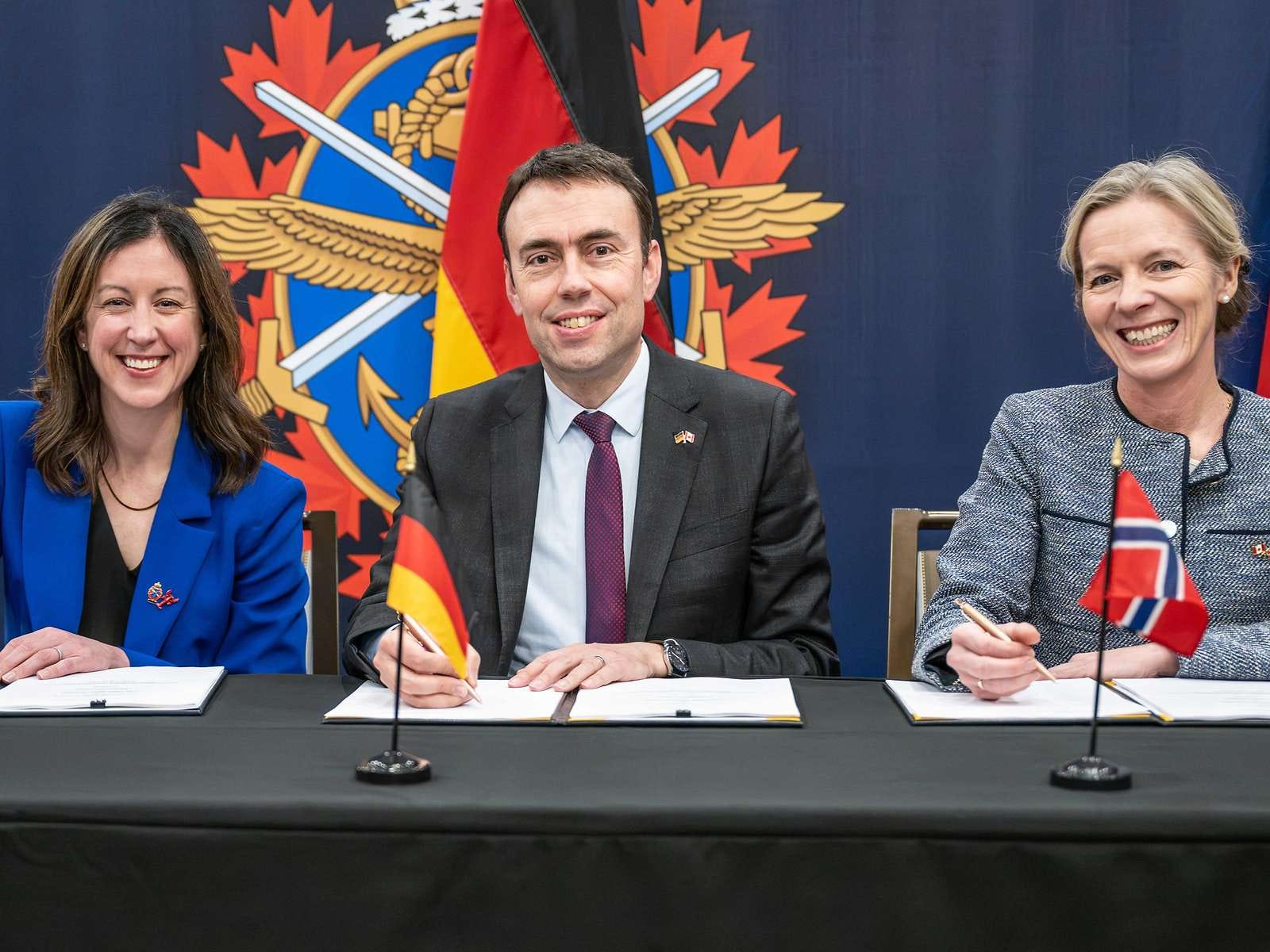
Parliamentary State Secretary Nils Schmid, representing Defense Minister Boris Pistorius, attended the first ministerial meeting of the Maritime Security Partnership (MSP) in Halifax on November 20, 2026. Together with Canadian Deputy Defense Minister Christiane Fox and Norwegian State Secretary Marten Gerhardsen, he signed a Memorandum of Understanding (MoU) on trilateral submarine cooperation for the U212CD class. This forms the basis for further cooperation between the three countries.
Together for greater security in the Far North
The Maritime Security Partnership (MSP) was initiated in 2024 by Canada, Germany, and Norway. Denmark joined the MSP in 2025, and Iceland in 2026. Its aim is to strengthen maritime cooperation in the North Atlantic and adjacent Arctic regions. This includes a shared situational awareness strategy, the exchange of intelligence data, anti-submarine warfare, the protection of critical underwater infrastructure, and joint training and exercises. In this way, the alliance enhances its ability to respond to threats in the High North.
Canada’s decision to participate in the German-Norwegian submarine cooperation stems from the country’s need to modernize its submarine fleet and enable its use in Arctic conditions. Canada had initiated the procurement of conventionally powered, ice-capable submarines and in 2026 opted for the Type 212CD – a submarine type that Germany and Norway will also jointly procure. This joint defense project will facilitate cooperation in operation, training, and maintenance, and strengthen the interoperability of the three navies. Germany and Norway will each procure six submarines of this type.
Deterrence and defense capabilities for the High North
The German Armed Forces are continuously improving their capabilities for operational conditions in the North Atlantic and the Arctic. This includes, for example, the procurement of submarines and frigates, as well as the new P-8A Poseidon maritime patrol aircraft. These aircraft can monitor large sea areas, provide data for a maritime situational awareness picture, and detect and combat submarines. Iceland is also important for Germany’s commitment: the two countries have agreed on closer military cooperation. Plans include the use of Icelandic port and logistics infrastructure, as well as Keflavík Air Base, for German naval units and the maritime patrol aircraft.
Germany also participates in NATO activities and multinational exercises in the High North. The NATO activity Arctic Sentry, launched in 2026, consolidates and coordinates NATO’s engagement in the region to strengthen its presence and situational awareness. Exercises such as Cold Response, Steadfast Defender, and Arctic Defender demonstrate cooperation with allies under challenging conditions. In this way, Germany, together with its European partners and Canada, is assuming greater responsibility for security in the North Atlantic.
Security situation in the Far North
The security situation in the region is increasingly tense. Russia has intensified its military activities in the Arctic, including the expansion of military infrastructure and the testing of new weapons systems. At the same time, China’s interest in energy, raw materials, and sea lanes in the region is growing. Secure sea lanes, reliable intelligence, and the protection of critical infrastructure are therefore important tasks for NATO and its partners.
Noah Note: This is a German Release, not a Canadian one. We did get a twitter post about it, but not an official presser on the agreement. I make that distinction known as it is an important one. Anywho, consider this another in the road towards a final strategic agreement between Canada, Norway and Germany.
Canada and Norway sre working towards are own Strategic Partnership, while we also work to try and secure a sub deal within the next few months. Obviously, there is still wotk to be done. I don't think anyone is getting their 2026 signing tnat was desired. That is esepcially true as TKMS attempts to get firmer commitments on tweove submarines.
That was also in the news a bit today, and I make the distinction again that it is a very serious target for the GERNOR side to see twelve commited too. I can't speak to what eight looks like on the economic side, we would lose things, but to what extent I can't say. I hear it would be dissapointing from several people, but that’s about it.
There is still obviously hope for something to come through, the pathway is still very much open and running well. Negotiations are still progressing smoothly on a number of issues. We'll just have to wait and see. Obviously, I want the whole twelve myself but that decision is for the Prime Minister to make.
What if 12 submarines but X number of this variant?
I can see the concern over technology changing prior to the last boats ever being started but just make a choice, cancel Alto and buy the subs.