


LUV…
I have been exploiting LUV for easy content since forever. I have tried to steer away, have tried to moce on and yet it keeps dragging me back.
Originally, I was just going to post my original thread on here and call it a day but, given new information has come out, and I'm no longer bound to twitters limits, why not take the time to update my original post?
So….
What is LUV?
The Light Utility Vehicle project (LUV) aims to replace the CAF's fleet of G-Wagons and Chevrolet Milverados that entered service back in the early 2000s. The project has been in the works since 2017, with a few delays during COVID.


The project is divided into three tiers: a Light Utility Vehicle to replace the G-Wagon, a Commercial-Off-The-Shelf vehicle to replace the Milverado, and panel vans.
The Mercedes-Benz G-Wagon, introduced to Canadian forces in the early 2000s, was procured as a Light Utility Vehicle, Wheeled (LUVW) to replace the aging fleet of Iltis vehicles. The G-Wagon offered superior off-road capabilities, enhanced protection, and versatility for a range of missions, from reconnaissance to convoy escort. Its procurement aimed to improve mobility and safety for Canadian soldiers, especially in rugged and unpredictable terrains.
Conversely, the Milverado, a militarized version of the Chevrolet Silverado, entered service to provide a reliable, heavy-duty logistics and utility vehicle. Selected for its robustness and adaptability, the Milverado supports transport, maintenance, and supply chain functions essential for both domestic operations and international deployments.
LUV is currently awaiting an RFP to drop in 2025, with a contract award currently expected in 2026
For the sake of this thread, though, we will be focusing on the two top tiers of LUV.

By the numbers, the project aims to acquire between 1900-2300 vehicles divided between 1500-1850 Light Utility Vehicles and 400-450 COTS vehicles. Along with this, LUV also intends to procure somewhere between 300-500 trailers.
Breaking down a bit further, four variants of the Light Utility Vehicle are expected to be procured: Command and Recce (C&R), Utility Vehicle, Military Police (MP), and Cable-Laying Vehicle.
I won't go into every requirement for LUV, though I will break down a few: maintain a cruising speed of at least 100 km/h, 600 KM range, must be able to be armored STANAG I/II Ballistic and Blast protection, and additional requirements for vehicles including add-on armor.

This is the basic info you need to know to understand what LUV is, what LUV wants to procure, and what is expected of potential candidates. Of course, if you are curious about all the requirements, I highly recommend exploring the RFI!
https://canadabuys.canada.ca/en/tender-opportunities/tender-notice/pw-blc-003-28678
Now that we know what LUV is, we can explore the suppliers that have qualified to submit to the RFP.
So who made the cut?
This was obviously a very big competition, with dozens of potential competitors narrowed down to just four candidates:
• AM General
• Armatec
• Oshkosh
• Roshel
We will be going over my speculation of what each bid MIGHT be, taking into account that there is some information we must speculate on. It's hard to stress just how competitive this was, especially with heavy favorites.


The ones who didn't make it
I try not to speculate on the ones who didn't make it. LUV had at the least a dozen entrants to the project, many of them fairly big names in the industry.
Supacat, GDLS, Thales, GM… All major companies whom didn't make the cut for one reason or another.
Comparatively, LUV went in quite the wild projection from what I myself was expecting. If we want to understand that more though, we need to look at another project.


The Next-Generation Fighting Vehicle (NGFV) is a CANSOFCOM project that aims to procure between 55 and 75 armored vehicles to replace the services fleet of HMMWV.
The three qualified suppliers were released in 2023:
• Oshkosh JLTV
• Thales Hawkei
• GDLS Eagle V
An RFP was supposed to be released last year, although has been delayed without an indication as to when it will be released.
In theory, both projects have similar needs for a similar vehicle, and yet only one, Oshkosh, managed to pull out and qualify for LUV.
The Hawkei, in turn, was at one point a heavy favorite, lightweight, decently armored, a matured design that fit all the requirements and had much hype in testing. It had its kinks, especially in the baraking department, but the Hawkei and Thales had worked to overcome those issues.
Another similar case is the GM LUV. While coming late to the project, Ala the Roshel Senator, the GM LUV offered what can best be described as more of the same.
Offering a new modernized version of the Milverado that has been valiantly serving the last twenty years, the GM LUV featured several new upgrades and features to bring the Milverado into the modern day.
Already in service, with a factory in Oshawa ready to produce, the GM LUV on paper seemed to offer a simple, one-to-one replacement, yet did not make it through the wider competition.
Why is that? Likely, GM does not have an upper tier vehicle to offer in the competition, a hindrance to a competition that originally wanted one common chassis to replace both fleets.
Along with that, one must ask a question that LUV has been circling since the beginning, what do we truly want? I'll talk more of that after though.
For the Hawkei and Eagle we can only speculate. Perhaps they did not perform as well in testing as hoped? Or maybe the platforms did not fit with the envisioned design the CAF had set out.
Either way, the competition has proven tough right out the gate, narrowing over a dozen companies down to a measly four.
For simplicity sake, we will be going over each competitor in Alphabetical order, using that info we have to speculate on what they could bring to LUV. We start with
AM General
AM General is the first name on the list, and one that's well positioned to capitalize on both tiers of LUV. AM has two potential offers that could fit the requirements for the upper tier of LUV, the JLTV A2 or the Humvee Saber.

The JLTV A2 is the second generation of the Joint Light Tactical Vehicle and features several improvements, including a more efficient Duramax engine, a new transmission for better fuel efficiency, enhanced corrosion protection, and a single lithium-ion battery.
AM General won the contract to produce the JLTV A2, valued at up to $8.66 billion, after a competitive process designed to ensure the best value for the U.S. Army and its allies.
The competition for the JLTV A2 contract was intense, with AM General and Oshkosh Defense as the primary contenders. Oshkosh initially secured the contract in 2015, producing the JLTV line under a $6.7 billion low-rate initial production contract, which transitioned to full-rate production in 2019. However, the Army retained the JLTV technical data package, allowing for a recompete to potentially reduce costs and enhance capabilities with a new contractor
Production of the JLTV A2 has experienced delays, pushing the initial delivery by six months. These delays are attributed to challenges in starting a new production line, transitioning from the previous vendor Oshkosh Defense, and sourcing directed parts and intellectual property. Additionally, AM General faced issues with tooling and part qualification.
Despite these setbacks, production is still slated for next year, and should not effect a possible contract under LUV, which isn't scheduled to be awarded until 2026.

The Humvee Saber, on the other hand, is a modern redesign of the classic Humvee based on the 13 chassis. The Saber features several upgrades and redesigns, though shares ~70% commonality with the original Humvee. The Saber includes a new 205 hp 6.5 L engine, 4-speed electronically controlled transmission, and is fitted with semi-active suspension. The big draw of the Saber, though, is its new upgraded survivability suite, including a new W-shaped hull, blast seats, a floating floor, and 360-degree kinetic protection.
Either of these are likely to be paired with the AM Chieftain to complement the lower tier of LUV.


The AM General Chieftain is a highly versatile and rugged tactical vehicle designed to meet the demands of modern military and security operations. Marketed as an Extreme Tactical Security Vehicle (ETSV), the Chieftain features a robust armoured crew cell capable of accommodating four personnel. It offers significant payload capacity, despite the additional weight of the armour and other tactical enhancements.
Powered by a 4.5-litre Cummins turbocharged diesel engine paired with a 6-speed Allison transmission, the Chieftain offers both 4x4 and 4x2 driving capabilities, with the added flexibility of high and low range through a transfer box. The vehicle's off-road capability is bolstered by locking differentials on both axles, making it adept at handling challenging terrains. Its operational range is validated from -32°C to +57.7°C, demonstrating its reliability in extreme climates
Before we continue, though, I wish to bring up the issue of the JLTV, which I will get into further with Oshkosh.
As of right now, AM has yet to take over production of the JLTV. Given that LUV's timeline stretches into next year, though, it is entirely possible that AM has offered the JLTV A2 with the expectation that production will be running before LUV is awarded. This leaves us with the pairing of the JLTVA2 and the Chieftain as AM's LUV offer.
If however, the JLTV A2 is not available AM General still has the Saber to fall back on although personally, I feel the Saber is lacking compared to the other options presented here.
This isn't me disregarsing it mind you, the Saber seems like a highly capable platform on paper. Yet LUV is confusing, and very open-ended in achieving its outcomes
This sadly means though that the playing field for vehicles like the Saber can often be stacked against it.
EDIT (10/8/24): I have come to remmeber that AM General actually has a THIRD option for a potential LUV submission. I apologize for this late addition and have decided to add it here.


The Bastion is a Protected Mobility Vehicle based off the VLRA 2 TDN-TDE chassis and manufactured by Arquus, recently acquired by the crazy people at John Cockerill.
It weighs around 12 tons and can carry a payload of up to 2.5 tons, which includes up to 10 fully equipped soldiers in addition to the driver. The vehicle is powered by a 5.0-liter V8 turbo diesel engine, which allows it to reach speeds of up to 110 km/hr, and has a very impressive operational range of around 1,000 kilometers.
The Bastion features a monocoque body with a v-shaped hull offering up to STANAG IIb protection, along with ballistic protection up to IIIa (Though with base STANAG I)
Since 2018 AM General has produced the Bastion under license. This agreement allows AM General to manufacture the vehicle in the United States, originally for the US Army, though recently the company delivered three such vehicles to Kosovo in 2021.
I don't expect the Bastion to be the offer here, both for the fact I still believe JLTV will make the cut, and Saber competed much more heavily for the second place spot behind it.
Bastion isn't used by any NATO/5E partner, nor is AM overly promoting of the vehicle. It isn't very common outside Africa and would be a strange offering compared to the Saber, which inherits the established legacy of the Humvee, as well as a much more integrated supply chain within both the Canada and among our NATO/5E partners.
Saber is still an updated Humvee at the end of the day, a vehicle already known to the CAF thanks to the small number of Humvee in service with CANSOFCOM, which are also due for replacement!
It is just so unlikely to me that Bastion would somehow outedge the Saber, which still meets all the requirements set out by LUV.
As far as I know AM is still licensing the Bastion, which makes it a potential LUV contender even if highly unlikely.
Now though, we move on to our weirdest entrant.
Armatec Survivability
Armatec Survivability is a bit of a surprise. Mostly because my knowledge of Armatec is extremely limited, and what we know about them in terms of LUV is absolutely nothing. Of course, that doesn't mean we can't give them a highlight!
Armatec is based out of Dorchester, Ontario. They specialize in enhancing vehicle survivability and crew protection. Since its founding in 1997, Armatec has provided the CAF with protective seating for vehicles such as the Bison and Leopard 1 as well as survivability testing.
Now, in terms of LUV, this one is a bit of a toss-up. I really can't give a concrete here on exacts.
Given their background, it is likely that they will be offering an uparmored vehicle based on a civilian chassis.
G-Wagon has been said, and that could be an interesting option of the CAF is open to modernizing the G-Wagon
Sadly though, we just can't say until they come out with more info. I like to believe they must be offering something interesting to make it this far in such a heavy competition.
Others might be able to help out a bit more on this! For now, though, it remains a bit of a wildcard.
Oshkosh
Now we get to the confusing part, the thing that leaves a bit to be rattling around. Let's get to the points we know thoufh
Oshkosh is likely to be offering the JLTV. While Oshkosh has lost out on the US side of things, that doesn't mean they're out of the race.

Designed to replace the aging fleet of High Mobility Multipurpose Wheeled Vehicles (HMMWVs), the JLTV traces back to a 2006 initiative by the U.S. Department of Defense to develop a more robust vehicle that could withstand modern battlefield threats. The JLTV is powered by a General Motors Duramax V8 engine, producing 340 horsepower, paired with an Allison 2500SP six-speed automatic transmission.
The JLTV's advanced suspension system, known as the TAK-4i independent suspension, offers superior ride quality and stability, allowing it to traverse rugged landscapes with ease. Internally, the JLTV is equipped with state-of-the-art electronic systems, including integrated C4ISR (Command, Control, Communications, Computers, Intelligence, Surveillance, and Reconnaissance) capabilities, providing soldiers with real-time data and enhanced situational awareness. Additionally, the vehicle features modular armor kits that can be adapted to different threat levels, offering maximum protection against ballistic and explosive threats.
The JLTV has been exported to several U.S. allied nations, including the United Kingdom, Lithuania, and Slovenia, ensuring interoperability with U.S. Forces.
The Elephant in the room
As mentioned before, AM General succeeded in unseating Oshkosh Defense, securing an $8.66 billion contract to produce 20,682 JLTVs and 9,833 trailers.
This competition was part of a strategic plan by the U.S. Army to leverage advancements in technology and ensure the JLTV's future upgradability. Oshkosh, which originally won the JLTV contract in 2015, had been the incumbent producer, manufacturing nearly 19,000 JLTVs for the U.S. military and several allied nations. Despite their extensive experience and established infrastructure, Oshkosh's bid was ultimately unsuccessful in this follow-on competition
Oshkosh expressed disappointment over the loss, emphasizing their experience and the best-in-class upgrades they proposed. They even filed a protest with the Government Accountability Office (GAO), arguing that AM General lacked the necessary manufacturing experience and supplier relationships. However, the GAO denied Oshkosh's protest, affirming the Army's decision to select AM General for the new contract
There are mixed messages about the future of Oshkosh production of the JLTV. Although domestic production of the JLTV will conclude in early 2025, Oshkosh anticipates continuing opportunities to supply JLTVs to foreign allies through direct commercial sales.
This of course leads to the very confusing situation of both AM General and Oshkosh offering the JLTV for LUV…
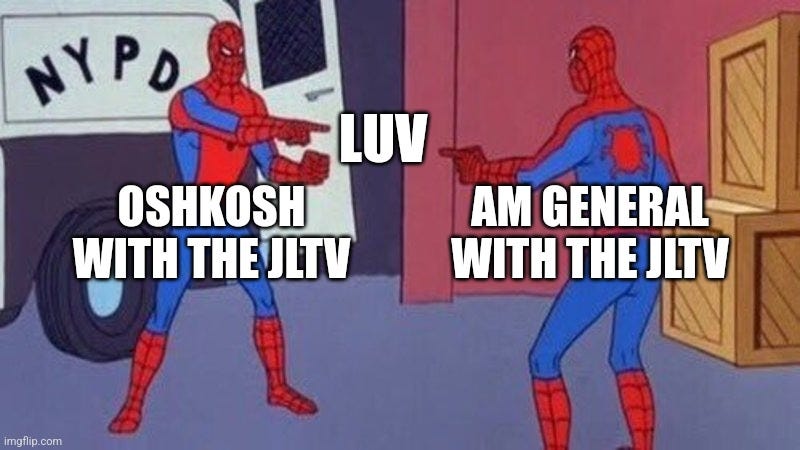
Needless to say, thats a bit of a mess. Similarly, I can't say ehat Oshkosh plans for the lower tier of LUV. They themselves do not have anything that meets the kind of vehicle the CAF might be looking for.
Roshel
What can I say about Roshel that I haven't said before? It is the messiah that the cult is built around, the one thing everyone agrees they want.


I have talked a lot about Roshel, at least three times a week these days, and through no fault of my own, amd seperate from any bias, it's the supplier with the supplier with the most interesting potentials to offer, but to know them, we gotta talk about some history.
Who is Roshel?
Roshel - Smart Armored Vehicles, headquartered in Brampton, Ontario, is the golden child of the Canadian military industrial complex.
Specializing in the design and manufacturing of advanced armored solutions, Roshel's reputation for innovation and reliability is underscored by its premier product, the Roshel Senator.
Based on the Ford F-550 chassis, the Senator family has gained a reputation, particularly for its deployment in the war in Ukraine.
The Roshel Senator has become a pivotal asset in Ukraine, where it has seen extensive use in various roles and organizations. The vehicle's robust design has made it a favourite among the AFU, with over 1,100 units produced and delivered.
This production figure highlights the Senator's role as one of the most frequently utilized Western armored vehicles in the region, reflecting both its effectiveness and the high demand for such vehicles in ongoing conflict situations. The company's production capacity has reached 140 vehicles per month.
The Senator series includes four main variants, each designed to meet different operational needs:
• Senator APC
• Senator ERV
• Senator MRAP
• Senator Pickup
A bit confusing? That's understandable. Roshel isn't known for their naming practices, and the common use of the Senator name often leads to confusion.
Despite being based off the same chassis, the Senator family offers a wide range of vehicles that is growing year by year with several new variants, such as the Super Senator and Senator 8x8 in the works.
To help you easily understand, here is a chart to help you identify some of the key differences, along with some easy nicknames to remember them by.
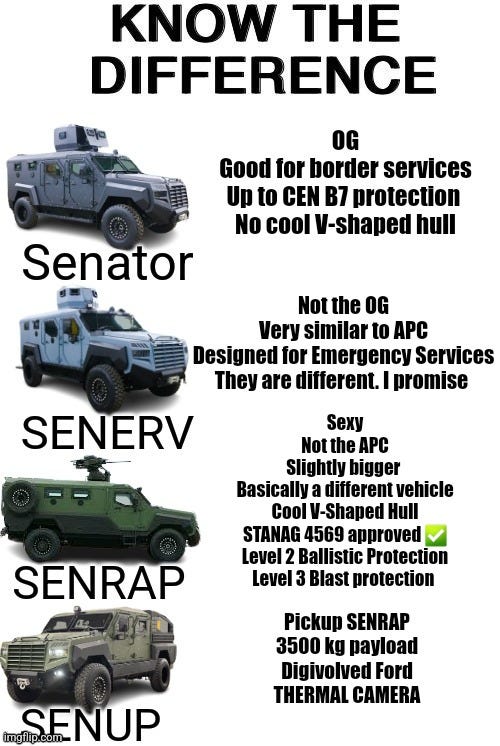
Makes sense? I hope so! Because now we get to the interesting part. What exactly will Roshel offer?

The SENRAP is a Protected Mobility Vehicle designed for high-threat environments.
Powered by a 6.7-liter V8 turbo diesel engine, the hull of the SENRAP is constructed from high-hardness ballistic steel and features V-shaped chassis to effectively deflect blasts away from the vehicle.
The SENRAP is rated for STANAG Level IIIA blast protection and Level IIB ballistic protection, providing protection against Anti-Tank mines up to 8kg.
The SENRAP is designed to carry up to 10 occupants. Its modular design allows for various configurations and adaptations based on mission requirements, further increasing its utility in diverse operational scenarios making it ideal for military and peacekeeping operations.
I talk about the SENRAP a lot, so I won't go to deep into it. The real interesting part is in the lower tier of the competition.
Roshel is the only company here with the capability to meet all three tiers of the LUV competition. My original assumption was that thr Senator APC, or a new version of the SENUP would be offered.
Then Roshel went ahead and began speaking of the SENLUV.


Thr SENLUV is a mysterious variant of the Senator first discussed in the lead up to CANSEC 2024. The SENLUV is widely speculated to be a new variant of the Senator family and was supposed to appear at CANSEC 2024.
Yet it didn't, and its been silent ever since…
I've speculated a lot on what the SENLUV might be. It does not fit the bill for any of the current versions of the Senator and is unlikely to be a rebranding given the info we know.
My belief still stand that it will be a refresh of the GEN-I APC, which has slowly been replaced by the GEN-II variant that falls more in line with the SENRAP in design.
I still stand by that, and still think that it will end up being Roshels lower tier offering.
But there is another, more interesting option at play…
Enter Babcock
Babcock International Group is a British multinational corporation specializing in engineering support services. Founded in 1891, the company provides critical infrastructure support for both military and civilian sectors, including naval ships, submarines, and land-based defense systems. Babcock also offers services in aviation, nuclear energy, and rail transportation.
Why are they important you ask? Babcock and Roshel have entered into two significant agreements aimed at supporting LUV.
The first is a teaming agreement where Babcock will provide in-service support to Roshel's proposal. This collaboration is designed to leverage Babcock's extensive experience in maintenance, repair, and logistics to enhance the capabilities of Roshel’s armored vehicles, ensuring they meet the specific needs of the Canadian military.
The second is a Memorandum of Understanding (MOU) to explore further opportunities for supporting the CAF and other government agencies.
At first, these agreements seem to the point and easy to move on from, until a couple days ago.
On July 30th, Babcock released their annual report. While usually I would give only a glance to these things, there was a certain part where speaking of Roshel that caught my eye
“This relationship provides us with the potential to build our civilian armoured vehicle (CAV) in Canada and support the Government of Canada, and address export opportunities in the North American defence and security market.”
Interesting statement to me, and one that made me think. If Roshel was merely offering a rebranded GEN-I why be so secret of it? Why hype it up and then not deliver? Is the APC, already so similar to the MRAP, the right way to go?
Enter the GLV


The Babcock General Logistics Vehicle (GLV) is a Light Utility Vehicle built on the robust Toyota Land Cruiser 70 series chassis, the GLV incorporates significant enhancements to cater to various mission requirements. It features a powerful 2.8-liter diesel engine, an automatic gearbox, and a specially designed military body that prioritizes crew safety and comfort.
The GLV is designed for modularity, making it adaptable for the evolving battlefield. Its design facilitates the integration of various communications and signal technologies, positioning it as a crucial component within an integrated C4ISTAR system. Additionally, the vehicle's payload capabilities allow for defensive upgrades, such as missile and UAV countermeasures, without compromising mobility.
The GLV family offers multiple variants to meet diverse mission requirements. The two primary variants are the long wheelbase and the medium wheelbase models. The long wheelbase version is designed for extensive missions, providing substantial cargo space and flexibility for different military roles.
The medium wheelbase variant, introduced at Eurosatory 2024, focuses on enhanced mobility and is ideal for command and control or small team patrols. It features a tighter turning circle, greater ground clearance, and improved approach angles, making it highly effective in rugged terrains.
Baseless speculation on my part? Absolutely, but it's a fun idea, and an interesting one that I can't just ignore when talking about this.
It also isn't Roshel's first time playing with the 70 chassis. While Roshel currently offered civilian uparmoring of thr Land Cruiser 70 chassis, the company at one point offered their oqn militarized variant, the Partisan


Do I think its gonna happen? No, not likely, but it provides a nice alternative to the Senator family in the lower tier, one thats highly flexible, highly customizable and something that the comoany has experience with.
My thoughts
Coming to the end of our analysis, I want to ask this question again. What do we want out of this?
No one can quite decide what a Light Utility Vehicle should be. The definitions are often vague and more and more we see the lines between LUV, PMV and MRAP blurred.
Should it be armoured? Is it armoured enough? Is it to big? Is STANAG II armor enough or is it a waste for a vehicle of this class?
I've heard it all the last few months, and its a question we should be asking more.
What role does a Light Utility Vehicle need to play these days? The days of Afghanistan are over, and the war in Ukraine shows how quickly the landscape has changed.
What future do they have to play in a future with a drone around every tree? Is what we're preparing for enough?
It's a headache, to say the least, and a debate I feel will be constantly being had.
To that point, the competition to me is set.
JLTV VS. Senator
There is no situation where I feel this isn't what happened, mostly because it's likely that three of the four vehicles will be one of these two!
Each offers a few distinct advantages. The JLTV has slowly matured grom several of its early issues. It is widely used by our closest ally, the United States, has gained traction with further allies in NATO and has evolved into a modular platform able to meet a variety of missions, from CUAS to strapping a God damn Mk.41 to it.
Thr JLTV, unlike the Senator is also a military platform, as opposed to the Senator's modified Civilian chassis.
While the Senator has proven itself capable, we do need to talk about the lengths that chassis could go, along with the weaknesses it brings.
On the other hand, the Senator is a Made-in-Canada vehicle that, unlike many in this competition has been put through hell. The Senator is cheap as well, coming in at ~325,000USD on average.
Roshel has also shown capable of producing a significant amount of Senators quickly, with 140 produced per months and plans to rapidly expand on several fronts both domestic and international.
The Senator is highly modular and Roshel, as shown through its work in Ukraine, is able to quickly and effective innovate and create solutions when problems arise.
Then we have the new Ford advantage

On July 18, Ford announced its plan to start producing F-Series Super Duty pickup trucks at its Oakville Assembly Complex beginning in the summer of 2026.
This move is part of a $3 billion investment, with $2.3 billion allocated for installing assembly and integrated stamping operations at the Oakville plant.
This expansion aims to meet the high demand for Super Duty trucks and will initially create approximately 1,800 jobs in Oakville, with an additional 150 jobs at the Windsor Engine Complex, which will produce V8 engines for these trucks
Having a local source of chassis a mere twenty minutes away is a huge advantage to Roshel in terms of both supporting Canadian industry as well as streamlining their supply chain.
This will allow Roshel not only to further expand production but have a local source for parts and services available near next door.
I plan to do a wider post between the Senator and JLTV in the future, but for now the competition seems set, and I have my belief firmly set on who I think will win.
Typical Canadian military bean counters 1 chassis to be all do all, so our troops end up with a weak armoured vehicle or a over engineered over priced pick-up truck. Maybe they can strap a 120mm gun on it and call it a Leopard 3 variant. This how we have ended up with crap vehicles in the past. How about just buy a good armoured vehicle and a seperate good pick-up truck, two contracts, the best of each.