


We got an interesting article from yesterday. The Hill Times had a chance to sit down with German Ambassador to Canada Matthias Lüttenberg regarding the current status of the Canadian Patrol Submarine Project.
We do hear from others, but the primary focus here is on the German side of things—a rare perspective that we don’t get nearly as frequently as the Koreans, who would tell you what they ate for breakfast if they could!
One thing I feel is that you get this sense of surprise, almost cautious in a way, when you hear Mr. Lüttenberg speak on the project. The timelines are now speeding up, there are a lot of new things being thrown around, and there is a renewed focus on the economic over the capability.
Certainly, there isn’t a sense of worry, but we tend to assume that—especially on the government side—people are well in advance of expectations and developments.
You don’t usually get that, and certainly, I don’t feel that with CPSP. You get a sense the Germans especially were taken aback a bit by how fast everything moved, and how priorities started to shift from a traditional procurement to Canada looking to form a strategic partnership.
Now, keep in mind that surprise here isn’t a bad thing for TKMS. I would argue that this shift has actually helped them a bit. We’ll get to that in a second.
On a quick note, I like the AUKUS analogy, and I’m sad I didn’t think of it myself. It’s a good way to look at things—and look at how Canada is approaching this. Murray and the CBC also had an article out yesterday discussing how CPSP could lead to further cooperation in other fields, like unmanned systems.
On that note, there are a few things that piqued my interest in all this. One was the increasing Norwegian presence in these discussions. For a long time, the Norwegians haven’t been an active voice in CPSP, despite the perceived partnership.
They’re around, but barely. I’m starting to hear them take a much more active and outgoing role as things heat up—no doubt trying to bolster the identity of this partnership.
Hard to call it a trilateral partnership when one of those partners barely speaks! I jest, but it is something of note. The GERNOR side (as I will now be referring to them as) has taken a much different approach to their advertising compared to Team One Korea, and I think it’s important to highlight it.
I’ve had a chance to speak briefly with some people at TKMS about the project and have been lucky enough to receive some material. TKMS is a very quiet company. They aren’t outgoing, don’t like to talk to folks like me, and keep their advertising to a minimum.
That isn’t a bad thing—it just means that sometimes it can be hard to gauge their thoughts and plans. It was something that certainly affected my work, given how active Hanwha and the Koreans are.
However, now that I have the material handy, I can see a bit more clearly how this shift in how the project is discussed has invigorated the GERNOR side.
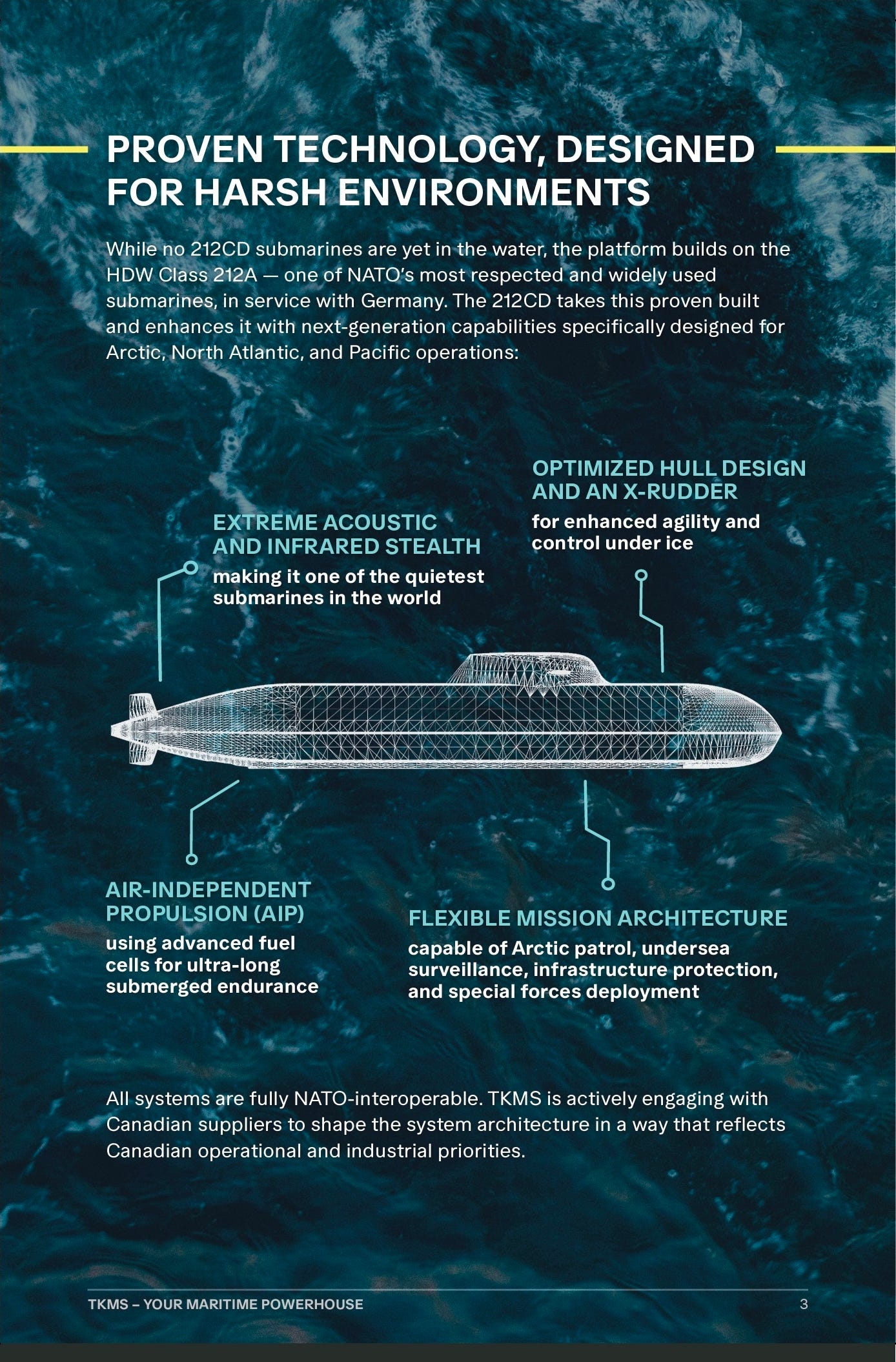
The Powerhouse under the Sea
Every document, every file, every discussion I’ve had has all revolved around one concept, and that is the chance for Canada to be “part of the family,” so to speak. I don’t want to merely use the word partnership, as it doesn’t really capture what TKMS truly says to me.
TKMS has built their offer off two concepts:
Their History
The Strategic Partnership Opportunities
There is obviously merit to the historical side of things. TKMS has almost two hundred years of history in the construction of submarines, dating back to the construction of the Brandtaucher by Schweffel & Howaldt in 1850. If you’re ever in Dresden, you can actually visit the Brandtaucher at the Bundeswehr Military History Museum!
The current lineage of submarines comes from the 1960s with the Type 201 and larger Type 205s. The Type 209 would be the company’s breakout platform for export, marking them as NATO, and the world’s, premier supplier of diesel-electric submarines.
Germany, Norway, Italy, Portugal, Turkey, Greece… Across NATO, TKMS remains the undisputed largest supplier of submarines, and despite some setbacks in places like the Netherlands, the company still maintains its crown.
So obviously they’ll play into this history. It is a storied one beyond almost anyone else, even with the obvious gaps in their submarine production after both World Wars. These facts are glaringly obvious at first glance, which in turn also means that people tend to dismiss it.
I don’t like to dismiss history. History builds a track record. It builds confidence. One can’t deny that TKMS maintains that historical advantage when it comes to delivery and export.
I tell people often that I have little reason to question if TKMS could, for example, deliver maintenance facilities here, or effectively provide in-service support.
They have that track record, across multiple countries where they supported domestic production. Of course, those were in partnership with large, already established yards in both Korea and Turkey. There have been failures, such as with Hellenic Shipyard.
It’s why I don’t support this concept of building the subs here, which is another thing that Jens Plötner, State Secretary for Armaments, Innovation and Cyber, threw out last week. There is too much risk and too little time for some things.
I did want to acknowledge this though, because TKMS also does acknowledge this. I completely forgot about it when writing my “Let’s Talk,” but TKMS actively raises these points in their own brochures about the project.

I thought my post on the topic, despite my reiteration that I wasn’t speaking on TKMS themselves, still bagged on them a bit and made it seem like they were incapable of handling what was asked.
That wasn’t my intent. I have zero worry that TKMS could support maintenance and ISS here. They’ve done it time and time again with little issue. Production is a different beast, but everyone acknowledges that—so I see no need to include it in future discussions.
This though gives me a segue into the big thing… what exactly the company sees in this partnership, and what they’re offering the government?
What We Know
We already know what Hanwha is offering in basically full. I was honoured that the company was willing to share their plans with me, and I have spoken extensively on it. I’m not here to fully compare the two. That is for another, more detailed article.
I do want you, the reader, to look through the wording and start to formulate your own concepts ahead of that article. I don’t want to do a full comparison without trying to highlight both sides individually. That would be unfair, even if one side has provided far more info than the other. Hopefully, that will change soon.
TKMS, from all I’ve seen, looks to bring Canada into something more than the Type 212CD. While it certainly is the centerpiece, the company has repeatedly brought up the opportunities for Canada to be more involved with others beyond that.
To start, what does TKMS offer us as part of the Type 212CD program? They’re offering us an equal stake in the partnership. That means supporting Canadian industry through tech transfers and IP for key systems, subsystems, and components. That will include TKMS ensuring that key systems and components are manufactured here to help bolster the collective supply chain.
Canadian companies will be allowed to participate in future programs and upgrades. Some, like Magellan Aerospace, are already helping to support the 212CD through their work on the Sea Spider Anti-Torpedo Torpedo (ATT) with Atlas Elektronik.
TKMS is also committed to fulfilling the demands set out by the Canadian government for maintenance facilities on both the East and West Coasts. These facilities would be operated by a Canadian partner in support of TKMS, supporting Canada’s desire for an independent ISS capability.
On this front as well, TKMS is open to standardizing Canadian technology and systems across all variants of the 212CD. This means adopting Canadian systems and technology as standard across the entire production line.
This has been one thing I’ve heard several times, how Norway and Germany are very open to allowing Canadian companies a chance to provide beyond the usual Canadization. It’s also something Admiral Topshee has previously brought up when speaking about how future batches of the CPSP could feature more Canadization, with the hope that whatever respective partner we choose will look to adopt those systems as well.
So this is certainly a step in the direction that we like to hear, but it isn’t all that TKMS is offering. Not only does TKMS want us involved in the Type 212CD, but it’s also throwing out the potential of supporting other allies.
TKMS has offered us a spot, as others, in their Submarine Cooperation Network. The SCN includes a number of NATO allies—including Greece, Italy, and Portugal—that aims to:
Promote shared training and operational experience
Create a system for joint procurement opportunities and stockpiling of spare parts
Support coordinated upgrades and obsolescence management
Through this system, Canada will not only have access to a much wider network of partners beyond Germany and Norway, but TKMS is also opening the door for Canadian industry to take part in other programs (both through manufacturing and potential integration) beyond the Type 212CD.
This could be the production of mutually shared spare parts, integration of Canadian technology on submarines designed for export, or the possibility of Canadian facilities working on allied subs.
I am hesitant on promises of export or work, always. However, I give both companies the fair benefit of throwing it out, even if I’m highly skeptical of it. For the sake of the offerings, I’ll treat them at their word, both in these and future analyses.
All of this is designed to get Canadian industry and facilities more involved, a part of the family, not isolated and to itself but an integrated part of TKMS’s global network of facilities. Canada would become a supplier not just to the Type 212CD, but across all of TKMS’s submarines, and potentially beyond to other programs.
It isn’t too dissimilar to what Hanwha has offered as well, that potential to be part of the wider network beyond just the KSS-III or Type 212CD. We still don’t know everything TKMS is planning, which is why I won’t be making one of my legendary charts yet, as I’m sure it will be outdated by the end of the week.
TKMS has partners lined up. They have more they are offering. They are quiet, however, and are keeping it close to the chest. Close enough that even I, fabled master of getting whatever info I want, have been unable to break it.
Yet while TKMS seems to have the basis of their offering down pat, there is a little elephant in the room I want to bring up.
One of the big advantages Hanwha has here is its lockstep with the Korean government. The Korean government, along with agencies like DAPA, are just as involved in this competition as Hanwha and Hyundai themselves.
Koreans are aggressive. They are aggressive marketers who take a whole-of-government approach to win these kinds of contracts. They start working the moment they get a sense of something to come. They are aggressive marketers, out there to the public, engaging with just about everyone.
The Korean government is fully prepared to support—financially, politically, and legally—to ensure that companies have the backing they need to throw out the massive, well-developed packages that Hanwha and the like are famous for.
This means that, despite the relative youth of their export market, Hanwha has been able to quickly learn and set up a system to support local manufacturing, tech transfers, in-service support…
This isn’t speaking to the size of these companies themselves, and the fact they can throw out incentives that TKMS can’t outside defence. We don’t know all of what TKMS is offering, so we’ll have to see.
However, it’s very likely they’ll need the German government in line with them to maximize that economic benefit and compete with Team One Korea.
When you have people like Plötner talking about Canadian production—despite TKMS speaking against it—as well as a German government that seems to be fairly docile when it comes to involvement, it doesn’t feel like everyone is on the same page for what needs to be said and done.
We have seen progress the last two or so weeks. TKMS has started holding Supplier Days, and several German officials, including Plötner, were here last week to discuss the project. The agreements are also there—on critical minerals, on maritime security cooperation with both Norway and Germany (and also Denmark!)—that are ready for moves to be made. They even mentioned drones, my favorite!
However, they are coming late, slow, and priorities between the company and government feel off. There is still time, and the steps are being taken. However, more care needs to be put into aligning goals and outcomes that the GERNORs want to present.
It also means exploiting current agreements—getting government actively involved now, not later when a partner is selected. Yes, there will be a period of negotiations before a contract is signed.
The time to start setting the stage—especially when you admit it’s your first time—is before you’re selected, before you have to enter into this unfamiliar territory. The Canadian government, for its part, might do better in conveying what it wants and being proactive in engaging on the topic, among others, to better give our allies a sense of where we’re going and what we want to do.
TKMS is building their offer, and I’m sorry if many of you expected this to be my big post or have more details on TKMS. Sadly, I’m one man, with limited time and resources. I wish I had more I could give.
TKMS is capable. They are starting to build a serious offer—one that can easily become stacked if they find the right partners. They still need the government to step up, be an active player. They need them to be their advocate, their supporter, to be prepared to add leverage and benefits to the deal if TKMS can hope to compete with the economic powerhouse of Team One Korea.
Especially as the company is being spun off and made public. This is certainly a time when they want good news, and to avoid anything bad in the media. Winning or losing one of the largest submarine contracts in the last several decades will certainly play a massive role in the new company’s jump into the public market. That’s coming on the 20th.
For now, I hope to get more info in the future—maybe soon. That would be nice. I’ve pushed off my submarine article to give companies time to respond and answer my questions, to those of you who have asked about the delay.
The competition is heating up. It’s going to be intense. I sure hope it is. These things get a bit boring when one side dominates!
I think the differences are largely cultural. That's just the way Germans are.
As far as the subs themselves, personally I started with a KSS III bias, but am now leaning 212CD. Either way, we are going to get a very good sub.
I think you hit the nail on the head, the Koreans are all in, but TKMS cannot fully commit the German government on it's behalf. They are forced to offer the "possibility" of all these secondary effects outside of the submarine itself. I think the only solid advantages TKMS has is it's part supply and training opportunities with other NATO members. to counter that, I don't think they have the scheduling advantage.
As much as I am a fan of the KSS, I will not be sad if we go with the 212CD, it is still a very good sub. However along with the scheduling issue, a change in German government could place restrictions on use once again and that is always my worry with their stuff.