



Happy Thursday!
WE ARE BACK! After a week long abscence due to CANSEC, Let's Talk is finally back this week, and even with a reduced schedule, you guys put me to absolute work with the longest Let's Talk we've ever had at nearly forty questions!
That is absolutely insane lol. You guys know how to come back from a break in style. Nearly 8000 words today, making me work this week lol. Well. Don't let me stop y’all. Let's get into it!
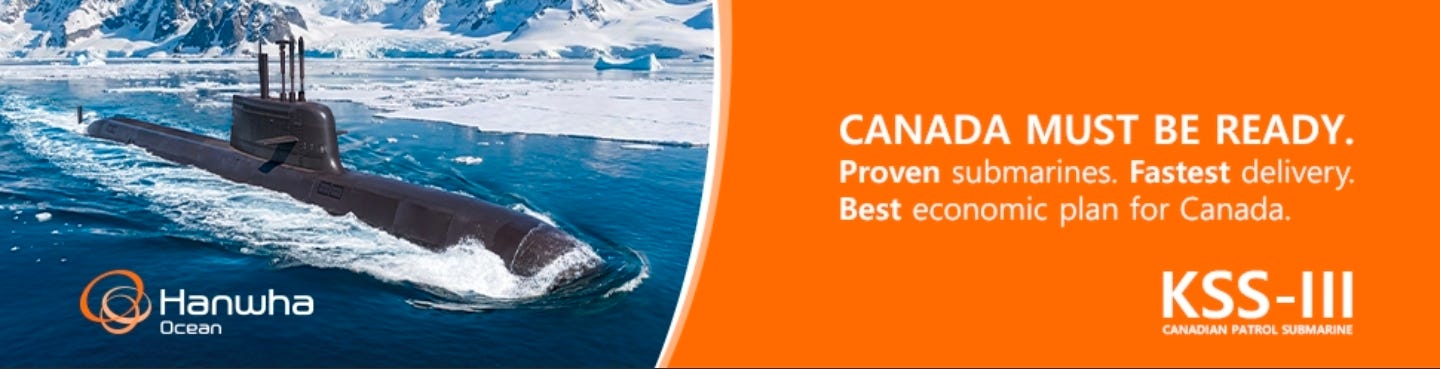
Q1. Do you think the Canadian government is waiting for CUSMA negotiations and the US mid-terms to conclude before committing to a full order of 88 F-35s?
It might not be the only factor, but certainly I think it is a factor. I don't think anyone really expects different; even the non-defence commentators know. I DO think they have an idea of what they want to do; however, I also think that the review can change it.
They won't cut the F-35, to me, if they believe it would ruin a potential larger trade deal. It isn't worth it. I also believe at the cabinet level, and I can say this confidently, that there is a desire to procure Gripen. There are some, mainly on the defence side, who will stick to a full order, but I can say a large part of cabinet has an opinion.
Basically, I think there is a wait, and the decision will be heavily influenced by how much of a fuck the Yanks actually give. If they see it as a hardline for 88 and we have a deal on the table? Then yeah, we'll get 88. No question. No one is sacrificing this for Gripen.
Q2. With the rumours Canada plans to pursue a split fighter fleet with domestically-produced Gripens, are we expecting an increase in overall airframe count?
I have never heard of an increase. Such a choice would come from cabinet in this case, and I have heard nothing on the RCAF side of things to indicate there would be a major increase. That doesn't discount a few additional airframes, but fleet numbers are not a trivial thing.
They are part of a deliberate calculation to which pilot assessments, infrastructure, etc., are tied into. If you expect a fleet of 88, you plan and budget that fleet into everything. It isn't so simple to jump up, day 30, 40 additional airframes. New hangars, as an example, are not built to necessarily have capacity at hand for expansion.
You could hypothetically set up emergency infrastructure, but it gets into deeper issues. How does the RCAF go about setting up a new squadron? That involves a lot more than pilots and infrastructure. How many additional pilots, which take nearly a decade to come to proficiency, do we need?
How does this affect RCAF planning? Will the Treasury Board and such support such an increase, or do the RCAF have to make cuts elsewhere? How does onboarding additional fighters affect staffing for other projects? It isn't so simple, sadly. Numbers come from somewhere, and those numbers are far more important than just fleet size. They are the string that ties a lot of other projects and assets together.
So, I have not heard anything, and by now I think we would unless the Feds drop this on the RCAF to suffer from. There is certainly no RCAF planning for such a scenario that I know, and given the age of the review, I wouldn't expect it.
Q3. Which submarine do you prefer and why?
Soon
Q4. With the RCAF now pursuing GlobalEye, I would imagine they will pursue probe & drogue as the in-flight refueling option for the Global 6500 aircraft?
That's the plan as I know it, although despite the RCAF discussing it, I wanna stress we have zero idea how far the concept is. Do we wait for AAR to be certified on the 6500 before we get anything? Do we wait for this to progress?
Or do we have a weird case of some can, some can't? Bombardier has studied this. Don't let others tell you otherwise. Saab looked into it, but it wasn't worth the cost because most people don't need it like us.
So, we have a concept but no funding confirmed, no plan, and no timeline. It is a need for the RCAF. I wrote about it in detail before. It isn't a luxury in their concept; so, I am curious to see where the balance is.
I think they all need that capability, in however way it can be done. I would say that needs to be done before we even discuss when we get the GlobalEye.
Q5. Sounds like an exceptionally busy, yet exciting week or so. Love the CANSEC coverage you provided. I’m a CDC junkie, did we learn “anything” new at CANSEC?
Sadly, in terms of the project itself, not much. Funny enough, two of the three companies I talked to asked ME if I had any info on it for them! So, unfortunately, the project remains as it has for a while.
There were a few things though, the biggest among them being beyond 16 cells. Everyone I talked to on CDC made a point that their design could go beyond 16 Mk. 41; and, in some cases, they said they were encouraging of it.
That isn't confirmation, mind you, because again no one has read an RFI. They know the Navy would like 16 cells from discussion, but no one has official requirements in front of them; so, it can be hard to tell.
What it signals to me, though, is that we are very likely to see designers pitch beyond 16 cells when the competition starts. That will likely be an attempt to draw opinion and favour by maximizing VLS cells in proposals.
The Navy is looking hard at potential options and, in turn, wants to maximize capability. If someone can balance that out in a hull under 120m, at a decent price point to others? It's gonna make people happy.
At least one, I can't say who, has a 32-cell concept. That is the maximum I can see offered. What it looks like? I don't know. That might be the biggest 'change' on a project front. Competitors believe that the Navy will be very open when it comes to packages and proposals, to the point they ain't gonna set a lot of hard limits. That gives a lot of fluidity to propose shit.
On designs themselves? Seaspan's model is outdated in several ways apparently. I'm told the separation of the aft payload space and mission bay is likely to be changed to a through-deck design. All of the CDC designs could meet Polar Class 6 levels of ice protection, though no one is looking to go for the designation, it seems.
There is a big thing on crewing. It's gonna be something the Navy looks at; so, everyone is trying to bring down the crewing levels as much as possible. Hanwha is also expected, from talking around, to join Team Vigilance as a major partner through their partnership with Ontario Shipyards. They apparently had some input into some recent designs.
Overall, I can't say we learned much. Mostly everyone was working off the same info we knew. Until an RFI is released, though, we're unlikely to get any major commitments on the design front from folks.
Q6. Do you think in the long term the global 7500/8000 could be militarized into aew&c, ew and other roles?
Maybe. I actually asked about feasibility, because I was curious how the new composites utilized would handle things, and I'm told it would be possible, but expensive and not really worth the effort.
The speed and range something like the 8000 brings is cool, but not enough to justify spending time and money on militarization. Keep in mind also that endurance is a funny thing that numbers alone can't measure; so, while there could be more range and hypothetical endurance, it is not always as much as you think.
The 6500 is already certified, has a massive supply chain behind it, and does 95% of what something like the 8000 could do. It won't take years of development, certification, or integration work to bring up to standard like the newer models; it is cheaper, and you don't have to pay for the development of those platforms.
It isn't impossible, but in 99.9% of cases, it just isn't really worth it to anyone. Don't fix what ain't broken and all that.
Q7. How is the navy going to address future support and sealift concerns with only 2 protecteur classes so far? Are there projects for sealift?
Kinda? Yes? No? It's a bit tricky. We have the Arctic Mobile Base, which will likely replicate a lot of what the Protecteur-class could do; but, they are specific platforms and not really, as we discussed extensively here, optimized for what you're likely thinking.
The Navy wants more JSS. They would love another two, but it's an idea, not something in the books. It isn't in the plans yet. The desire is there, because we have always recognized that three is the minimum, and many will argue four, to provide adequate availability and provide the Navy with the tasking they need for continuous support.
So, there are two ideas, with AMB being in the books now and more JSS being just an idea people would like. I would love to see more JSS. I would like more before AMB; that is me, and my opinion doesn't change. As for Sealift? There is no specific Sealift project on the books. AMB might kinda count.
As always, you can ALSO read my thoughts on that here. I spoke on Sealift extensively, in great detail. There is nothing official, though.
Q8. If Hanwha wins and hyunmoo establishes a missile manufacturing plant in Canada, would the RCN consider utilizing these missiles on the river class VLS?
Highly, highly unlikely. Hyunmoo 4-IV ain't going in Mk. 41. Haeseong-III and V could hypothetically fit, but it isn't so simple. First, Haeseong-III/V are capsule-launched, tube-integrated missiles first and foremost; so, that right there is a bloody problem.
But let's assume for a second that we just ignore that. Integration entails bridging Haeseong-III/V with the electrical and digital architecture of the Mk. 41. That isn't simple. Digital integration means undertaking the massive effort of custom proprietary rewrites to ensure your Korean missile can communicate and feed data with your American VLS system and AEGIS.
That is never a simple feat, and oftentimes it is not worth the cost and effort to ensure that integration, if it can even be done. Americans are tight on the source code for AEGIS and Mk. 41. It is notoriously not simple or easy for munitions to be integrated into that architecture; see CAMM.
Second is exhaust management. A VLS cell relies on a tightly enclosed, shared plenum to direct that exhaust away from the ship's superstructure. Ramjet systems like the Haeseong-V produce massive, sustained thermal backpressure that could overwhelm the Mk. 41's gas-management system, risking catastrophic over-pressurization and hull damage if not properly accounted for.
I can't speak to this level of technical details. I can't say fundamentally if it is possible, as I am not knowledgeable enough to say. HOWEVER, the cost, extensive timeline for integration, and high risk of failure is not worth it for the Royal Canadian Navy to undertake.
Q9. Notwithstanding a Flight II RCD, are the CDCs are the best path towards more fleet VLS magazine depth, assuming they interface with the RCD Aegis/SPY-7 complex?
Probably. I mean, adding VLS to the River is possible, but it's likely the easiest path forward to support our second tier of combatants. Some might throw MUSV or LUSV here; I am not confident in that. There are still major hurdles in that department, from self-defence, security, having reliable communication and control with platforms, maintenance, the experimental nature of a lot of autonomy software, integrating that into your larger C5 infrastructure, making sure that systems like the Mk. 70 work as intended, and ensuring platforms can reliably communicate and share data with each other.
All of that needs to be figured out still, by just about everyone. Maybe they come into themselves in the next few years, and I will be the first to admit I'm wrong. However, I am not confident they are a solution in the short or medium-term timeframe, certainly not enough for us to spend billions trying to make it work.
So, in the immediate? More cells on the River-class and CDC are how you add additional VLS cells in the medium term. I don't see many other options sitting around.
Q10. With some pushing for CDC to have more than 16 VLS. Do you think this could lead the RCN to consider a Flight II CSC with more VLS?
There were always plans to investigate more cells. That's an active discussion. I don't think CDC shifts that much even with more cells, because the fundamental issues are timelines for hulls in the water and the Type 26 itself, and finding balance.
That doesn't change with CDC, nor is CDC suddenly making the conversation louder. It has always been here. All it really does is present a risk of people trying to use CDC as cover to scale back the Rivers, something I don't support.
Q11. I am very curious about what an effective and achievable Canadian undersea surveillance capability would look like for the high arctic and key sea approaches?
Luckily for you, we do have a Navy concept for what this kinda thing looks like. The Navy has been extensively focused on the Seabed to Seashore concept and creating the ecosystem to achieve that. Now, obviously, they can't do that alone. The RCAF also has a big role to play here, being the guys tackling space and such.
However, most of the concept rests on the Navy and their plans. I have written individually about most of these concepts; so, I'll provide the rundown but also the links to those pieces. The primary concept that you need to think up is persistence. That is the fundamental concept being aimed for: persistent, continuous awareness of our waters, undersea, on water, and above it.
To achieve the underwater portion, especially in the Arctic, the primary player will be the future Canadian Patrol Submarine. It will act as the vanguard and the deterrent. It will not be everywhere. They will not be hunting things under the ice; they don't need to do that. What they need to be is available and around the critical points, the key approaches as you put it.
That is especially true up North, where pathways are defined and we know exactly where our adversaries will eventually have to come from. A CPS can stay lurking in near silence at the ice edge. It does not need to hunt. It already knows if someone tries to come through, that they will find themselves confronting it.
We know the routes of the Archipelago that, say, a Russian submarine is likely to take. We know where our submarines need to be. If you look at a bathymetric map and calculate some distances, you can likely get a good, basic idea too.
But that isn't persistent. It doesn't create consistent coverage. That's where we have to leverage the assets we have to create a layered, dispersed network of nodes to feed data into. That shifts depending on environment. For the Arctic, the primary supplement to this will be the AOPS, future Autonomous Systems, and the Canadian Arctic Suite of Sensors.
AOPS can venture into the Archipelago and beyond. They have the ability to carry significant payloads and provide support to other assets if needed. An AOPS can operate independently in the Arctic during the peak months, and with them will come the nodes.
Projects like the Containerized OnBoard Relay Array (COBRA) aim to provide the AOPS with a containerized ASW system able to act as a secondary node to other platforms. ASW in ice, especially with a towed array, is a near herculean task, but the AOPS won't always be in those ice-filled areas; and, while their utility as hunters is limited, the intent is also not to turn the AOPS into ASW platforms. It is merely to add another node, to gather more data, to give adversaries another thing to be concerned about.
On top of that are projects like the Uncrewed Underwater Surveillance System, which will procure dedicated XLUUV like the Cellula Robotics Guardian AUV. These will be the primary runners for the Navy in the Arctic, in theory. They will be able to traverse under the ice, in areas where larger platforms like dedicated submarines could not operate.
They will be long-range, long-endurance platforms that will loiter for weeks at a time across the Archipelago. From them, projects like the Canadian Arctic Suite of Sensors will procure things like AUV, rapidly deployable sensors, and other such payloads that could be deployed across the Archipelago. That could include barrier systems, lines of sensors resting at the critical channels of the Archipelago that sit in wait for something to cross it. It could be smaller UUV with various sensors or payloads of their own.
These XLUUV would be deployable from assets like the AOPS or future icebreakers. It is highly likely we see the CCG participate in this as well, as the future icebreaker fleet could also support the deployment, recovery, and maintenance of future autonomous systems.
The Canadian Arctic Suite of Sensors project will also look at other potential systems, such as shore-based sensors, ice-moored systems, etc., to potentially supplement this hypothetical fleet of UUV.
CDC will come with a hull-mounted sonar and ASW capabilities. Even assets like FASST-V could hypothetically deploy small UUV or even something like a hammerhead with various sensors. We've seen Hammerhead carry sonobuoys; that's one step.
CDC has a mandate for the management and deployment of autonomous systems. The River-class could, hypothetically, deploy with XLUUV in its mission bay to act as collaborative undersea platforms.
What platforms do the Navy plan to support Undersea Domain Awareness? Everything! Why talk about individual nodes when you can just find a way for every platform to participate? When talking about the amount of ocean we need to cover, hell, everywhere.
The St. Lawrence isn't safe in conflict. We already learned that lesson. Ask the SS Carolus, Nicoya, or Chedabucto how safe the St. Lawrence is. Hell, with the proliferation of cheaper, more accessible AI systems and manufacturing capabilities, how do we know the Great Lakes are safe from rogue UUV or such?
We ain't afforded the luxury of non-participation. In conflict, every platform needs to be a node. Every platform needs to be able to monitor, to provide data from Sault Ste. Marie to Baffin Bay, and we want our adversaries to know that too. We want them to know that we can see them, that we have the capacity to know exactly where they are the moment they enter our waters.
That isn't easy. Remember the MUSV and LUSV above? Same issue there presents with XLUUV, worse in fact when considering the Arctic environment. That's why I said it ain't a singular effort. You need the space-based assets. You need platforms like the CP-140 to participate. You need a working maritime helicopter.
We don't rely on one branch; but rest assured, the Navy has thought about this extensively, and they ain't leaving a single thread dangling when it comes to building up a proper SENSE capability for the undersea domain.
Q12. There are rumours about a return to North Bay and some saying an outright repurchase of the airport. You hear anything?
Well, it is likely the future home of the AEW&C fleet, but you didn't hear that from me. I have not heard anything on the airport, and I would have doubts. This is my neck of the woods, and I know folks; so, I hope if such a thing was on the table, I would know about it!
I'm sorry! Sadly, I don't have anything to share there.
Q13. To cut reliance on US, should the CDC use European missiles? If US isn’t reliable, should we de risk our ships from US tech? Sylver is lighter and cheaper.
Oh gosh. How do I answer this without annoying our growing French audience? Now the fifth biggest! Look, I get where you're coming from, but Sylver will never be the answer. Ever. Never in a million years. Not unless something big happens.
Mk. 41 is just too good. Better collection of munitions, more expansive supply chain, maintains better interoperability with our key allies. This isn't digging on Aster, not at all, and I don't wanna say Sylver just sucks compared to Mk. 41. However, if everyone gets what they want, Mk. 41 will be a more diverse system for European munitions anyways.
I'm not confident that happens, and there are great options that ain't American in the works for a platform like CDC. CAMM, IRIS-T, Tyrfing maybe, hell, maybe even Aster itself! There is no competition here. Mk. 41 is the pinnacle we have and everyone else is second, and that gap ain't small.
Access to ESSM and SM-2 Block IIIC alone is a really difficult combo for even Aster to top, IMO, when looking beyond just inherent capability. That gap is only growing, too, as new munitions are added. If you want a European loadout? By all means, sure. I love CAMM, love IRIS-T. They could be awesome for CDC.
You don't get that right now with Sylver. You get Aster, MdCN, and that's really about it. They wanna integrate CAMM; I hope they do. I also hope Stratus works. Sylver is not a bad system, and neither are her munitions. She just ain't Mk. 41.
Q14. Are there any plans for new AAMs beyond the current AIM-120s and AIM-9s? Like AIM-260, -174b, or Meteor(if it ever actually gets F35 integration)
Yes. It is called the Long-Range Missile (LRM), and it is explicitly designed to provide a long-range air-to-air capability beyond AIM-120. It is in the Identification phase last I heard, has an introduction date sometime in the mid-2030s; so, it's still a while away.
We have no idea what is wanted. We don't have requirements. We can guess; I can guess it is likely we want the AIM-260. Is Gunslinger even planning on F-35 integration? I can't say. Meteor could be an option, absolutely. However, as you said, a lot right now depends on integration and if things will be available.
AIM-260 is likely the safer option here on that front, and NORAD commonality, although if the fighter review goes one way...
Q15. 26 HIMARS seems like an absurdly low number to divide between available, training, and maintenance systems. Are there any indications that more will be ordered?
26 was on the lower end of the spectrum. There were higher concepts out there. I saw ones for division and corps level numbers. Some pushed 80+. One funny thing people forget is that, at one point, we were looking at a low of like 12!
I would have loved to see more, but 26 fits in the current structure of the Fires Brigade, which is what was wanted. So, it might feel low, but it does align.
There are some people talking wanting more, but for now it is set at 26. You'll be shocked by how much capability a single HIMARS brings with PrSM.
Q16. What is the next shoe to drop, assuming after CSPC? FFLIT has to be close.
Same as my CANSEC predictions. FFLIT is set to go apparently. LCVTS apparently has someone downselected. The first contracts for CHER are expected over the summer. GBAD UOR and LUV Phase I, I believe, are pushed out to the fall time period? I can't confirm.
But yeah, FFLIT would be a good prediction to make.
Q17. With Rheinmetall presenting the MissionMaster UGV product at CANSEC again, what are the Canadian Army's plans for the trial and procurement of UGVs?
Ooooooh boy. You came at a good time. Not only is the MINERVA Initiative looking at acquiring UGVs for the Army, but we actively have some small procurements on request! MINERVA I feel everyone knows my mistrust, but they are still looking at UGVs, with an initial focus on cargo transport, breaching, and recce.
The UGV side of Minerva gets forgotten a lot, and that's mostly because the main focus is on UAS at this time. However, to supplement that, we do have a few active procurements. If you read the newsletter, you've likely seen them pop up. We have multiple RFIs for Mini-UGV, Small-UGV, Quadruped UGV and UGV as part of CASEVAC.
That has been supplemented by a new RFI that essentially combines most of them into a single RFI for small and medium UGVs. This just came out yesterday in fact! I plan to write a whole post about this later today or tomorrow; so, I won't spoil. This is a standing offer for interim acquisition, such as until a permanent solution can be found, likely through MINERVA.
So, the answer is that lots on UGVs are in the works, and you'll be able to read about the latest soon.
Q18. IF a mixed F35/Gripen fleet is chosen, do you think Arexis pods will procured, maybe as be part of CDSEA?
Maybe. CDSEA has that mandate in the project. In a hypothetical Gripen, fuck, any Gripen acquisition, if we can't get non-Saab IP, those Swedish bastards better include the Arexis IP in the package. That's probably one of the key technologies we want access to.
So, I guess the answer is they fucking better throw it in there.
Q19. Have you heard the rumors that Hensoldt is designing an electronic attack bizjet for an EU client? If so, do you think they could be in the running for CDSEA?
Nothing can be in the running for CDSEA because we have zero clue what the RCAF wants; but, if it goes how I imagine they want it? Maybe.
The program you're thinking of is luWES, which I swear is looking at the A400 as the base platform? So immediately, the calculation changes significantly if we try to integrate the suite into a Global. That's why I didn't bring it up. You can't just shift equipment from one aircraft to the next.
Maybe their suite could be of interest, but sadly I don't have enough technical information to say.
Q20. I should have phrased it better…is there any new rumours coming down about S Korean equipment for Canada……that you can talk about
As in bidding? IFM, MCAV, the usual stuff. I sadly have not heard of anything else, unless you count the rumor of Hanwha being a partner on Team Vigilance. As far as I know, Koreans ain't going after GBAD or sensors.
There is KAI/Lockheed and the T-50? That isn't new, but it is often forgotten. Unfortunately, outside what we've known for a while? I have heard nothing.
Q21. Another user asked, your CPSP preference and why? You previously mentioned a detailed response coming. You gotta share your preference before it’s a moot point.
I'll know when the announcement will be made, and I'll make sure to make it known. Gotta drag it a bit for the suspense. I am a showman after all.
Q22. Is the army considering having both a tracked and wheeled SPH platform for IFM or will there only be 1 vehicle type?
The preference is still for a singular platform, more specifically a wheeled platform. Even with the existence of stuff like MCAV, the preference is still heavily leaning to a wheeled platform. The RCA prefers a platform they believe will be simpler and can be better maintained in the current environment.
I would argue they want a LAVtillery, something that could theoretically try to share a common supply chain and maintain similar capabilities to the LAV, which is why the LAV 10x10 is of so much interest, even though I don't think there's actually much commonality there honestly. I'll need to press for a lot more info. Sadly, the CANSEC folks wouldn't answer me.
But no matter what, wheeled is the preference heavily.
Q23. How will the arctic mobile base support sealift and support of the fleet and do you think they should pursue a different type of ship to fill that role?
You can actually find a very long piece here about it! I go into extreme detail on this very topic. My opinion overall remains the same. The Arctic Mobile Base is a response to the failures of the Canadian government and CAF to create capability in spite of the Arctic environment.
It is the rage against the machine, so to say; a radical attempt to fix the problems of mobility and naval support in the Arctic after we've tried and tried, time and time again, to do the traditional. All of which, as one can see in Nanisivik, have not worked.
AMB doesn't come from nowhere. It is the result of trying everything else and coming short. It is not a desperation move, but is deliberately something that aims to eliminate the biggest challenge of building such capability in the Arctic: the environment and nature of the Arctic itself.
How you imagine it? It likely isn't. She isn't a Karel Doorman, Mistral, or Bay. She is a unique beast, one built to be dominant in a singular environment, one of the harshest on Earth. Dependent on how far she leans into that will determine her value elsewhere, but all of that is in the post.
If I had a choice? I would get more JSS. Two more after a few years of using Protecteur and Preserver so we can figure out where they lack, what capabilities they might need, etc. In an ideal world? Two more JSS and two more AMB would set us up fantastically, but I still have doubts we could see both.
You can also find this post on Sealift where I kinda get into AMB and potential alternative Sealift options.
Q24. Do you think that the cdc shouldn’t be fitted with more armament (24 vls rumor) and why do you think it’s being rumoured/thought of as a possibility?
I want CDC to be more armed. I would love them to be as spec'd out as possible. Who wouldn't? My concern is that there comes a point where the general public and political apparatus are gonna try and turn a very, very high-end CDC and use it against the Rivers.
No one should want that, because I promise you it isn't gonna be "Cut Rivers and add three more CDC"; it's gonna be a capability loss. It will end up with a smaller fleet. That isn't to say we should cut CDC at the ankles, but in the current environment? There will be some who will see CDC as good enough and cut down the River.
That ignores that the River, and the Type 26 in general, are one of the premier ASW platforms on earth; it ignores their critical role as a layer in our IAMD architecture. The general public and political class don't see that. They don't visualize those things as some of us here do.
They see a good enough ship, Canadian, and say that's perfectly fine; and we would end up with a worse navy because of it. That's what happens when you reduce vessels to simple concepts like VLS count. You make terrible decisions. They are fundamentally two different vessels for two different roles, but many can't see that.
So, it isn't that I don't want a stronger CDC. I just worry about what that does to the conversation, especially when that pendulum of public support for defence starts to come back the other way, and it will.
Q25. If CUSMA negotiations go poorly the public is going to want cuts in most US procurement beyond current level of expectations, are there plans to address this?
I have not heard them. Sorry. If there are, they're not known to folks like us. That is something for the PMO to decide a course of action on.
Q26. Cutting armament and placement has me wonder about stability issues on Rivers, should we replace Aegis? Stock Type 26 can fire sm2 too. Switch to Thales?
Absolutely not. AEGIS is the world's premier CMS for BMD. It is considered an integral part of our future IAMD plans. There is no substitute for it if we want the River-class to be part of that chain; and believe me, look at the capabilities even the likes of the Houthi have available. That? That's becoming more accessible. That's becoming a standard for even smaller adversaries.
Now imagine what the big guys have? We can't afford losing such a critical node. That's why we took the leap on SPY-7 and AEGIS. It isn't something we can rely on the Americans for anymore. It isn't a gap we can leave in our security.
Give that up? You cut the entire IAMD strategy at the ankles and permanently exclude the Navy from the conversation, which for a primarily maritime power like Canada should be seen as an absolute red line to not cross, IMO; and there is nothing better than AEGIS on the market right now.
Q27. The US is delaying purchases etc, they seem less reliable during war prioritizing themselves, should we be putting less US stuff in ships etc like in Japan, SK?
I mean, Japan and SK ain't my first choices. We have great suppliers here if we wanna talk non-American systems. Thales is one who is keen to do more; Saab. No matter what, you likely ain't replacing American munitions, nor Mk. 41. That is the golden standard for a reason.
I believe in diversification where it makes sense, and I think CDC will show that a lot is possible. I just worry the general public won't care as much because of the use of things like Mk. 41 and the inclusion of people like Lockheed Martin Canada, which is entirely unfair to the folks at LMC who very much see themselves as Canadian and are doing great stuff.
Diversification is good when it makes sense, but it shouldn't be done just to stick it to people, especially if it leads to a major loss of capability. That is my metric.
Q28. I heard a concept of ordering both F-35A and F-35B in addition to the Gripen. The concept also included buying the Italian LPD to operate the F-35B. Thoughts
I saw that too. We don't need a vessel like Trieste at this time. Let's focus on more JSS and stuff first. Hawky has argued for it, I ain't a firm against, but stuff like more JSS, AMB, CDC, etc., are far more consequential, important, and will have a bigger impact than a Canadian aircraft carrier.
That is a capability others in NATO take over just fine. There isn't a deficit for us to fill there. There is always a need for more tankers, for Arctic capability, and for more combatants to be available. It's like bottom of the bottom list for me. I would rank even cable-laying vessels ahead, honestly. That is a scarily critical capability that is very much lacking on all fronts.
It's a very expensive, very specific capability that, sadly, is just not as important as others right now.
Q29. What is Roshel actually pitching to the CAF? The super duty LUV or the Senator?
LUV for Phase I and whatever the CAF leans to for Phase II. The thing is, the CAF still hasn't fully decided what they want from Phase II of LUV. They still don't know exactly how large, how capable, etc., a platform they want.
So, having the LUV and Senator available gives Roshel some safety depending on where it leans towards. Right now there is still some waiting from the CAF on what kinda platform they want.
Q30. Any good info from Logistik at CANSEC about SOCEM/CCUE?
No, because despite trying thrice, no one would talk to me there. Too busy for Noah, sadly.
Q31. How does the current icebreaker fleet(both CCG and RCN) look, and are there any plans to bring (limited) icebreaking capability to platforms like CDC?
I mean, icebreaker is a dedicated classification. You can make a distinction between an ice-strengthened vessel and a proper icebreaker. They are not the same. The AOPS are not icebreakers. They are ice-strengthened, but are not classified as icebreakers because that is a specific classification.
For the RCN, that technically means they have none, by definition. The AOPS are ice-strengthened patrol vessels up to PC4/5, but are not classified as icebreakers. Same for the two CCG AOPS coming online soon.
The CCG maintains Canada’s fleet of 19 icebreakers. That consists of the two heavy icebreakers, Louis S. St-Laurent and Terry Fox; the four vessels of the Type 1200-class; the three newer interim icebreakers of the Tor Viking-class; and the host of light icebreakers with the CCGS Griffon, six of the Martha L. Black, two Type 1050, and most recently CCGS Judy LaMarsh.
That is the current icebreaker lineup. These will all eventually be replaced by the two Polar icebreakers, six Program icebreakers, and sixteen Multi-Purpose icebreakers, bringing the pure icebreaking fleet to 24. That isn't counting the AOPS, MSMM, or any other ice-strengthened vessel, even though light icebreaking is a task for the MSMM.
Yes, the Navy wants the CDC to have some ice-strengthening. The official ask is 'similar to Polar Class 6 capability', which means a vessel that can operate similarly to a PC 6 vessel, but might not meet all the requirements.
And just to make sure we get the message out there, this is your reminder that a Polar Class rating is not a measure of icebreaking capability. Rather, it is a measure of structural survivability, specifically the hull's ability to withstand local ice loads and the machinery’s capacity to function in a polar environment.
Two PC 4 vessels can have very different icebreaking capabilities. Similarly, as an example, some PC 4 vessels actually perform better than some PC 3 vessels. That's why relying on PC ratings is a bit of a gross oversimplification.
Also, a Polar Class vessel is not automatically an icebreaker. There is actually a separate notation for icebreaking vessels; this is something that Peter Rybski has had to remind me of many times over the years.
I should also note that many vessels do not fall under the Polar Class rating. Only vessels contracted for construction after July 1, 2007, fall under the Polar Class designation, and some countries, such as Russia, continue to use their own system.
The Polar Class system isn't designed to be used as a ranking system. You can definitely use it as a quick comparison system, and it has value in discussions because it is still an official measure of capability, but when it comes to icebreaking? It isn't that simple.
So, the answer is we have a general idea of how strong we want the strengthening to be. CDC should be designed to have limited navigational ability in the summer months and be able to operate at the ice edge. That's the general idea.
Q32. Are you following NRC's contribution to the Defense sector? They were at CANSEC.
Yes, but sadly I was not able to get to them! Far too busy at that end of things, especially with the coffee right there, too. Hellscape.
Q33. If the military gets everything they’re asking for, would we then be on the upper end of the middle power spectrum?
You know what? I don't think I have ever really put the numbers together and compared to others. Honest. I don't think I have ever really done a proper comparison.
Certainly, we would be up there with the likes of Italy, Germany, UK, France. Some exceptions apply, but such comparisons are things I don't like to do, and are far more complex than people care to admit. I don't like just throwing numbers like Global Firepower and saying done.
However, we would certainly be in the NATO echelon, assuming everything goes through. That would be the two AMB, 12 to 20 Corvettes, the full 12 submarines, all the space projects, IFM, MCAV, etc. It's a lot more than I feel many recognized.
But again, I honestly never did, like, the full list out. Maybe I should at least as a thought experiment. Would you guys like that? Even if I don't like it, I know many of you likely would. Definitely in that NATO tier, though, but definitely optimized for continental defence over expeditionary operations.
More fun question: how would our capabilities in the Arctic stand compared to others?
Q34. Do you know whos gonna win submarines? Would you say it is you knew?
I don't know, and I don't want to. I have actually asked several people who would tell me to not spoil me. I wanna be surprised. I don't wanna know before everyone else. If I did get spoiled? No. I won't spoil it, and I encourage others to do so as well. I think it's better to be surprised here. Have some fun. Get excited.
I know 99% of contracts before they're announced. I want one thing I can just not know about. I know I'll likely get spoiled, but I wanna try and not be. If it leaks, it won't be from me.
Q35. I heard Raytheon plans a major expansion here. How true is that?
No comment
Q36. Who gave you the Fox nickname
Can't say who; don't think they would appreciate exposure, but it's cooler than a cat.
Q37. Chances of a New Defence Policy dropping early?
Very high. They're asking around and consulting about it. I have offered my opinions if anyone wants to add my ideas. When does it release? No idea, but I do think we need a new one.
Q38. What vehicles do Hanwha plan to produce here?
Officially? K9, K10, Redback, and Chunmoo have been mentioned. That is along with other 'vehicles' for both the CAF and commercial market that have not been disclosed. I have also never been told exactly what these vehicles could be.
Like Australia, the idea is for a multipurpose facility that could quickly convert lines to make new vehicles as demand shifts; so, it could be any of the above depending on demand.


Re: Q33. That would be interesting! I know that it would be difficult to do an apples to apples comparison of strength with a more expeditionary focused nation, but maybe you could divide the assessment into different areas, like sovereign defense, expeditionary, artic, etc. maybe make a list of countries that have a similar defense posture, with a similar mixture of sovereign defense to expeditionary, and where we would rank against them. You might have to make it relative to population or landmass, because scale obviously matters. A smaller country might have a greater sovereign defence capability with smaller forces because they are defending less.
Part of me knows it's not a good idea to use arbitrary comparisons to assess the value of the CAF, but I have a sneaking suspicion that seeing where we will (hopefully) end up might actually provide a shot of confidence to many Canadians. It's been all too popular to dunk on the CAF for decades, and it would be great to have an impressive favourable comparison in response to disparaging comments.
But find a way to frame it that will make it fun for you. If rating out current and future arctic capabilities excites you, start with that.
“Absolutely not. AEGIS is the world's premier CMS for BMD.” - You’ve indicated similar several times when talking about “diversifying” our procurement. The US produces the best military equipment of basically everything. How do you propose we diversify if we’re unwilling to make the choice of going with the No.2 option that’s “good enough”, but not the Cadillac?
“which is entirely unfair to the folks at LMC who very much see themselves as Canadian and are doing great stuff.” - that’s great, but at the end of the day, do the profits of LMC stay in Canada? Nope, they go to the US. Plus, at any point in time, a board from a foreign company could simply choose to shut them down and take the IP with them. Are the workers Canadian? Sure. Do they pay Canadian taxes? Sure. But they’re not a Canadian company, and the general public knows it.