


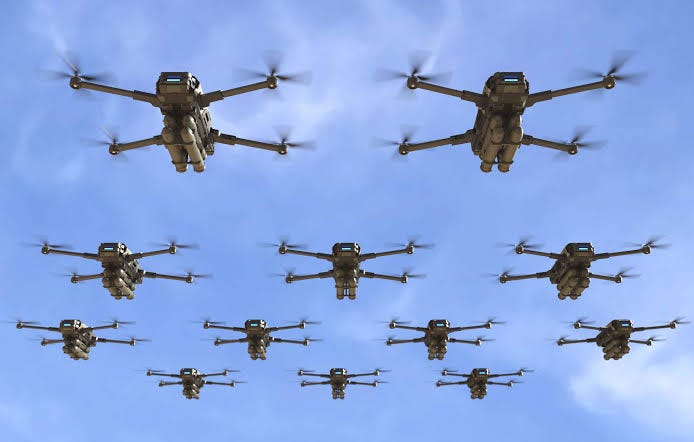
Another day, another UAS post.
I feel like I can't escape them this week. Everywhere I look I see uncrewed systems, autonomous platforms, and about sixty new drone companies I swear popped up a week ago. It feels like there is no escape from them the last week, and I feel that this is only the start of things.
Anyway, we have a new RFP and typically I would elect to not do a full post on something like this, but considering the DDIM announcement, all the recent talk, and the fact this is fairly larger than most other similar examples? I felt that I could at least do something small to highlight it.
It's another Group I UAS! But this time it's specifically for the Light Infantry. That in itself isn't too surprising. The desire for a light, man-portable UAS system has been a common ask among the Army's Light Infantry for several years now, and their unofficial role as the Army's little testers and trialers of future concepts and equipment makes them the optimal group for these sorts of experimental purchases.
This is not a project, to get that out of the way, nor does it fall under the DDIM. This is a Minor Capital Acquisition for a small fleet of several dozen UAS systems. This is separate from any ongoing procurement on the books. That doesn't mean there aren't consequences. What the Light Forces do, the rest of the Army has a little distinction in recent memory to follow, if you catch my tone here.
So whatever the case, smaller acquisitions like these can often provide us a glimpse into what the wider requirements for such systems might look like. That isn't always a guarantee, but it is common enough that when we see a fairly substantial purchase of something, we can infer that its own requirements are likely broadly aligned to similar programs.
With little out right now about DDIM and what exactly will be asked from it, acquisitions like this can give us some context clues, and some looksies into what areas planners might be prioritizing their attention with. That always makes things a little extra fun. See the Medium UGV RFI as well for a recent example of such a trend.
So, without further rambling, let's take a look at what exactly a Light Forces GPUAS looks like.
The Requirements
To start off, the RFP has a 26-day window, running to August 25th. Like many of the last week of drone projects, this is another short and sweet closing period to get things moving. I feel kinda bad for the folks running this, Deep Precision Strike and DDIM back-back-back.
The requirement calls for a minimum of 80 complete UAS systems specifically again for the light forces, all of which are to be delivered to 7 CF Supply Depot in Edmonton by March 1, 2027. The project sets the maximum allowance at $6,572,250 including taxes (so firmly an MCE project). This is a small-figure, fast turnaround buy. There are no security requirements, email-only bid submission, etc.
The solicitation is open to Canadian Suppliers only under the Policy on Prioritizing Canadian Suppliers and Canadian Content. Any offers from outside the Canadian system are rejected outright. That means the supplier must be Canadian, with a permanent place of business, Canadian tax registration, and a commitment not to hollow out the work through offshore subcontracting. The product itself isn't mandated to be Canadian, but it is preferred.
So what are we actually looking for? Each system is required to consist of at least one UAS, a ground control station, an IP67 hard case, the data link equipment, field-repair spares and support equipment with documentation, and one electro-optical/infrared imaging turret per aircraft, plus every cable, battery, and piece of software needed to make it all work. The soft case is a small item I'll make note of quickly as the RFP mandates that it must be suitable for dismounted operations and parachute jumps.
The UAS itself is a sub-five kilogram platform. That MTOW ceiling is a hard mandatory, with a dash speed over 55 km/h, a service ceiling of at least 8,000 feet, endurance of no less than 30 minutes with the sensor turret fitted, and a flight distance of at least 20 kilometres at cruise. Endurance beyond 30 minutes earns points.
Some deeper specifics for the folks here who are making notes, the UAS must carry position lights visible to the naked eye and an infrared strobe visible only to Gen III night vision goggles, both switchable off by the operator, and it must be inaudible to unaided ears at 100 metres range in still air.
Launch and recovery must be runway independent and automatic once initiated, with points for systems that need no rails or nets and that permit manual override during launch and recovery for emergencies. One operator plans and flies the sortie, one operator carries the system, and the whole thing must go from stowed to deployed in three minutes.
GPS is the mandatory baseline and an alternate GNSS constellation is merely point-rated, but the system must have safety routines for temporary signal loss, and must support automatic waypoint navigation and geofencing. It must have a jam-resistant navigation subsystem, with no performance floor or test method attached. It must be able to operate and navigate in GNSS-denied environments. Fairly standard stuff.
Also a nice inclusion here that doesn't always get detailed in these sorts of things, we actually get some deep requirements on the optics desired, more so than most. The electro-optical sensor must recognize a standing human at 1,200 metres and a vehicle at 1,500 metres by day, while the infrared sensor must do the same at 600 and 750 metres by night, all at the recognition threshold of four cycles across the target with a 50 percent probability of discrimination.
The turret must be mechanically stabilized on at least two axes with three-axis digital stabilization on the imagery, must track stationary and moving targets through its full field of regard in either mode, and must produce the geographic position of tracked targets with or without a laser rangefinder.
Onboard recorded data must be encrypted, imagery must be geo-referenced, and the daylight camera must deliver at least 1080p video and 21-megapixel stills with 10x combined zoom, alongside a 640x512 long-wave infrared channel.
Then come the optional payloads, all at additional points, and this is where things get a little bit fun. The Army will award points for a communications relay attachment capable of mounting Trellisware radios to extend soldier meshes. It will award points for a remote payload release mechanism for explosive and non-explosive payloads.
Additional points will be awarded to a supplier who can provide a rangefinder good to at least two kilometres, then an infrared marker in the 800–900 nanometre band visible to night vision, and finally a STANAG 3733-compliant laser target designator, the standard that lets a UAS this size mark targets for precision-guided munitions. Electronic sensing payloads and modular attachment points supporting 500 grams or more round out the list.
The Statement of Work is quite blunt that these UAS won't be limited to just ISR, as we have often seen up until this point. The explicit tasks listed are ISR, force protection, targeting and strike. The primary task is still ISR. That remains the bulk of what these systems will undertake; however, there is no hesitation on the part of the RFP to make it known that these are also intended to be used as a strike platform utilizing air-dropped munitions. That would be a first for a system at this scale. The system must also support growth margins to receive future payloads, and must have networking and power provisions for vendor-agnostic additions. A complete technical data package enabling Canada to develop its own payloads is also explicitly asked about.
The data link must be a continuous line-of-sight RF link with a mandatory range of no less than five kilometres, ten being granted additional points. Also asked for are pre-flight frequency selection, near-real-time imagery transfer, frequency hopping or equivalent anti-jam features, and encryption to a minimum of AES-256 or a NATO-aligned equivalent.
Mandatory operations span from -20 to +45 Celsius, sustained winds to 10 knots with 25 knots asked about, rainfall to six millimetres per hour, an IP53 ingress floor with higher ratings earning points, and the standard MIL-STD-810H suite for salt fog, shock, vibration, humidity, and solar loading.
On maturity, the system must have accumulated 1,000 flying hours in military operations or 2,000 hours in routine commercial operations, with development, experimental, and test hours explicitly excluded from the commercial count. Suppliers must have demonstrated safe operations in both controlled and uncontrolled airspace.
Operators themselves perform first-line and field-level maintenance, line-replaceable units must swap without specialized tools, and the contractor is responsible for keeping software and firmware current (remotely and securely) throughout the service life.
That covers most of the major details pertaining to the systems themselves. Obviously there is more to it if you want to get down into the gears, but this hopefully gives you a very definitive picture of what's being asked for. Unlike most RFPs, this one is available on Canadabuys! So you don't need an SAP account to access it yourself.
It's overall a fairly unremarkable ask as far as your recent line of quadcopters goes. There is little here that will surprise those of you following such systems elsewhere. There is a novelty to seeing Canada pursue things, always will be. That's the mentality you get in a drought of good news and innovation.
Overall though? The interest remains in seeing how this stack of requirements compares to future asks through DDIM, which in itself puts a big mandate on low-cost, attritable, Canadian UAS of this class. There is significant overlap no matter what is asked really, but how deep that overlap goes remains to be seen.
Is it a hidden messenger, blessing us with our first look at the DDIM like the Medium UGV felt? Not really, but it is still something to note nonetheless. It is the closest we've gotten to a single, well-documented RFP for UAS of this class at scale, not just a small handful, not a bunch of Teal 2 inherited from the original GPUAS. This is nearly a hundred systems in itself, not a small ask by any means.
For a future comparison tool to see how things differ between a light forces optimized system and what the Army sees as its real General-Purpose requirements? I think it'll serve well. I'm sure no one is gonna complain at the prospect of dropping explosives on folks with drones. Somewhere, someone I know is really freaking hyped right now when they learn about this.
Small batches, quick feedback/learning 👍
How long until wars are just flocks of drones autonomously hunting targets in a given direction or area. No signals to jam, just hundreds upon hundres of drones hunting eachother and identifying targets.